
 darkknight:
Calc Help on volume from known cross section areas (SS will be posted shortly)
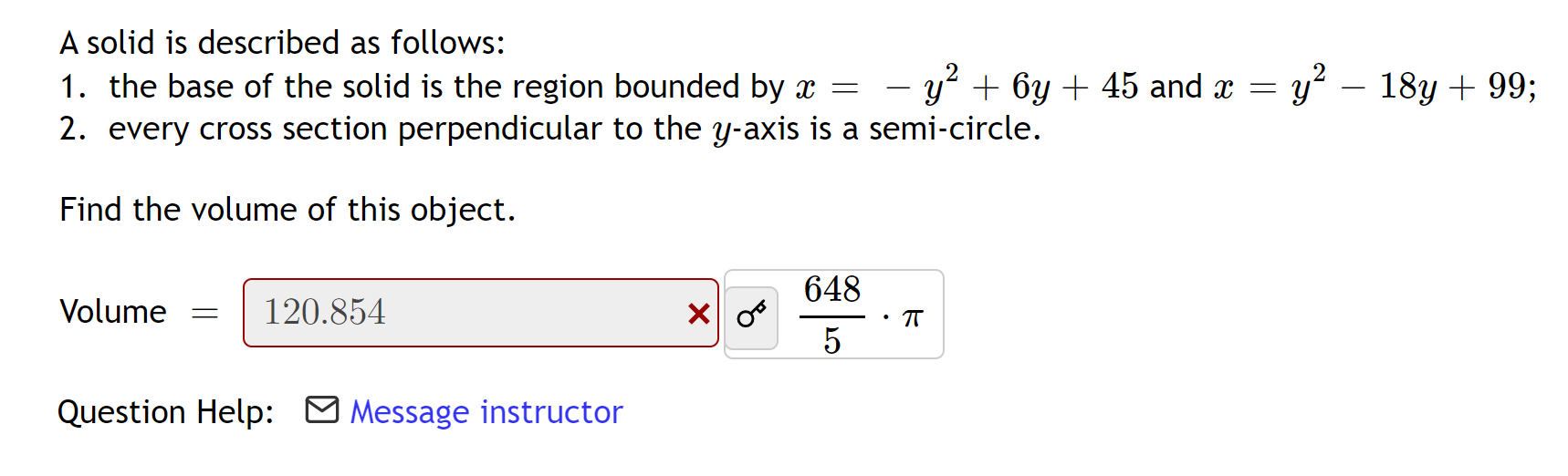 darkknight:
Very confused on what to do here, I originally graphed them out and saw that one was a top function and the other was below it so I wrote the equations in terms of x so that \(y=9-\sqrt{\left(-18+x\right)}\) and \(y=3+\sqrt{54-x}\)
darkknight:
Volume is the integral of the area \[V=\int\limits_{18}^{54}A(t)*dt\] And Area of a semi-circle is \[(\pi*r^2)/2\] but idrk what to do next
darkknight:
@imqwerty @dude
darkknight:
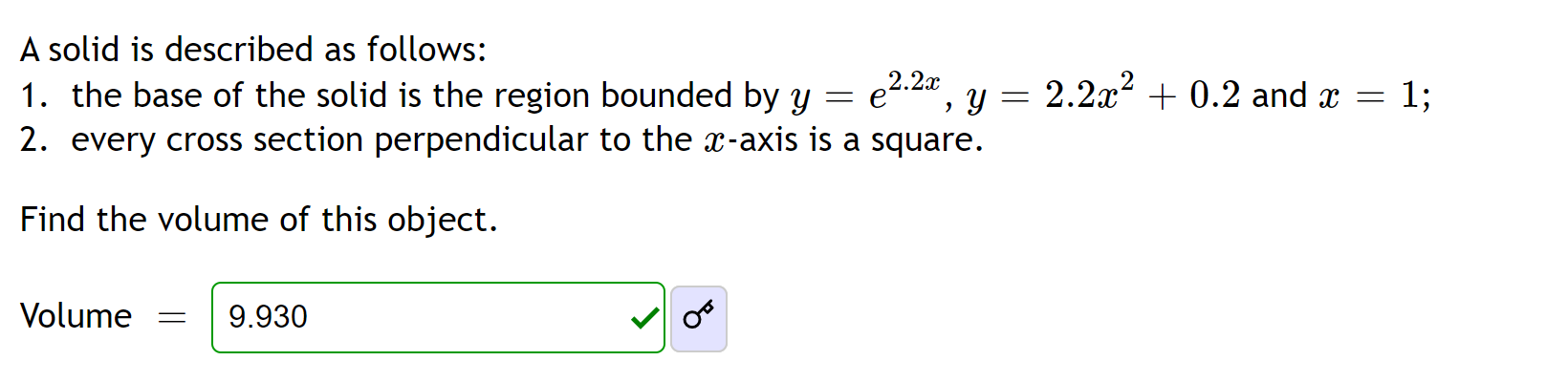
A problem sort of similar to this, I used the same ideas as I did above \[V=\int\limits_{-.347}^{1}\left(\left(e^{2.2x}-\left(2.2x^{2}+.2\right)\right)^{2}\right)dx\] because on the left both functions intersect at x=-.347 and we are bounded by x=1 and since cross sections are squares the area is length squared hence why I found the distance b/w the 2 functions and then squared it for area. I just don't get what radius is in the other problem is it like half the distance? Not sure how to set the other one up
 darkknight:
@563blackghost e.e
darkknight:
@florisalreadytaken @AZ @vocaloid
 Vocaloid:
Looking @ my notes there's a specific formula for the volume of a shape w/ semicircular cross sections perp. to x \[V = \frac{ \pi }{ 8 }\int\limits_{a}^{b}(t-b)^{2}dx\] obv. change dx to dy since ours are perpendicular to the y-axis. additionally, your a and b boundary values are also the y-values of the boundaries (which are 3 and 9, not 18 and 54. Got these by graphing the boundary equations.) When I plugged in everything into the formula I was able to obtain the answer key solution.
darkknight:
Thanks for the help! Just some clarifying questions, 1. so if we are finding cross-sections perpendicular to say the y-axis we use dy instead of dx and is finding cross-sections perpendicular to y-axis same as parallel to x-axis? 2. How does this actually look like? like is it semi-circles coming out of the page or...? 3.
darkknight:
Hmm, I now realized t-b is twice the radius. t-b (which equals \[-2y^2+24y+-54\]) So the radius is \[(-2y^2+24y+-54)/2\]) now we can put this in the semi-circle formula \[\pi*r^2/2\] And I got the same answer the formula gave me, and I can use this process on other shapes such as triangular cross-sections, etc
 imqwerty:
darkknight:
Thanks
Join our real-time social learning platform and learn together with your friends!
 VERNEISH:
Two objects are moving along separate linear paths where each path is described by position, d, and time, t.
VERNEISH:
Two objects are moving along separate linear paths where each path is described by position, d, and time, t.

 Maci:
what are the best stock apps for people who want to start investing?
Maci:
what are the best stock apps for people who want to start investing?
 Twaylor:
genuienly how do i get better self control i keep watcing youtube and theres this
Twaylor:
genuienly how do i get better self control i keep watcing youtube and theres this
 IzzyCookie:
|dw:1792074056138:dw| Uhm, I don't know where to ask this, but I'm in college welding at my community college, and I need help learning vertical welding for
IzzyCookie:
|dw:1792074056138:dw| Uhm, I don't know where to ask this, but I'm in college welding at my community college, and I need help learning vertical welding for

 thehearken:
not sure if this is considered spam, im sorry if it is, but does anyone have tips
thehearken:
not sure if this is considered spam, im sorry if it is, but does anyone have tips