
 Adovbush:
help.
 Ardin:
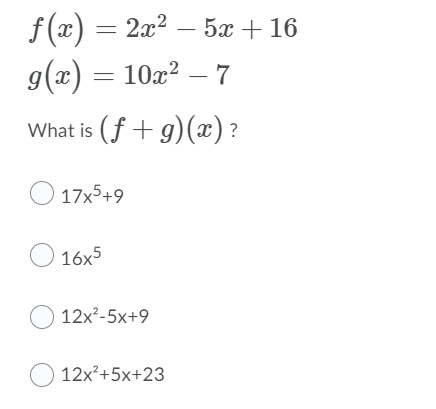
have you plugged the foromulas in yet to replace f and g?
 mhanifa:
Sum the expressions on the right side
mhanifa:
And bring to standard form after simplification
Ardin:
its gonna be (2x^2 - 5x + 16) + (10x^2 - 7) if im remembering this stuff right
Adovbush:
ah so it's c
Adovbush:
thanks what about this The amount of pop in a bottle is normally distributed with a mean of 2000 mL and a standard deviation of 62mL. If 5000 bottles of pop are filled on a production line, approximately how many bottles would contain less than 1885 mL?
Ardin:
ah, deviations and mean i don't remember very well, im guessing you know the standard deviations use, uhm lets see, 2000ml give or take 62, 2000ml time 5000 bottles uh im not sure
 Isolation:
compare 1885 to 2000, it's 125, which is 2 times the standard deviation So it's 2000mL - 2SD If you know the SD graph thing, 68, 97, 99.7 So by 2 SD's, you only have 100-50-34-13.5 = 2.5 so it's 2.5% So do 5000 tiems 2.5%, which is 5000 times 0.025
Isolation:
I'm not really sure how to explain it without the distribution curve lol
Adovbush:
dope thanks An apple orchard's workers pick 12,500 apples in the month of October. A sample of 300 of these apples shows that 15 of them are damaged and bruised. What is the best estimate of the number of apples picked at the orchard in October that are bruised and damaged?
Isolation:
Adovbush:
how do i do that
Isolation:
\[(\frac{x}{12500})12500=\frac{15}{300}(12500)\\x=\frac{15}{300} \times 12500\]
 Extrinix:
Convert \(\dfrac{15}{300}\) to a percent, We can convert it to it's lowest fraction, \(\dfrac{1}{20}\), and to find the percent just multiply it by 5 on top and bottom, \(\dfrac{1}{20}~\dfrac{\times 5}{\times 5}\) which equals, \(\dfrac{5}{100}\) Then take the percent as a decimal, \(0.5\) and multiply it by \(12500\), \(12500 \times 0.5\) which would give you: \(625\)
Adovbush:
thank you all very much.
Extrinix:
You're welcome.
Join our real-time social learning platform and learn together with your friends!
VERNEISH:
Two objects are moving along separate linear paths where each path is described by position, d, and time, t.

 Maci:
what are the best stock apps for people who want to start investing?
Maci:
what are the best stock apps for people who want to start investing?
 Twaylor:
genuienly how do i get better self control i keep watcing youtube and theres this
Twaylor:
genuienly how do i get better self control i keep watcing youtube and theres this
 IzzyCookie:
|dw:1792074056138:dw| Uhm, I don't know where to ask this, but I'm in college welding at my community college, and I need help learning vertical welding for
IzzyCookie:
|dw:1792074056138:dw| Uhm, I don't know where to ask this, but I'm in college welding at my community college, and I need help learning vertical welding for

 thehearken:
not sure if this is considered spam, im sorry if it is, but does anyone have tips
thehearken:
not sure if this is considered spam, im sorry if it is, but does anyone have tips