
 potatooooo1010:
I could REALLY use help with this!!!
 SmolPotato:
@snowflake0531
potatooooo1010:
@jhonyy9
 Extrinix:
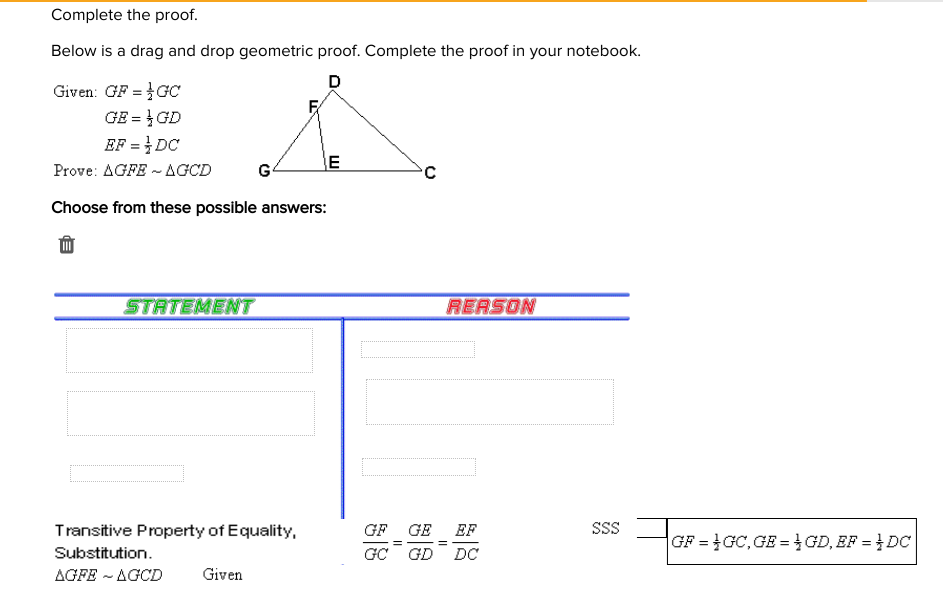
So first, you want to look at your given statements, \(\color{lime}{GF = \dfrac{1}{2} GC}\) \(\color{lime}{GE = \dfrac{1}{2} GD}\) \(\color{lime}{EF = \dfrac{1}{2} DC}\) These can all be equal using transative prop. of equ., \(\color{cyan}{\dfrac{GF}{GC}=\dfrac{GE}{GD}=\dfrac{EF}{DC}}\) So, your first portion would be your given values (lime) - - - - - - 1: (lime values) | Given - - - - - - Now, the cyan values are done through the transative prop. of equ., so - - - - - - 2: (cyan values) | Transative Property of Equality - - - - - - Finally, because of the transative prop. of equ., you can assume that side-side-side is possible, so - - - - - - \(\triangle GFE\) ~ \(\triangle GCD\) | SSS
potatooooo1010:
Extrinix:
each of the values listed inside of the dashes are what youre looking for.
potatooooo1010:
i dont understand
Extrinix:
so, \(\color{lime}{GF = \dfrac{1}{2} GC}\), \(\color{lime}{GE = \dfrac{1}{2} GD}\), \(\color{lime}{EF = \dfrac{1}{2} DC}\) | Given \(\color{cyan}{\dfrac{GF}{GC}=\dfrac{GE}{GD}=\dfrac{EF}{DC}}\) | Transative prop of equ. \(\triangle GFE\) ~ \(\triangle GCD\) | SSS
potatooooo1010:
Right! Okay thank you! Could I ask you for help with another one?
Extrinix:
Sure... I'm not any good at all on it but yeah.
 potatooooo1010:
@extrinix there is my other question
Extrinix:
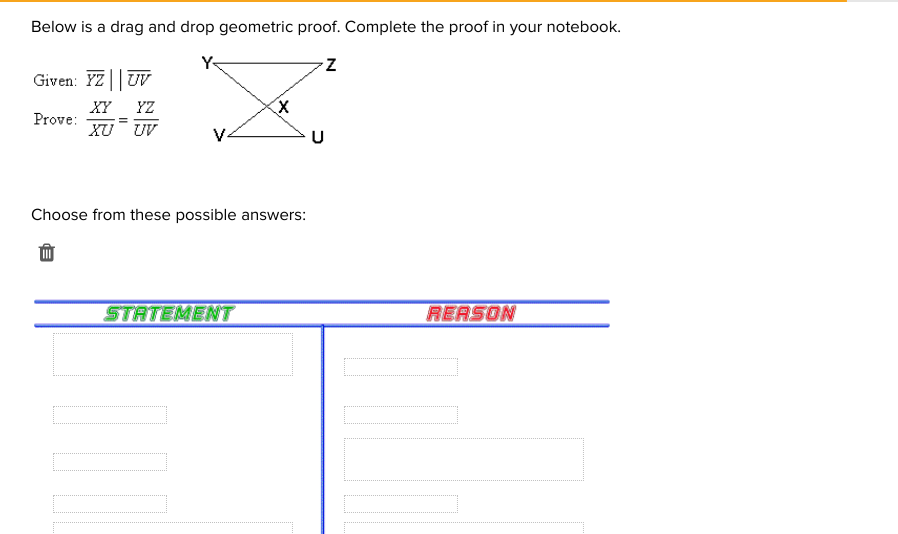
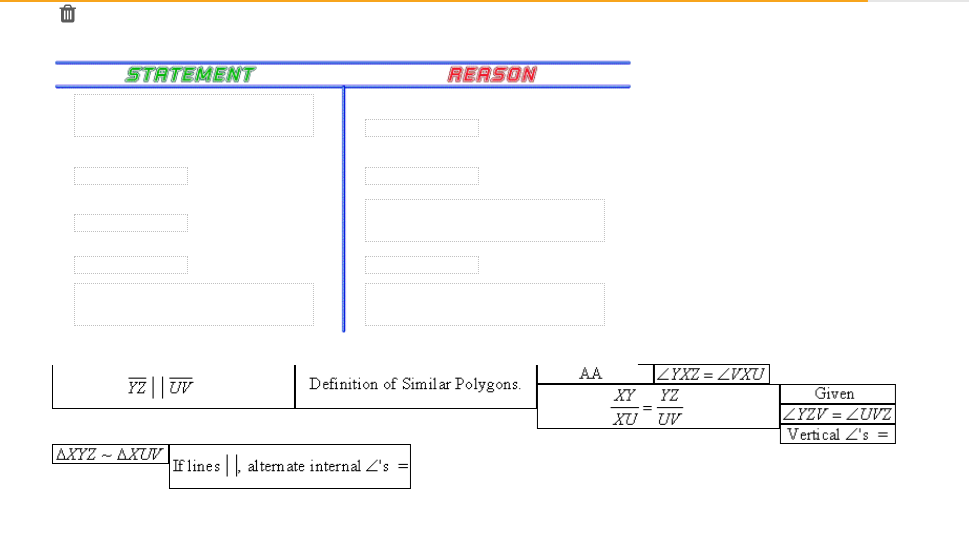
Ok, first off you should state your given statement, \(\color{tomato}{\overline{YZ} \parallel \overline{UV}}\) [] Given Now, because they are parallel we can assume alternate interior angles to be equal, so, \(\angle YVZ\) and \(\angle UZV\) are alt int angles \(\color{yellow}{\angle YVZ = \angle UZV}\) [] If lines \(\parallel\) then alt int \(\angle\)'s \(=\) With this, we can assume, \(\color{lime}{\triangle XYZ \text{~} \triangle XUV}\) [] Def of similar polygons With ALL of this, we can identify, \(\color{cyan}{\angle YXZ = \angle VXU}\) [] Vertical \(\angle\)'s \(=\) This makes our last step easy, with the others we gave reasoning to \(AA\), so \(\color{violet}{\dfrac{XY}{XU} = \dfrac{YZ}{UV}}\) [] AA
Join our real-time social learning platform and learn together with your friends!
VERNEISH:
Two objects are moving along separate linear paths where each path is described by position, d, and time, t.

 Maci:
what are the best stock apps for people who want to start investing?
Maci:
what are the best stock apps for people who want to start investing?
 Twaylor:
genuienly how do i get better self control i keep watcing youtube and theres this
Twaylor:
genuienly how do i get better self control i keep watcing youtube and theres this
 IzzyCookie:
|dw:1792074056138:dw| Uhm, I don't know where to ask this, but I'm in college welding at my community college, and I need help learning vertical welding for
IzzyCookie:
|dw:1792074056138:dw| Uhm, I don't know where to ask this, but I'm in college welding at my community college, and I need help learning vertical welding for

 thehearken:
not sure if this is considered spam, im sorry if it is, but does anyone have tips
thehearken:
not sure if this is considered spam, im sorry if it is, but does anyone have tips