
 angelcook2007:
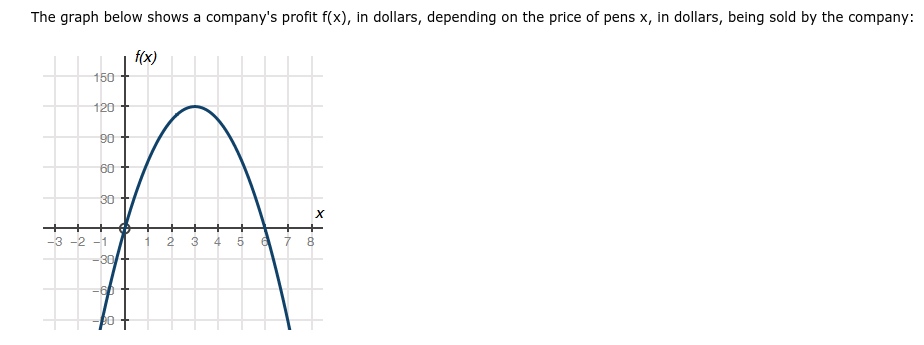
Part A: What do the x-intercepts and maximum value of the graph represent? What are the intervals where the function is increasing and decreasing, and what do they represent about the sale and profit? (6 points) Part B: What is an approximate average rate of change of the graph from x = 3 to x = 5, and what does this rate represent? (4 points)
 mhanifa:
First off, do you have any idea? Anything particularly you need help with?
angelcook2007:
angelcook2007:
I've done something similar to this before and it had product on the bottom and profit in the y axis
mhanifa:
This is similar
mhanifa:
Do you remember how you solved that?
 Florisalreadytaken:
Part A: What do the x-intercepts and maximum value of the graph represent? the profit this company makes is represented by \( f(x) \) right? that means where the lines intersect, that is going to be how much profit the company makes. in the image you attached, the \(x\) intercepts are \(0\), which means that they represent where this company's profit is \(0\) the maximum value of the graph, so vertex represents the maximum profit the company makes by selling \(3\) pens as you can see there in the \(y\) axis, and \( 120$ \). \(\cdot\)What are the intervals where the function is increasing and decreasing, and what do they represent about the sale and profit? well, we can see where the parabola starts there at \(0\) and finishes at \( 6 \), where 3 is the peak of it right? so we can say that if \(0\leq x \leq 3\) , then we have a profit increase, the left hand side, whilst on the right hand side we can see that if \(3\leq x \leq 6\) , we are going to have a profit decrease. Part B: What is an approximate average rate of change of the graph from x = 3 to x = 5, and what does this rate represent? (4 points) to figure that out we will be using this formula: \[ \frac{y_2 -y_1}{ x_2- x_1} \] where \[ (x_1 , y_1) \Rightarrow (3 , y_1 ) \text{ and } (x_2 , y_2) \Rightarrow (5 , y_2 ) \] to find the values of \( y_1 \) and \(y_2\) you will have to look at the graph after you find the values of both \( y\), then its pretty easy from there right?
angelcook2007:
@florisalreadytaken
Join our real-time social learning platform and learn together with your friends!
VERNEISH:
Two objects are moving along separate linear paths where each path is described by position, d, and time, t.

 Maci:
what are the best stock apps for people who want to start investing?
Maci:
what are the best stock apps for people who want to start investing?
 Twaylor:
genuienly how do i get better self control i keep watcing youtube and theres this
Twaylor:
genuienly how do i get better self control i keep watcing youtube and theres this
 IzzyCookie:
|dw:1792074056138:dw| Uhm, I don't know where to ask this, but I'm in college welding at my community college, and I need help learning vertical welding for
IzzyCookie:
|dw:1792074056138:dw| Uhm, I don't know where to ask this, but I'm in college welding at my community college, and I need help learning vertical welding for

 thehearken:
not sure if this is considered spam, im sorry if it is, but does anyone have tips
thehearken:
not sure if this is considered spam, im sorry if it is, but does anyone have tips