
 darkknight:
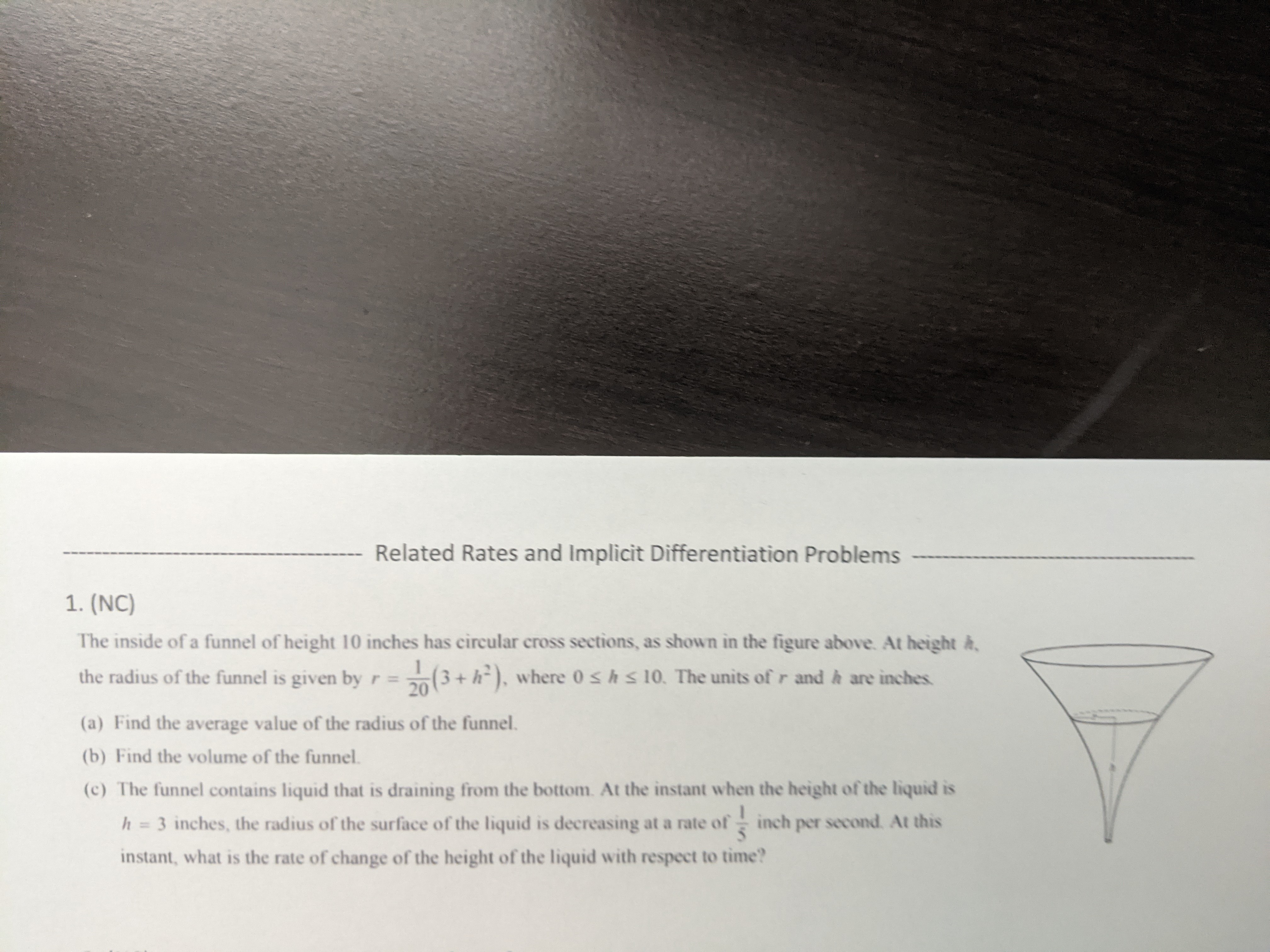
Calc help on Related Rates and Implicit Differentiation problems Question 1
 darkknight:
So what is the formula for the volume of this? Is is \[v=1/3*r^2*h*\pi\] For part A i did \[1/(b-a) * \int\limits_{a}^{b}r *dr = \] \[1/(103/20-3/20)*\int\limits_{3/20}^{103/20}* 1/20(3+h^2)dh = .605\]
darkknight:
I got 103/20 from plugging in h =10 into the formula that it gives and got 3/20 from plugging in h=0
darkknight:
@dude @tranquility
 Mathery:
Let's try to label that funnel first.
darkknight:
?
darkknight:
@florisalreadytaken
 Florisalreadytaken:
you are looking for b right? what you did above, i dont get its logic -- youve overcomplicated it, and in a wrong way also
darkknight:
so \[r=1/20(3+h^2)\] so to get the average value for the radius, don't we plug in 0 and 10 in for h (because 0< h< 10 INClusive) into the formula and get "a" and "b" ?
Florisalreadytaken:
no b is 10 a is 0
darkknight:
Oh, i see now, let me redo part a
darkknight:
So what is the formula for the volume of this? Is is \[v=1/3*r^2*h*\pi\] For part A i did \[1/(b-a) * \int\limits_{a}^{b}r *dr = \] \[1/(10-0)*\int\limits_{0}^{10}* 1/20(3+h^2)dh = 109/60=1.816666\] *** changed it ****
Florisalreadytaken:
omg i was doing b and i was like what is this guy doing... and then i looked at the image again and i realised youre doing A -- its 2am so yeah do not expect much that looks all good
darkknight:
oh alr, so the first was correct or the second for a?
Florisalreadytaken:
avg value is ok have you done the rest?
Florisalreadytaken:
for b use \[ \pi \int\limits_{a}^{b}r^2 *dr \]
darkknight:
Not quite, so for b to find the volume of the funnel I have to write an eqn for the volume in terms of r and h. But would the eqn be v = 1/3*pi *r^2*h or what Not sure what the volume formula for a funnel is.......
darkknight:
Florisalreadytaken:
well yeah you are right its quite a complicated figure you want to do the same you did with your previous post right? separate it into circles do you get he idea of it?
Florisalreadytaken:
treat it like a cylinder
Florisalreadytaken:
One last thing i want to point out be4 i go haha I meant dh not dr That would be the height I just copied your latex thats why its dr lol : )
darkknight:
How to do part c though? @az maybe if you have time
 AZ:
AZ:
darkknight:
AZ:
The volume of the funnel is going to be the sum of the areas of each consecutive circle that's formed as a cross section at different heights so \[ \text{Volume} = \pi \int\limits_{a}^{b}r^2 ~dh \] Volume = pi * r^2 h \(\pi\) is a constant so it's taken out and then you're integrating it with respect to the height so dh
AZ:
For the related rates part c, we know r = 1/20 (3 + h^2) you can distribute the 1/20 inside and we get \( r = \dfrac{3}{20} + \dfrac{h^2}{20}\) now it's easier to differentiate and you won't make any silly mistakes We want to know the rate at which the height is decreasing with respect to time (that is dh/dt) we know r = whatever can you differentiate that with respect to time so what is dr/dt = ?? and then you have to use what the question states, they tell us that the radius of the liquid is decreasing at a rate of 1/5 inch per second so that means you substitute -1/5 in place of dr/dt and then all you have to do is solve for dh/dt and that's your final answer
darkknight:
AZ:
darkknight:
\[r=3/20+h^2/20\] \[dr/dt=0+h/10*dh/dt\] -1.5 = 0 + 3/10 * dh/dt -1.5*10/3 = dh/dt
AZ:
\(\dfrac{\text{dr}}{\text{dt}} = \dfrac{d}{\text{dt}} \left(\dfrac{3}{20} + \dfrac{h^2}{20}\right) = 0 + \left( \dfrac{1}{20} \cdot\dfrac{d}{\text{dt}} \left(h^2\right) \right) \) \( = \dfrac{1}{20} \cdot 2h\cdot \dfrac{\text{dh}}{\text{dt}} \) \(\dfrac{\text{dr}}{\text{dt}} = \dfrac{h}{10} \cdot \dfrac{\text{dh}}{\text{dt}}\) so, yup good job but be careful, it's -1/5 not -1.5 but other than that, you're on the right track now :)
darkknight:
oh alr, yeah My head, I "mis-saw" that lol. Thanks (:
AZ:
You're welcome :)
Join our real-time social learning platform and learn together with your friends!
VERNEISH:
Two objects are moving along separate linear paths where each path is described by position, d, and time, t.

 Maci:
what are the best stock apps for people who want to start investing?
Maci:
what are the best stock apps for people who want to start investing?
 Twaylor:
genuienly how do i get better self control i keep watcing youtube and theres this
Twaylor:
genuienly how do i get better self control i keep watcing youtube and theres this
 IzzyCookie:
|dw:1792074056138:dw| Uhm, I don't know where to ask this, but I'm in college welding at my community college, and I need help learning vertical welding for
IzzyCookie:
|dw:1792074056138:dw| Uhm, I don't know where to ask this, but I'm in college welding at my community college, and I need help learning vertical welding for

 thehearken:
not sure if this is considered spam, im sorry if it is, but does anyone have tips
thehearken:
not sure if this is considered spam, im sorry if it is, but does anyone have tips