
 bivibes:
help math below
 jhonyy9:
@extrinix
jhonyy9:
 Extrinix:
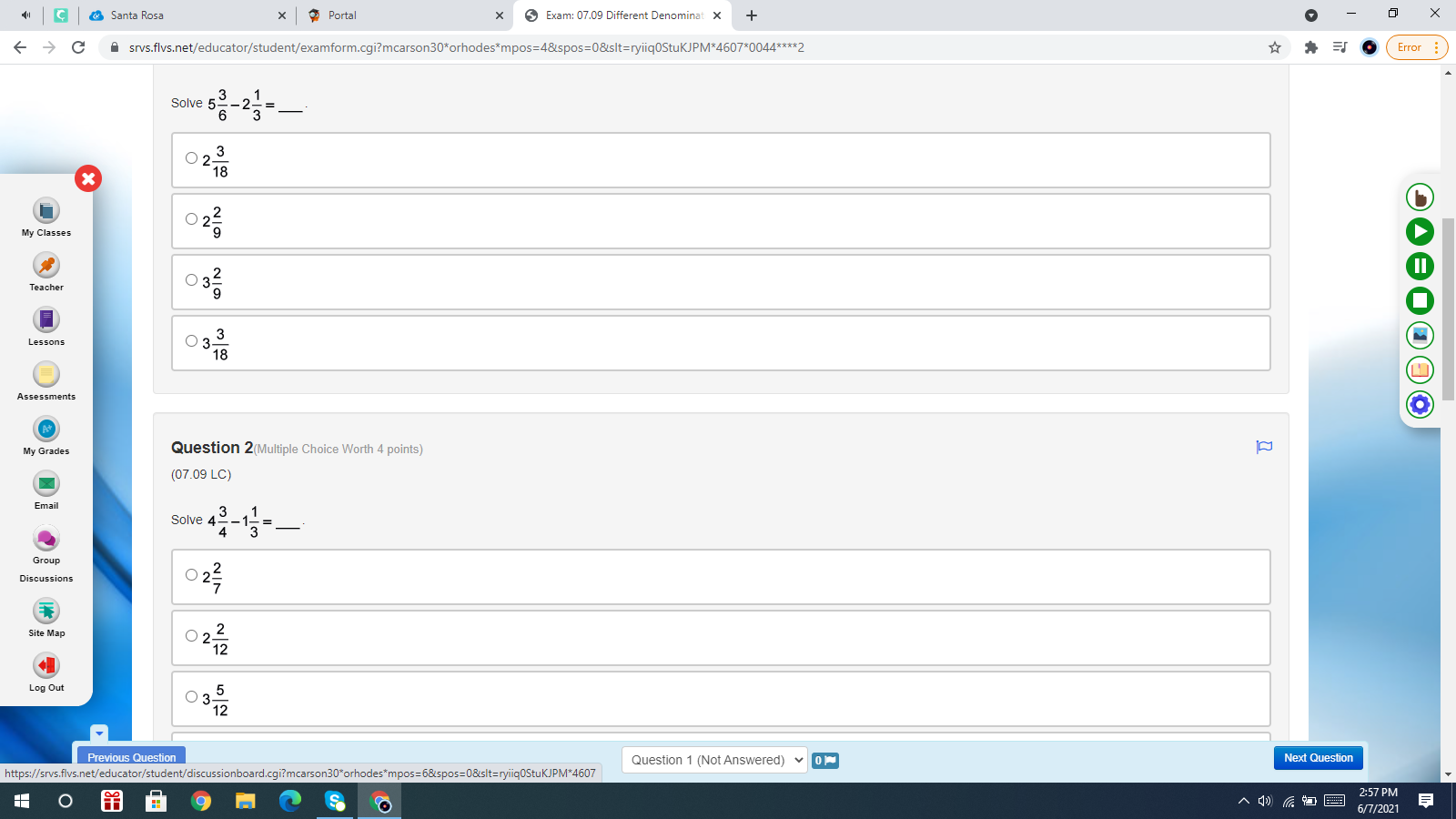
Ok, so to solve this, you need to convert them into improper fractions and then find similar denominators, it would look like this: \(5\dfrac{3}{6}\)-\(2\dfrac{1}{3}\) Improper fractions: \(\dfrac{5 \times 6 + 3}{6}\) - \(\dfrac{2 \times 3 + 1}{3}\) This gets you: \(\dfrac{33}{6}\) - \(\dfrac{7}{3}\) Now we need to find a common denominator, so how many times can 3 go into 6? 2 times. It would look like this: \(\dfrac{33}{6}\) - \(\dfrac{14}{6}\) So just solve it, \(\dfrac{33}{6}\) - \(\dfrac{14}{6}\) = \(\dfrac{19}{6}\) Which, when converted looks like: \(\dfrac{19}{6}\) = \(3\dfrac{1}{6}\)
 cuteDADDY:
jhonyy9:
Extrinix:
Oh, I see where I messed up, one moment.
jhonyy9:
np just look please what choice correspond to your result
jhonyy9:
@extrinix your result is right just look please what choice correspond with your result
jhonyy9:
have you get it ?
jhonyy9:
\[3\frac{ 3 }{ 18 } = ?\] the last one choice
Extrinix:
Ohhh okay, so basically just multiply it got it, \(\dfrac{3}{6} \times \dfrac{1}{3}\) Which would give you \(\dfrac{3}{18}\) Then separately you would do 5-2 which would give you, \(3\dfrac{3}{18}\) Yeah I was never taught to separate out the whole numbers, I was taught to convert it to an improper fraction...
jhonyy9:
Extrinix:
Maybe it’s looking for it’s GCF?
Join our real-time social learning platform and learn together with your friends!
VERNEISH:
Two objects are moving along separate linear paths where each path is described by position, d, and time, t.

 Maci:
what are the best stock apps for people who want to start investing?
Maci:
what are the best stock apps for people who want to start investing?
 Twaylor:
genuienly how do i get better self control i keep watcing youtube and theres this
Twaylor:
genuienly how do i get better self control i keep watcing youtube and theres this
 IzzyCookie:
|dw:1792074056138:dw| Uhm, I don't know where to ask this, but I'm in college welding at my community college, and I need help learning vertical welding for
IzzyCookie:
|dw:1792074056138:dw| Uhm, I don't know where to ask this, but I'm in college welding at my community college, and I need help learning vertical welding for

 thehearken:
not sure if this is considered spam, im sorry if it is, but does anyone have tips
thehearken:
not sure if this is considered spam, im sorry if it is, but does anyone have tips