
 myabell:
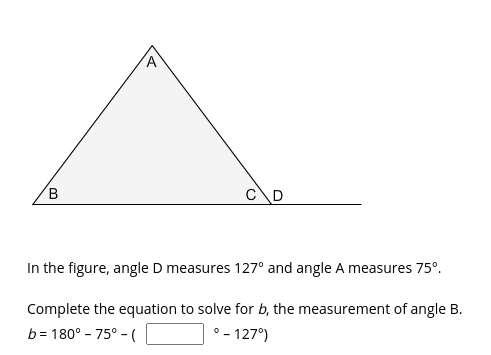
Can someone help me work is below
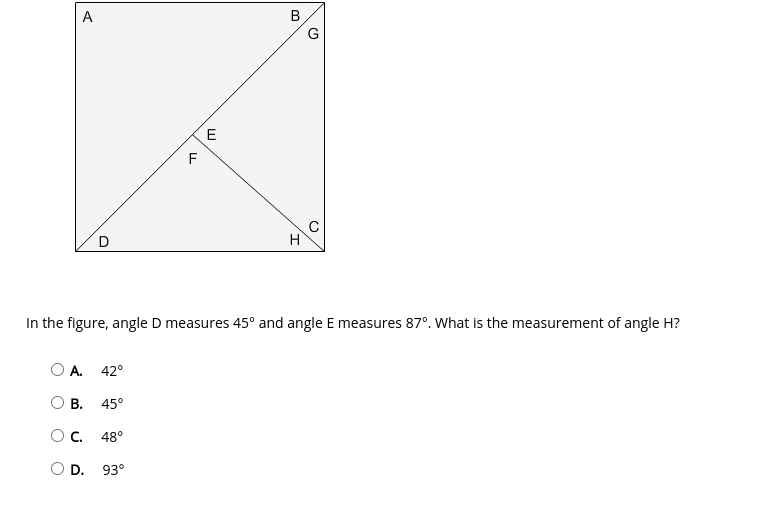
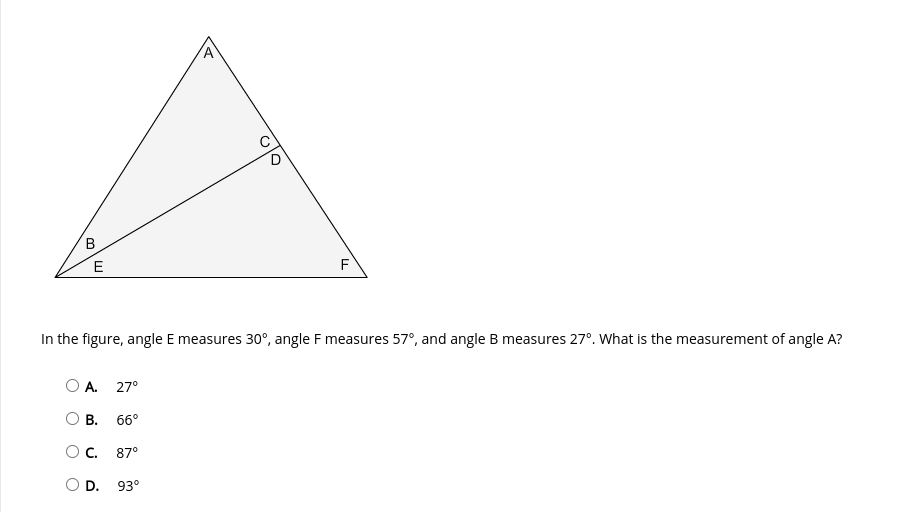
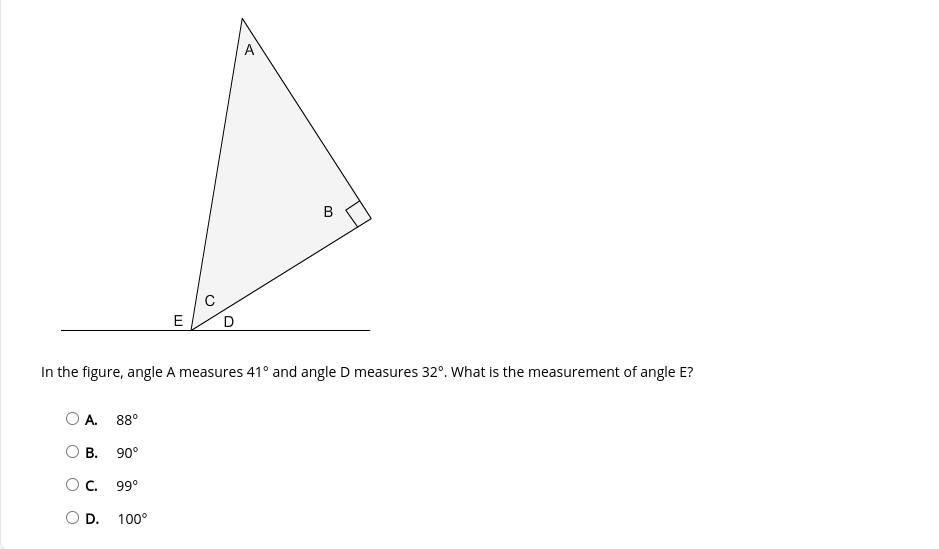
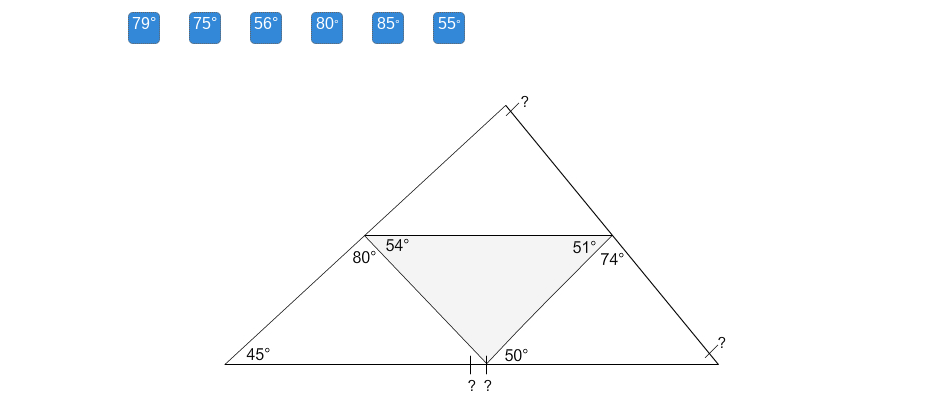
 ItzAgar:
@snowflake0531 @florisalreadytaken
 Florisalreadytaken:
well, we can see that \( \angle C \) and \( \angle d \) form a straight angle, which is \( 180 ^\circ \) since we have got d, just take that amount off the \( 180^\circ \) and that's it/
Florisalreadytaken:
just for instance, \( D=127 \) right? so you should take that off the 180 yes?
myabell:
yes
Florisalreadytaken:
sweet!
 mhanifa:
 Florisalreadytaken:
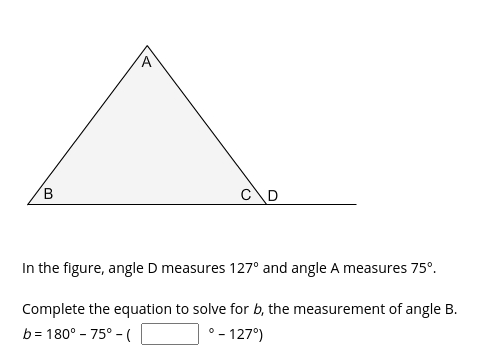
i thought you got it ok so for starters, a triangle's interior angles sum up to \( 180^\circ \) you are given the top one, which is \( 75^\circ \) then, there in the right angle of that triangle, we can see that the line continues and continues in a straight line -- that would make it a straight angle whose measure is \( 180^\circ \) as well ; since that straight angle is formed from C and D, it basically means that \( 180^\circ =C+D \) where C is the interior angle (the one we are looking for) and D is the exterior angle whose measure is \( 127^\circ \) what you are looking to do here is to find C, so that would look like this: \[ 180^\circ =C+D \ \ \Rightarrow \ \ 180^\circ =C+127 ^\circ \] you can move the 127 at the left hand side, as you want to leave C by itself (you should change the operator right): \[ 180^\circ-127 ^\circ =C \] now lastly, back to our main thingie, we are asked to find B well as i mentioned, a triangles interior angle sum is \( 180^\circ \) -- so to find b, just subtract the other two angles
myabell:
thanks
Join our real-time social learning platform and learn together with your friends!
VERNEISH:
Two objects are moving along separate linear paths where each path is described by position, d, and time, t.

 Maci:
what are the best stock apps for people who want to start investing?
Maci:
what are the best stock apps for people who want to start investing?
 Twaylor:
genuienly how do i get better self control i keep watcing youtube and theres this
Twaylor:
genuienly how do i get better self control i keep watcing youtube and theres this
 IzzyCookie:
|dw:1792074056138:dw| Uhm, I don't know where to ask this, but I'm in college welding at my community college, and I need help learning vertical welding for
IzzyCookie:
|dw:1792074056138:dw| Uhm, I don't know where to ask this, but I'm in college welding at my community college, and I need help learning vertical welding for

 thehearken:
not sure if this is considered spam, im sorry if it is, but does anyone have tips
thehearken:
not sure if this is considered spam, im sorry if it is, but does anyone have tips