
 snowflake0531:
.
 NerdyLizard:
This is an odd question. What does the degree argument have to do with anything?
snowflake0531:
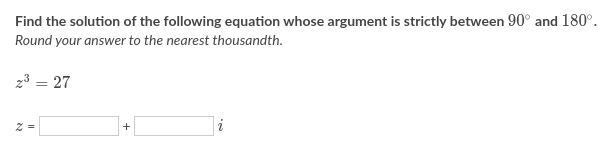
when it's in the form of r(cos(theta) + isin(theta)) the theta has to be between 90 and 180, since there'll be more than one solution ig idk
NerdyLizard:
Okiday den. Lemme put a guess into the desmos and then I'll get back to ya.
snowflake0531:
.. it isn't a desmos thing
NerdyLizard:
Ik ik. I just use desmos to do stuffs. Also, are only numbers allowed in those boxes?
snowflake0531:
yes
NerdyLizard:
Sorry, I am completely lost on this one. I am unsure how to solve this.
snowflake0531:
@tranquility @AZ @florisalreadytaken @dude when you guys become alive e.e please and thank you
snowflake0531:
@smokeybrown
 SmokeyBrown:
I'm not very familiar with complex numbers, so I used this article to refresh a bit. https://byjus.com/maths/argument-of-complex-numbers/ Apparently, the argument of a complex number is calculated using the formula arg (z) = tan^-1(y/x) This seems like it would still leave many possible answers that could be correct (even given the range between 90 and 180 degrees?), so I'm a bit confused on how to find the solution. I feel like I might not be approaching this the right way
 mhanifa:
https://www.khanacademy.org/math/precalculus/x9e81a4f98389efdf:complex/x9e81a4f98389efdf:complex-mul-div-polar/a/complex-number-polar-form-review this should help you
Florisalreadytaken:
i wouldnt even get into \( a+bi \) at all -- time consuming you jcan just change it into: \[ z^3=27 \ \ \Rightarrow \ \ z^3-3^3=0 \] as you might know this formula: \[ a^3-b^2=(a-b)(a^2+ab+b^2) \] where in our case \( a \) is z right? and \( b \) would be 3, the base of it from that you would get two separate equations, respectively: \[ (a-b)=0 \ \ \ and \ \ \ (a^2+ab+b^2) =0 \] and that would give you the three solutions, exactly the same as the ones the link above says -- this is just an alternative way and i think you did post one like this not long ago did you?
snowflake0531:
\[(z-3)(z^2+3z+9)=0\\z=3\] \[ \frac{-3 \pm \sqrt{9-4(9)}}{2} \\\frac{-3 \pm \sqrt{-27}}{2}\\\frac{-3 \pm 3i\sqrt{3}}{2} \] \[z=3\\z=-1.5 + 1.5i\sqrt{3} \\ z=-1.5 - 1.5 i \sqrt{3}\]
snowflake0531:
but then later i have to get it to the form tho of a + bi
Florisalreadytaken:
oh well,, i did not see the way the answer was supposed to be to make it easier for you, \( 27\) is exactly the same as \( 27+0i \) thus, we write: \[ z^3=\left(\left(27+0i\right)^{\frac{1}{3}}\right)^3 \] can you solve that?
snowflake0531:
uh dont the 1/3 and 3 make it 1... and then it'd be still 27 e.e
Florisalreadytaken:
nah it would be 3+0i Then just continue as you would normally do Refer to what surjit sent you Just math from there, really
 AZ:
AZ:
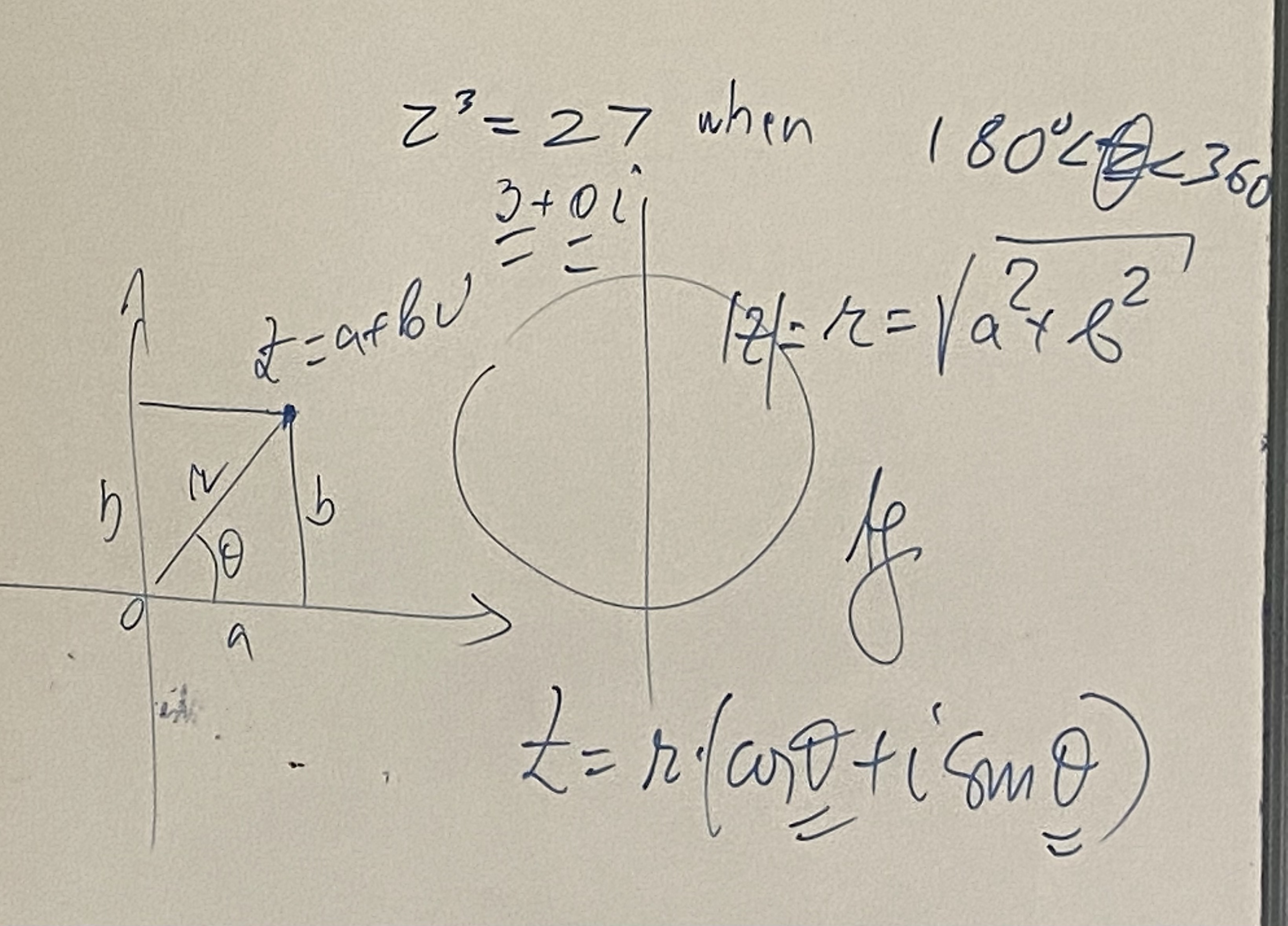
You already know that a + bi is a complex number When you write it in polar form, it would be in the form of \(r(\cos \theta + i \sin \theta)\) so we can say that z = a + bi and another form is \( z = r(\cos \theta + i \sin \theta)\) so if you had \(z^n\) that would be \(\Large z^n = r^n[\cos(n \cdot \theta) + i \sin (\cdot \theta)]\) and so remember how I said another way to write 'z' is as a + bi so basically z^n is (a+bi)^n and so we're trying to find that now z^3 = 27 27 is a real number, there's no imaginary number here so as Flor said, you can re-write that as 27 + 0i and so remember that formula r^n (cos theta + i*sin theta) But first does that make sense so far?
AZ:
|dw:1623971373929:dw|
 snowflake0531:
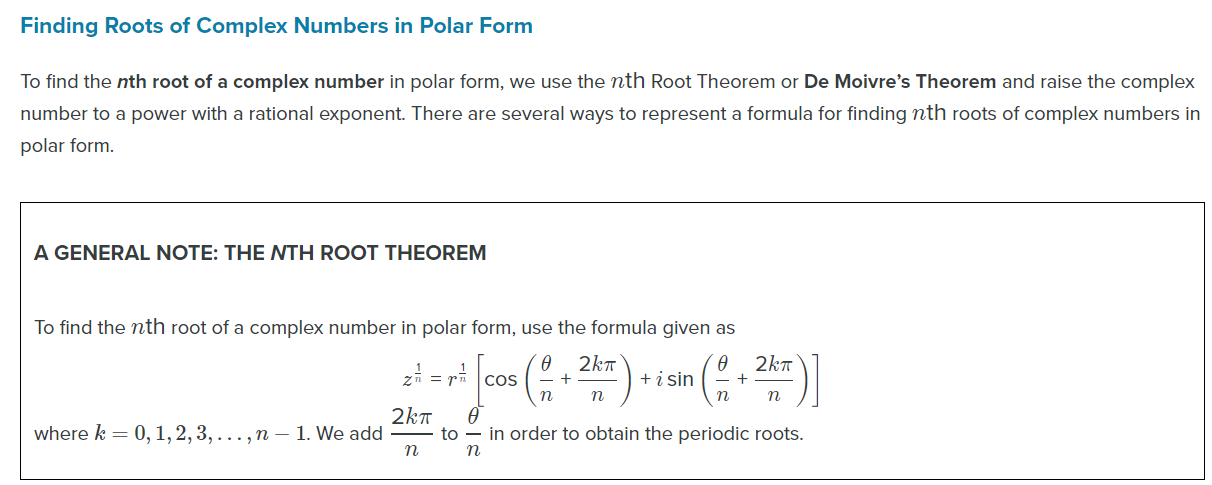
that's one over n tho o-O
snowflake0531:
wouldn't we just use what you wrote earlier o-0 \[z^n = r^n[\cos(n \cdot \theta) + i \sin (n\cdot \theta)]\]
snowflake0531:
but how do you use that to get the r and theta >.>
Florisalreadytaken:
theta is arctan of b/a if some rule is true — i really cannot remember it at the moment ; just google it, and you will find it and for r look above rah
snowflake0531:
3 + 0i, b is 0 though, it would be undefined
Florisalreadytaken:
What? No — its 0
snowflake0531:
oh o: arctan 0 would be 0 o:
Florisalreadytaken:
🤝👏🏻👍🏻 — now find where theta belongs (i did this but someway something’s missing)
snowflake0531:
if it's 0 isn't theta 0 ._.
Florisalreadytaken:
where it belongs you donnie
snowflake0531:
1. what is a donnie 2. i don't understand -.-
Florisalreadytaken:
Then stay confused One thing i dont get though is it why doesnit say to round it? I get real whole numbers as in the answer
snowflake0531:
maybe something different in radians and degrees o:
Florisalreadytaken:
who does degrees in this? And just fyi 90 degrees is there at the upper half of y axis, and 180 is at the right hand side of the x axis so out number is in between there But i am just confusing myself for some reason
snowflake0531:
yikesiez
Florisalreadytaken:
would be intrigued if i am missing something basic — good luck AZ.
snowflake0531:
and you just leave- :|
snowflake0531:
@AZ @AZ @AZ @AZ @AZ @AZ @AZ @AZ @AZ @AZ @AZ @AZ @AZ @AZ @AZ @AZ @AZ @AZ @AZ @AZ @AZ @AZ @AZ @AZ @AZ @AZ @AZ @AZ @AZ @AZ @AZ @AZ @AZ @AZ @AZ @AZ @AZ @AZ @AZ @AZ @AZ @AZ @AZ @AZ @AZ @AZ @AZ @AZ @AZ @AZ @AZ @AZ @AZ @AZ @AZ @AZ @AZ @AZ @AZ @AZ @AZ @AZ @AZ @AZ @AZ @AZ @AZ @AZ @AZ
AZ:
since we have three roots z^3 means there are three roots just like if you had a quadratic equation (x^2) then you would have two roots so since we have three roots, you have to plug in k = 0, 1, 2 to find the different solutions
snowflake0531:
\[r^3(cos(120k) + i sin(120k) \] ?
AZ:
your angle would be 360 because cos 360 is 1 and sin 360 gives you the 0 and so 360/n is inside the parenthesis n is 3 because z^3
AZ:
yeah
snowflake0531:
\[27(cos(120k) + i sin(120k)\]
AZ:
wait no the angle inside the parenthesis for the polar form should still be 360 but when you're solving it, using that formula in the last screenshot I sent- the angle (theta) is 360 and then you divide by n
snowflake0531:
360/3 is 120-
AZ:
\( z= 27(\cos(360k) + i \sin(360k)\)
AZ:
snowflake0531:
\[27^{\frac{1}{3}}[cos(\frac{360}{3} + \frac{2k\pi}{3}) + i~sin(\frac{360}{3} + \frac{2k\pi}{3}) \\ 3[cos(120 + \frac{2k\pi}{3}) + i~sin(120+\frac{2k\pi}{3})\] \[k = 0 \\ 3[cos(120 + \frac{2(0)\pi}{3}) + i~sin(120+\frac{2(0)\pi}{3}) \\3[cos(120) + i~sin(120)]\\ -\frac{3}{2} + \frac{3i \sqrt{3}}{2} \] using mathway \[k=1 \\ 3[cos(120 + \frac{2\pi}{3}) + i~sin(120+\frac{2\pi}{3}) \\ \] It WoNt LeT mE sImPliFy ittttttttttttt \[k=2 \\ 3[cos(120 + \frac{2(2)\pi}{3}) + i~sin(120+\frac{2(2)\pi}{3}) \\3[cos(120 + \frac{4\pi}{3}) + i~sin(120+\frac{4\pi}{3}) \] although I did get the 3 roots earlier though, \[z=3\\z=-1.5 + 1.5i\sqrt{3} \\ z=-1.5 - 1.5 i \sqrt{3} \] idkidk
AZ:
Okay so the thing is 360 is degrees so you could just write that as 2pi lol and then you'll be able to simplify it but you see that when k = 0 that's 120 degrees inside of cos and sin that's going to be within 90 and 180 degrees and is your answer
snowflake0531:
then it would simplify to\[3[cos(240) + isin(240)]\]
snowflake0531:
and then be the root o-0
snowflake0531:
nvmd i finally figured it out *big dumb*
AZ:
yes haha
Join our real-time social learning platform and learn together with your friends!
VERNEISH:
Two objects are moving along separate linear paths where each path is described by position, d, and time, t.

 Maci:
what are the best stock apps for people who want to start investing?
Maci:
what are the best stock apps for people who want to start investing?
 Twaylor:
genuienly how do i get better self control i keep watcing youtube and theres this
Twaylor:
genuienly how do i get better self control i keep watcing youtube and theres this
 IzzyCookie:
|dw:1792074056138:dw| Uhm, I don't know where to ask this, but I'm in college welding at my community college, and I need help learning vertical welding for
IzzyCookie:
|dw:1792074056138:dw| Uhm, I don't know where to ask this, but I'm in college welding at my community college, and I need help learning vertical welding for

 thehearken:
not sure if this is considered spam, im sorry if it is, but does anyone have tips
thehearken:
not sure if this is considered spam, im sorry if it is, but does anyone have tips