
 kathleentrow8:
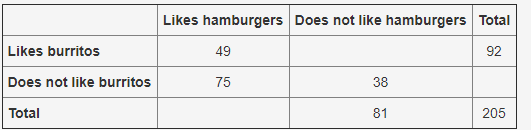
A food truck did a daily survey of customers to find their food preferences. The data is partially entered in the frequency table. Complete the table to analyze the data and answer the questions: Likes hamburgers Does not like hamburgers Total Likes burritos 49 92 Does not like burritos 75 38 Total 81 205 Part A: What percentage of the survey respondents do not like both hamburgers and burritos? (2 points) Part B: What is the marginal relative frequency of all customers that like hamburgers? (3 points) Part C: Use the conditional relative frequencies to determine which data point has strongest association of its two factors. Use complete sentences to explain your answer. (5 points)
 SmokeyBrown:
For A, you can see that the number of people who don't like burritos AND don't like hamburgers is in the square where that column and row overlap: 38. Then the total of all the customers is in the bottom right: 205. So, you can find the percentage by dividing 38/205 (and multiplying by 100) I'm not very familiar with relative frequencies, which are needed for parts B and C... Maybe we can ask someone else who might know...
kathleentrow8:
SmokeyBrown:
No problem. @mhanifa might be able to help more, maybe?
kathleentrow8:
@smokeybrown ok ty
 mhanifa:
The marginal relative frequencies are found by adding the joint relative frequencies in each row and column. To find a conditional relative frequency , divide the joint relative frequency by the marginal relative frequency.
mhanifa:
Part B Add 49 and 75
kathleentrow8:
mhanifa:
Fill in the table first, the totals on the right column and bottom row are sums of the previous two numbers
mhanifa:
Then you may convert all numbers to percent considering 205 is 100%, (you will change the table of numbers into table of percent value of those in terms of total of 205) this will help to solve the part C
kathleentrow8:
Join our real-time social learning platform and learn together with your friends!
VERNEISH:
Two objects are moving along separate linear paths where each path is described by position, d, and time, t.

 Maci:
what are the best stock apps for people who want to start investing?
Maci:
what are the best stock apps for people who want to start investing?
 Twaylor:
genuienly how do i get better self control i keep watcing youtube and theres this
Twaylor:
genuienly how do i get better self control i keep watcing youtube and theres this
 IzzyCookie:
|dw:1792074056138:dw| Uhm, I don't know where to ask this, but I'm in college welding at my community college, and I need help learning vertical welding for
IzzyCookie:
|dw:1792074056138:dw| Uhm, I don't know where to ask this, but I'm in college welding at my community college, and I need help learning vertical welding for

 thehearken:
not sure if this is considered spam, im sorry if it is, but does anyone have tips
thehearken:
not sure if this is considered spam, im sorry if it is, but does anyone have tips