
 karremat:
pls i need help
 Alexis1415:
What do you need help with?
 Silverpayton23:
are u in trouble?
Alexis1415:
The first one is already answered right? just making sure
karremat:
its not
Alexis1415:
Oh, okay
Alexis1415:
Do you know how to use Punnet Square/s?
karremat:
yes i do
Alexis1415:
okay and do you know how to find the recessive Allele and the dominant Allele?
karremat:
no like am really sorry but that is what am just doing right now can i get back to you when am done because am having class now
Alexis1415:
sure c:
karremat:
and i know how to find it
Alexis1415:
that's good
karremat:
Hi can i do it now
 XxXNessalulbaddieXxX:
karremat:
i know but how do i start
XxXNessalulbaddieXxX:
karremat:
the document at the top
XxXNessalulbaddieXxX:
karremat:
@smokeybrown pls can you help out
 SmokeyBrown:
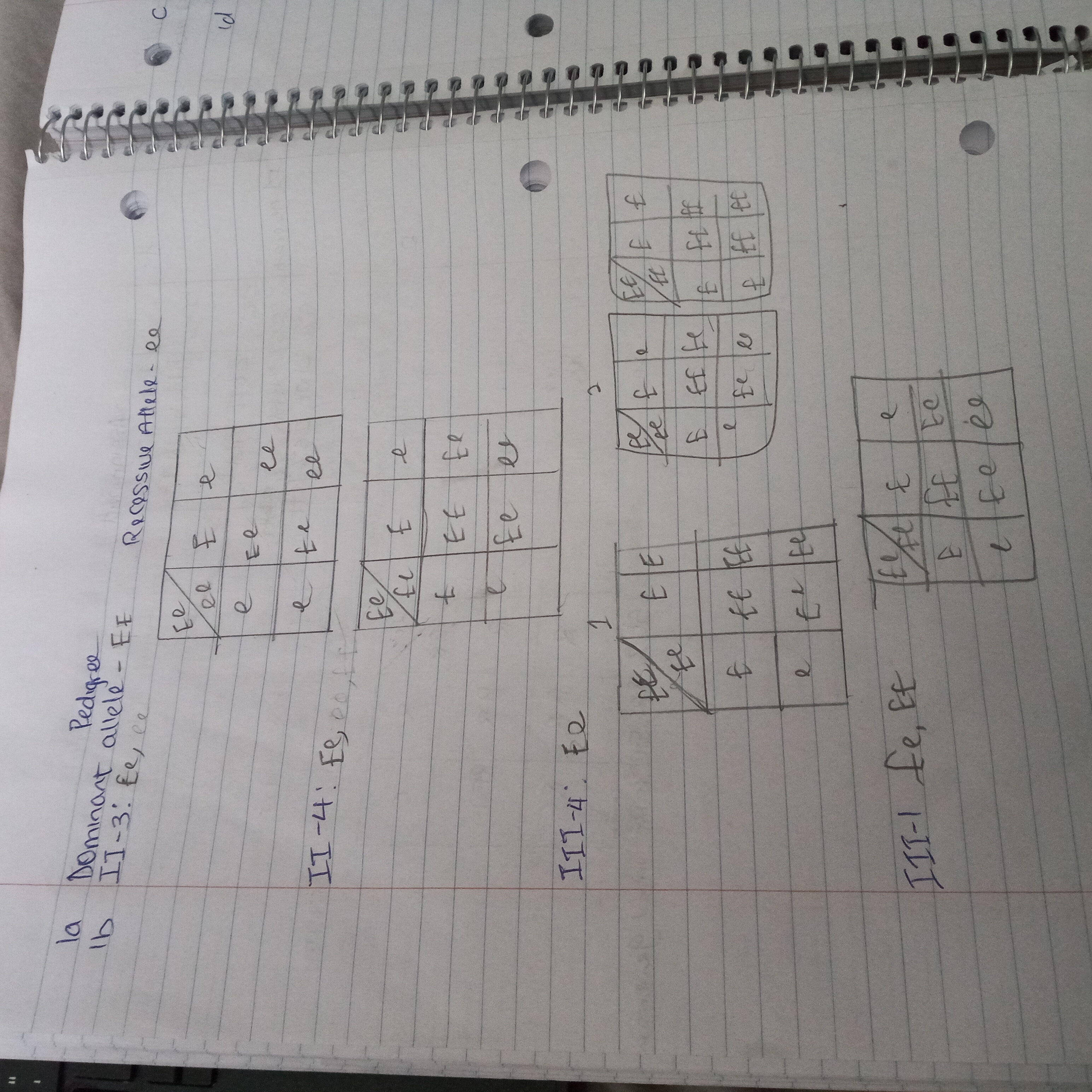
I'm not sure which For question 1.a. you simply need to match the proper allele E or e to the proper label, dominant or recessive. As a general rule, the dominant allele will be represented by an uppercase letter and the recessive will be represented by a lowercase letter. For 1.b. you can start by finding the child on the tree. So, for instance, for II-3 you would go to the second generation and find the third child. Then, you can draw a Punnett Square for the parents of that child in order to see what allele combinations are possible. You may have to draw more than one Punnett Square, if the parents' genotypes are uncertain. Using the information from the Squares you draw and the phenotypes (expressed traits) of the child, you should be able to list the possible genotypes of the child Part 1.c, requires you to make some reasoning based on what you know about gene expression. The father I-1 has an attached earlobe, while the mother I-2 does not. The question asks you to give reason(s) why none of I-1 and I-2's children have attached earlobes. Part 1.d. is similarly based on reasoning. We know that I-1 has an attached earlobe, which is a recessive trait. Thus, we can say for certain that I-1 has a genotype of 'ee'. For the child, II-1, we see that the child does not have attached earlobes; based *only* on this observation, it is possible that their genotype is EE or Ee. However, we know that her father had ee alleles. So, is it possible that II-1 is EE? Why or why not? Part 1.e. relies on the rules described at the top of the page, specifically the rules for how children are arranged in the chart based on order of birth. Hint: children who are born first (to the same parents) appear to the left of children who are born later. For part 2, you are only required to predict all the possible genotypes of the given people, based on their expressed traits. So, if someone does express the recessive trait (shaded in black), you know they must have all recessive alleles. And if someone does not express the recessive trait (shown in white), then their genotype could either be EE or Ee, so you would list both possibilities.
SmokeyBrown:
A small addition to question 2: For parents (d) and (e), note that neither of them can possibly have EE, since they produce a child (g) who has ee. So, in that case, you know that (d) and (e) both have Ee, even though neither of them express the recessive trait, based on the expression of their child.
karremat:
ok thanks i will try them out
karremat:
but i will do it later cause am in class now
SmokeyBrown:
Ok sounds good. If you get any results later, I'll be happy to take a look at them
karremat:
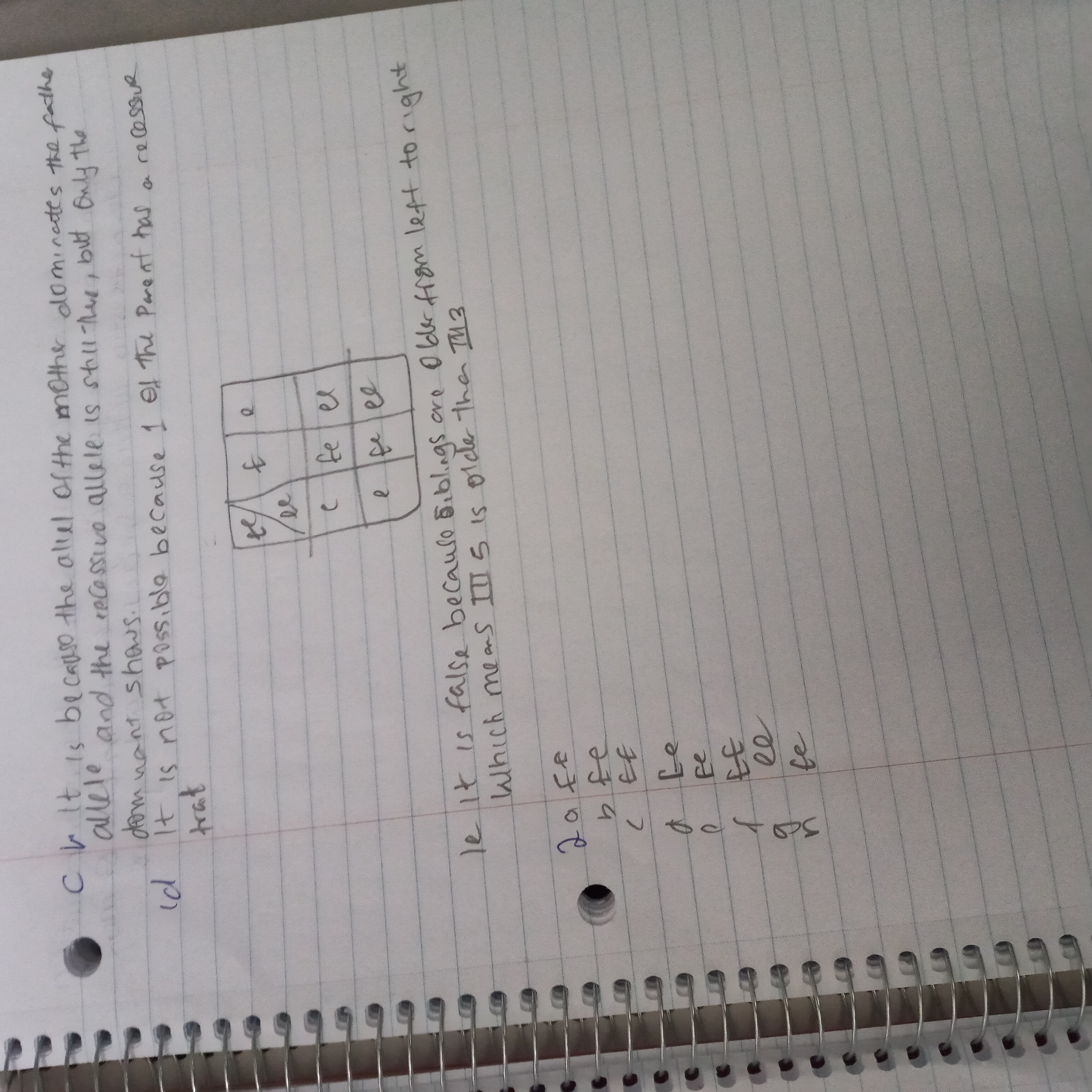
for 1c answer i wrote that it is because the allele of the mother dominates the father allele and the recessive trait is there it just doesn't show
SmokeyBrown:
karremat:
for id i wrote that it is not possible because one of the parent has reccessive trait
karremat:
for Ie, it is false because siblings are older from the left to right which means III5 is older than III3
 SmokeyBrown:
karremat:
ok thank you so much for the help
SmokeyBrown:
Not a problem! I'm glad to help
Join our real-time social learning platform and learn together with your friends!
 VERNEISH:
Two objects are moving along separate linear paths where each path is described by position, d, and time, t.
VERNEISH:
Two objects are moving along separate linear paths where each path is described by position, d, and time, t.

 Maci:
what are the best stock apps for people who want to start investing?
Maci:
what are the best stock apps for people who want to start investing?
 Twaylor:
genuienly how do i get better self control i keep watcing youtube and theres this
Twaylor:
genuienly how do i get better self control i keep watcing youtube and theres this
 IzzyCookie:
|dw:1792074056138:dw| Uhm, I don't know where to ask this, but I'm in college welding at my community college, and I need help learning vertical welding for
IzzyCookie:
|dw:1792074056138:dw| Uhm, I don't know where to ask this, but I'm in college welding at my community college, and I need help learning vertical welding for

 thehearken:
not sure if this is considered spam, im sorry if it is, but does anyone have tips
thehearken:
not sure if this is considered spam, im sorry if it is, but does anyone have tips