
 mdobbs6856:
Help.
 SmokeyBrown:
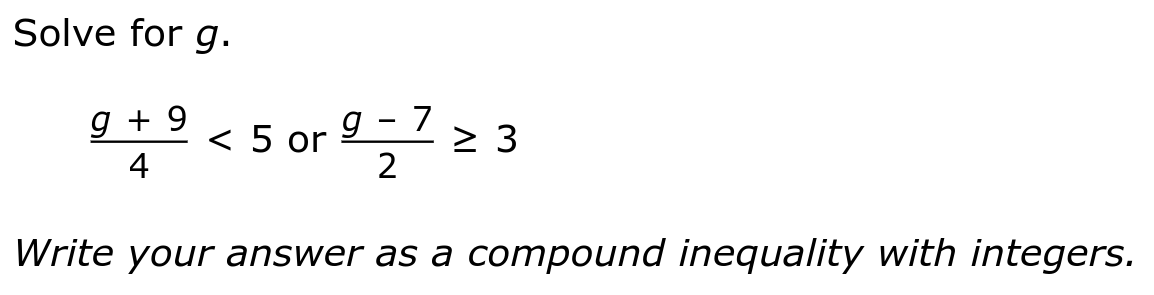
Looks like we've got two inequalities here: 1)\[\frac{ g+9 }{ 4 }< 5\] and 2)\[\frac{ g-7 }{ 2 } \ge3\] For the first inequality, we can start by multiplying both sides by 4. This would give us \[g+9 < 20\] Which we could then simplify by subtracting 9 from both sides to get the inequality \[g < 11\] For inequality 2, we can similarly start by multiplying both sides by 2 to give us \[g-7 \ge 6\] Next, we would add 7 to both sides to get \[g \ge 13\] Taking both inequalities together, it seems that g is either less than 11 or greater than or equal to 13. Do you know how to represent this relationship as a "compound inequality" as the question asks?
mdobbs6856:
It means the two number statements join to make to make a sentence using word “or” or the word “and", I think
SmokeyBrown:
I see, that makes sense. Well, it looks like you should have an easy job of it, then. If you do run into any trouble, please feel free to let us know. I'll do my best to take a look, if that's the case :)
mdobbs6856:
Thank you sm! @smokeybrown
Join our real-time social learning platform and learn together with your friends!
 VERNEISH:
Two objects are moving along separate linear paths where each path is described by position, d, and time, t.
VERNEISH:
Two objects are moving along separate linear paths where each path is described by position, d, and time, t.

 Maci:
what are the best stock apps for people who want to start investing?
Maci:
what are the best stock apps for people who want to start investing?
 Twaylor:
genuienly how do i get better self control i keep watcing youtube and theres this
Twaylor:
genuienly how do i get better self control i keep watcing youtube and theres this
 IzzyCookie:
|dw:1792074056138:dw| Uhm, I don't know where to ask this, but I'm in college welding at my community college, and I need help learning vertical welding for
IzzyCookie:
|dw:1792074056138:dw| Uhm, I don't know where to ask this, but I'm in college welding at my community college, and I need help learning vertical welding for

 thehearken:
not sure if this is considered spam, im sorry if it is, but does anyone have tips
thehearken:
not sure if this is considered spam, im sorry if it is, but does anyone have tips