
 summerh0819:
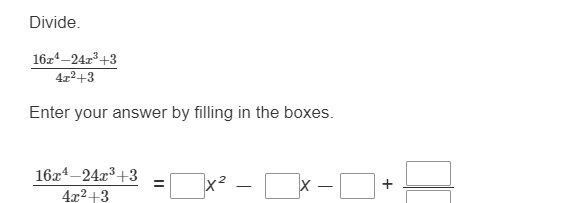
Divide. 16x^4−24x^3+3 / 4x^2+3 fill in the boxes(spaces lol) = x^2 - x - + / Enter your answer by filling in the boxes.
 TogaHimiko:
u need help on tht one also?
TogaHimiko:
ohhh ok
summerh0819:
no thats the question i just snipped a picture of it so you could see it
TogaHimiko:
k
 FexrlessRxby:
So do you know what to do to start off?
 SmokeyBrown:
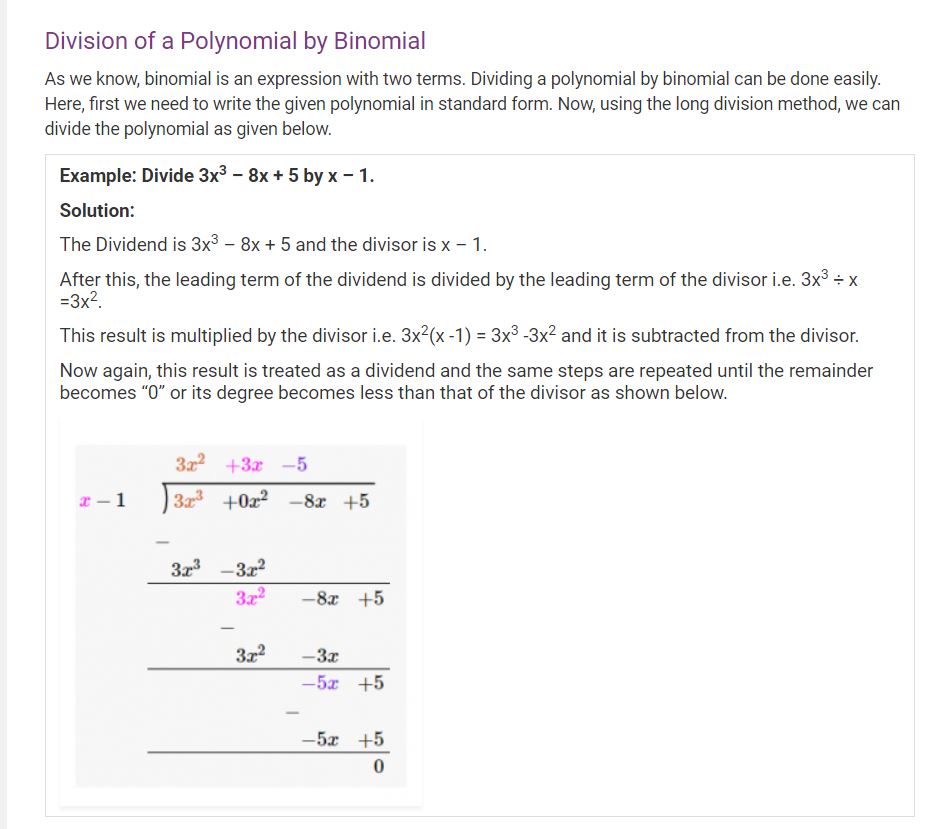
We can use the method described in this screenshot (taken from the website: https://byjus.com/maths/polynomial-division/ ) 4x^2 + 3 INTO 16x^4−24x^3 + 0x^2 + 0x +3 Let's start with the "leading terms" as the method describes: 4x^2 can be multiplied by 4x^2 to go into 16x^4. So, let's multiply the entire expression (4x^2 + 3) by 4x^2, giving us (16x^4 + 12x^2) We then subtract this from the dividend so that our new expression is: 4x^2 + 3 INTO 24x^3 - 12x^2 + 0x +3 (and our quotient so far is 4x^2...) We'll continue using leading terms: 4x^2 can be multiplied by 6x to go into 24x^3. Once again, we multiply the entire expression (4x^2 + 3) by 6x to get (24x^2 + 18x) and subtract this from the dividend to get: 4x^2 + 3 INTO -12x^2 -18x + 3 (our quotient so far is 4x^2 + 6x...) Just like before, 4x^2 can be multiplied by -3 to go into -12x^2, so we multiply (4x^2 + 3) by -3 to get (-12x^2 - 9), subtract it from the dividend to get: 4x^2 + 3 INTO -18x + 12 (our quotient so far is 4x^2 + 6x - 3) Now, 4x^2 does not go into -18x, so our long-division ends here. The quotient we find through this method of polynomial long-division is (4x^2 + 6x - 3) and the remainder is (-18x + 12) Perhaps you can use these results to fill in the blanks of your question? I hope this helps with your understanding of the concept; please let me know if there's any further guidance I can give :)
 AZ:
AZ:
I think both of you might want to check your work again \(\dfrac{16 x^4 - 24 x^3 + 3}{4x^2+3} = 4x^2 - 6 x - 3 + \dfrac{18 x + 12}{4x^2+3} \) https://www.wolframalpha.com/input/?i=%2816x%5E4%E2%88%9224x%5E3%2B3+%29%2F+%284x%5E2%2B3%29
SmokeyBrown:
 surjithayer:
i am sorry ,i will do it again 4x^2+3)16x^4-24x^3+0x^2+0x+3(4x^2-6x-3 16x^2 +12x^2 - - ______________________ -24x^3-12x^2 + 0x -24x^3 -18x + + ______________________________ -12x^2+18x+3 -12 x^2 -9 + + _________________ 18x+12 ____________ \[\frac{ 16x^4-24x^3+3 }{ 4x^2+3 }=4x^2-6x-3+\frac{ 18x+12 }{ 4x^2+3}\]
AZ:
Join our real-time social learning platform and learn together with your friends!
VERNEISH:
Two objects are moving along separate linear paths where each path is described by position, d, and time, t.

 Maci:
what are the best stock apps for people who want to start investing?
Maci:
what are the best stock apps for people who want to start investing?
 Twaylor:
genuienly how do i get better self control i keep watcing youtube and theres this
Twaylor:
genuienly how do i get better self control i keep watcing youtube and theres this
 IzzyCookie:
|dw:1792074056138:dw| Uhm, I don't know where to ask this, but I'm in college welding at my community college, and I need help learning vertical welding for
IzzyCookie:
|dw:1792074056138:dw| Uhm, I don't know where to ask this, but I'm in college welding at my community college, and I need help learning vertical welding for

 thehearken:
not sure if this is considered spam, im sorry if it is, but does anyone have tips
thehearken:
not sure if this is considered spam, im sorry if it is, but does anyone have tips