
 Nerdyhuman:
If anyone could just help me with the formulas since my professor did not teach me anything that would be great! I think I am fine solving them.
 Nerdyhuman:
@vocaloid
 Vocaloid:
speed = distance/time be careful with units. the time is given in minutes, but the answer choices ask for seconds.
 Vocaloid:
a) average acceleration = (final velocity - initial velocity) / time in this case, your final velocity is 0 (coming to a stop) initial velocity is given as 33 km/hr time is 19 minutes make sure to convert all your units to meters and seconds
Vocaloid:
b) average velocity = (final speed - initial speed) / time * important: normally, you need to consider the direction too, but in this case it's only asking for the magnitude final speed is 0 since it's coming to a stop initial speed is 33km/hr time is 19 minutes be sure to convert units to meters and seconds
Nerdyhuman:
I'm lost on a I got 29 and its wrong
Vocaloid:
33km/hr = 33*1000 m/hr = 33*1000/(3600) = 9.16666(repeated) m/s initial velocity final velocity = 0 time = 19 minutes = 19*60 seconds = 1140 seconds avg. acceleration = (0 - 9.16666)/1140 = -0.00804 m/s/s
Nerdyhuman:
It says that is wrong too
Vocaloid:
@smokeybrown I can't figure out what I'm doing wrong w/ my calculations (second problem, part a)
 SmokeyBrown:
Nerdyhuman:
maybe take the negative out?
Nerdyhuman:
you have to take the negative out
SmokeyBrown:
Nerdyhuman:
so what do I do for b does a get used anywhere in the solving?
SmokeyBrown:
For part (b) of the question about the ship, I think the average velocity would be half of its initial velocity, assuming that the ship accelerates from max velocity to 0 at an equal rate. So, unless I'm mistaken, that would be 33 km/hr divided by 2 (16.5 km/hr), only in meters per second instead of kilometers per hour. 16.5 km/hr = 16500 m/hr = 4.58 meters/second I think that is the average velocity you are looking for
Nerdyhuman:
thank you! I would have solved it I just forgot the half part but I have two more questions that I may need help with
SmokeyBrown:
Sounds good. I'll be happy to take a look and try to help if I can
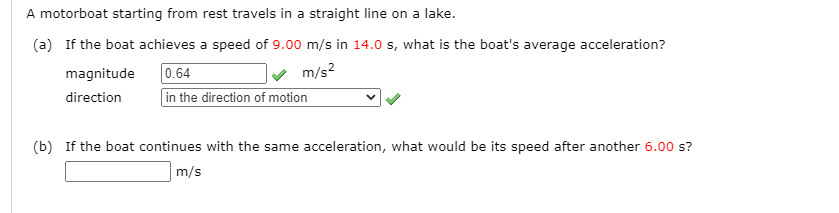 Nerdyhuman:
so how do I solve this
SmokeyBrown:
You found that the rate of acceleration is 0.64 m/s/s. So, the motorboat is gaining 0.64 m/s of velocity with every second that passes. After 6.00 seconds, as the question mentions, the boat will gain 0.64*6.00 m/s of velocity, according to this acceleration. That equals an additional 3.84 m/s of velocity. If you add this extra velocity to the velocity that the boat already has (9 m/s), you should be able to find the speed of the boat after 6 seconds have passed: 9 + 3.84 = ?
Nerdyhuman:
12.84
Nerdyhuman:
that makes sense
SmokeyBrown:
Yup, that should be the final velocity of the boat after accelerating at that rate for 6 more seconds. Glad it makes sense :)
Nerdyhuman:
last one and then no more of this hw I will just study the content for my exam next week lol
 Nerdyhuman:
This is supposed to be physical science for educators but then first day we are told that the content is not what we would teach upper elementary school students so yeah
SmokeyBrown:
Interesting. Sounds like a good plan. The question seems straightforward, so we can probably finish this up quick so you can go about your business. We are given the initial height of the object and we're told that it is dropped from freefall; we can find out how long the object takes to reach the ground based on the equation: \[Time = \sqrt{2*height/gravity}\] Now, the gravity constant on earth is about 9.8, and the question says that the gravity constant on Uranus is about 0.889 times that on earth (0.889*9.8=0.871) So, the amount of time the object takes to reach the ground on Earth would be: \[Time = \sqrt{2*69/9.8}\] = 3.75 seconds And the amount of time the object takes to reach the ground on Uranus would be: \[Time = \sqrt{2*69/8.71}\] = 3.98 seconds You can calculate the difference in the time it takes, in order to answer the question
Nerdyhuman:
.23 this is not that bad
Nerdyhuman:
thank you so much!!!
SmokeyBrown:
No problem! Glad we could help :)
Join our real-time social learning platform and learn together with your friends!
VERNEISH:
Two objects are moving along separate linear paths where each path is described by position, d, and time, t.

 Maci:
what are the best stock apps for people who want to start investing?
Maci:
what are the best stock apps for people who want to start investing?
 Twaylor:
genuienly how do i get better self control i keep watcing youtube and theres this
Twaylor:
genuienly how do i get better self control i keep watcing youtube and theres this
 IzzyCookie:
|dw:1792074056138:dw| Uhm, I don't know where to ask this, but I'm in college welding at my community college, and I need help learning vertical welding for
IzzyCookie:
|dw:1792074056138:dw| Uhm, I don't know where to ask this, but I'm in college welding at my community college, and I need help learning vertical welding for

 thehearken:
not sure if this is considered spam, im sorry if it is, but does anyone have tips
thehearken:
not sure if this is considered spam, im sorry if it is, but does anyone have tips