
 Foreverangel:
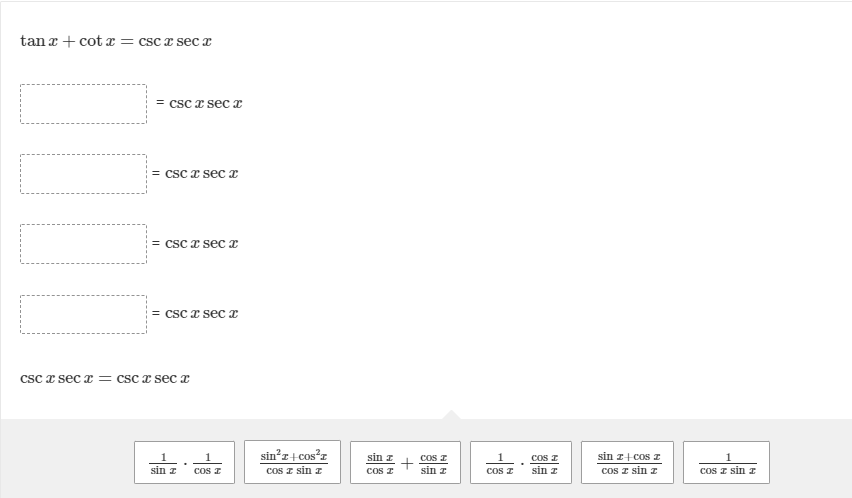
Verify the identity. tanx+cotx=cscxsecx Drag an expression into each box to correctly verify the identity.
 Vocaloid:
you can re-write tan(x) as sin(x)/cos(x) you can also re-write cot(x) as cos(x)/sin(x). that gives you the sin(x)/cos(x) + cos(x)/sin(x) as the first line from there, you can make both denominators equal to cos(x)sin(x). multiply sin(x)/cos(x) by sin(x)/sin(x) and multiply cos(x)/sin(x) by cos(x)/cos(x) from there, use the identity sin^2(x) + cos^2(x) = 1 to simplify finally, use the fact that csc(x) = 1/sin(x) and sec(x) = 1/cos(x) to get your answer in terms of csc and sec can you try re-arranging the blocks now?
Foreverangel:
Im gonna be honest here I have no clue I have gone over this so many times today and havent been able to get it
Vocaloid:
I'll write out the steps in a minute ^^ I think the main two things are to remember the properties, and think about how you can use them to make both sides equal.
Foreverangel:
Alright thank you! I am gonna right this stuff down so I can have it to look at
Vocaloid:
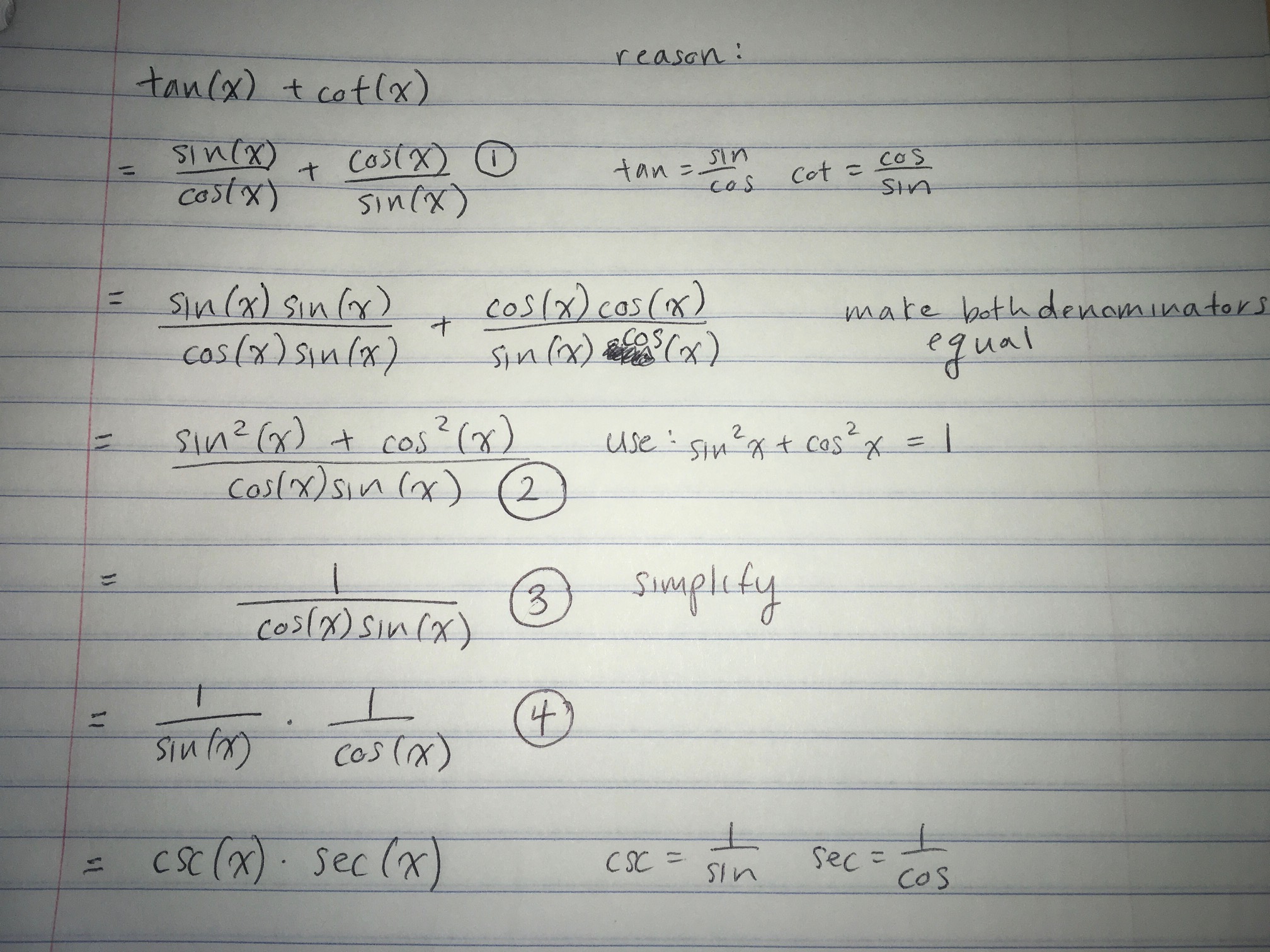
To the right side, I also wrote the reason why the step works. Notice how the reasons are all identities or basic mathematical operations. Let me know if you have any questions about each step.
 Foreverangel:
Thank you so much! I am going to write and go over everything.
Vocaloid:
I think the hardest step to think of is the denominators step. My logic: I have two separate expressions separated by a plus sign. The final step is csc(x)sec(x). So to "combine" the fractions sin(x)/cos(x) + cos(x)/sin(x) I had to make both denominators equal to cos(x)sin(x) by multiplying by either sin(x)/sin(x) or cos(x)/cos(x) as appropriate. Because sin(x)/sin(x) and cos(x)/cos(x) are both equal to 1, I can multiply each fraction by 1 without changing the actual value of the fraction. However, changing both denominators lets us "combine" the two terms. Additionally, it also gives us cos^2(x) + sin^2(x) = 1 as the numerator, which helps us simplify the numerator. ^ that's my logic behind my steps. It's hard at first but with practice, this kind of thinking will become more natural.
Join our real-time social learning platform and learn together with your friends!
 VERNEISH:
Two objects are moving along separate linear paths where each path is described by position, d, and time, t.
VERNEISH:
Two objects are moving along separate linear paths where each path is described by position, d, and time, t.

 Maci:
what are the best stock apps for people who want to start investing?
Maci:
what are the best stock apps for people who want to start investing?
 Twaylor:
genuienly how do i get better self control i keep watcing youtube and theres this
Twaylor:
genuienly how do i get better self control i keep watcing youtube and theres this
 IzzyCookie:
|dw:1792074056138:dw| Uhm, I don't know where to ask this, but I'm in college welding at my community college, and I need help learning vertical welding for
IzzyCookie:
|dw:1792074056138:dw| Uhm, I don't know where to ask this, but I'm in college welding at my community college, and I need help learning vertical welding for

 thehearken:
not sure if this is considered spam, im sorry if it is, but does anyone have tips
thehearken:
not sure if this is considered spam, im sorry if it is, but does anyone have tips