
 baileyadams:
Can someone please help me
 Sailor:
Maybe Voca can help when she/he gets the chance? @vocaloid
 Vocaloid:
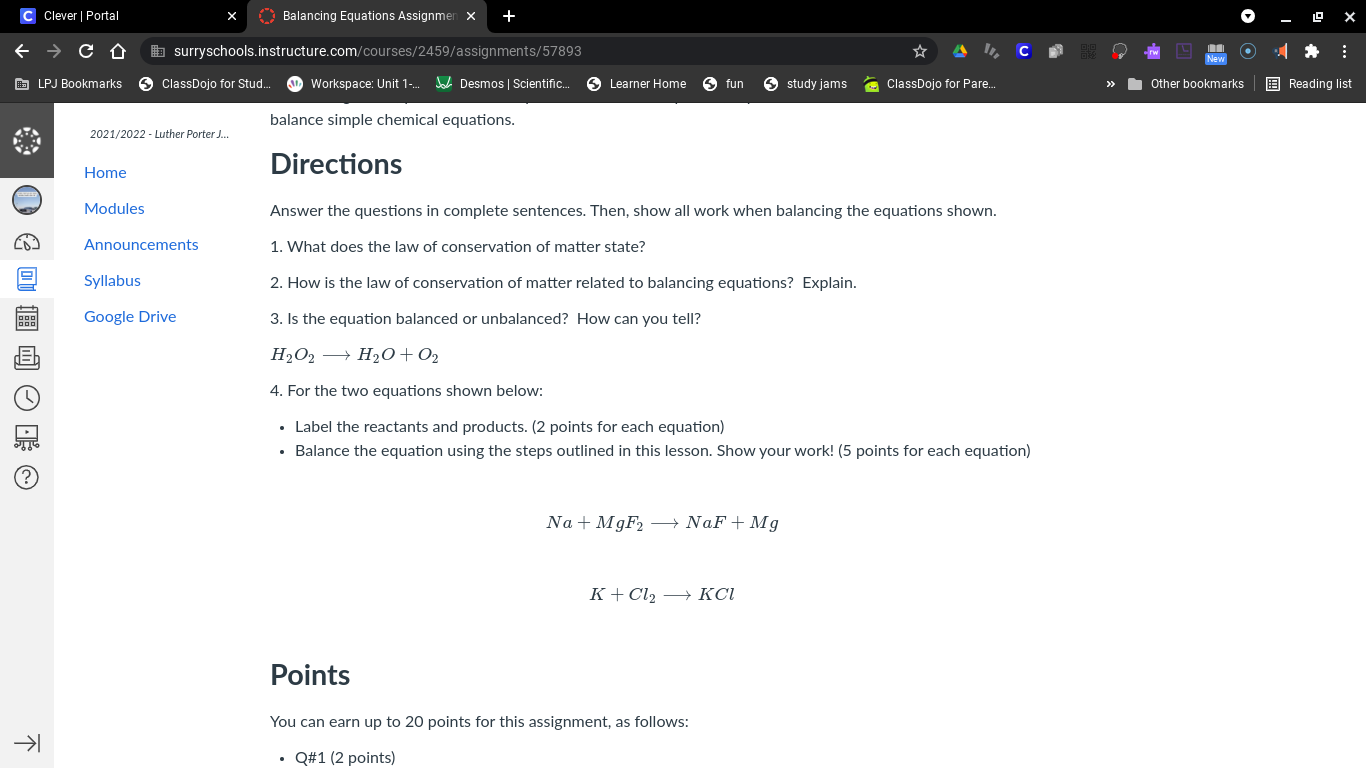
Please do not copy-paste my responses. 1. this is a definition you'll simply have to learn/memorize. law of conservation of matter states that matter cannot be created or destroyed. 2. applying this to balancing equations, because matter cannot be created or destroyed, the atoms on one side of a chemical reaction (the left side, or the reactants) must contain the same atoms, in the same quantity, as on the right side (the products) 3. for this problem, count the number of hydrogen atoms and oxygen atoms on the left side, compare this to the right side. if they're the same, it's balanced. if not, it's unbalanced. 4. reactants are all on the left side of the reaction arrows, products are on the right. label accordingly. to balance, add coefficients in front of compounds until both sides have equal #'s of atoms of each type. for example, for Na + MgF2 ---> NaF + Mg you have 2 F atoms on the left but only 1 on the right, so you can add a 2 in front of NaF to get 2 F atoms. however, now you have unbalanced Na atoms, so balance those using the same method. repeat this process until both sides are balanced. repeat w/ the second equation.
baileyadams:
Join our real-time social learning platform and learn together with your friends!
 VERNEISH:
Two objects are moving along separate linear paths where each path is described by position, d, and time, t.
VERNEISH:
Two objects are moving along separate linear paths where each path is described by position, d, and time, t.

 Maci:
what are the best stock apps for people who want to start investing?
Maci:
what are the best stock apps for people who want to start investing?
 Twaylor:
genuienly how do i get better self control i keep watcing youtube and theres this
Twaylor:
genuienly how do i get better self control i keep watcing youtube and theres this
 IzzyCookie:
|dw:1792074056138:dw| Uhm, I don't know where to ask this, but I'm in college welding at my community college, and I need help learning vertical welding for
IzzyCookie:
|dw:1792074056138:dw| Uhm, I don't know where to ask this, but I'm in college welding at my community college, and I need help learning vertical welding for

 thehearken:
not sure if this is considered spam, im sorry if it is, but does anyone have tips
thehearken:
not sure if this is considered spam, im sorry if it is, but does anyone have tips