
 Nerdyhuman:
help last question
 Nerdyhuman:
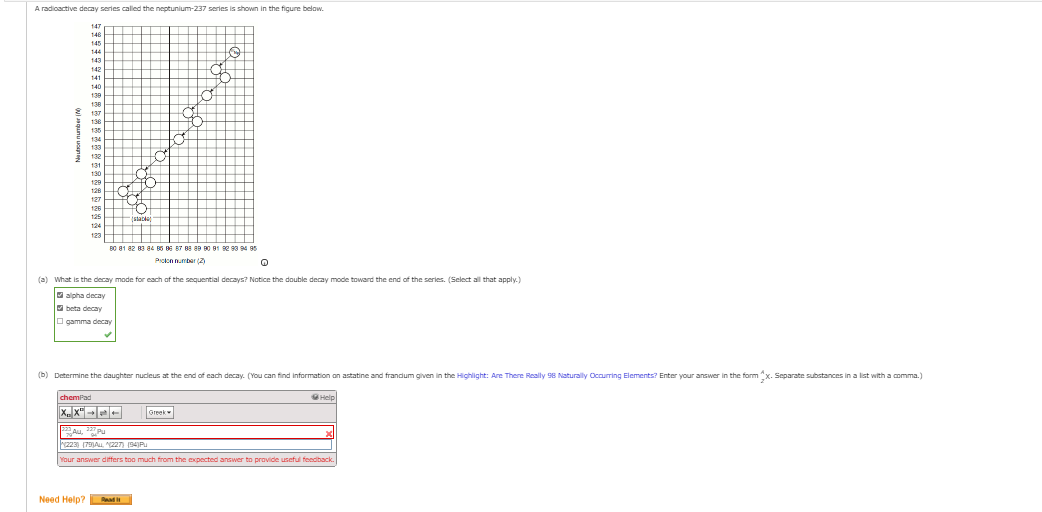
@vocaloid I'm not really sure where I get the daughter nucleus part. I know how to do decays.
 Vocaloid:
For each step look at the atomic number and atomic mass. There’s 7 steps where you have one daughter nucleus and 2 steps at the end where you have two nuclei each First step: atomic number 91 atomic mass 142 This is proctactinium 142 91 Pa (On my phone but you get the formatting)
Nerdyhuman:
So, I am confused. Will I need to find alpha and beta for all the steps or just identify the decays on the graph?
Nerdyhuman:
@vocaloid
Vocaloid:
It's just asking for daughter nuclei, so no alpha or beta particles
Nerdyhuman:
okay, so will I have 7 answers then?
Vocaloid:
hm... I'm looking at the diagram again, I think there are actually 11 daughter nuclei (I'm not sure I entirely understand the last decay step myself)
Vocaloid:
sorry I'm going to get a second opinion on this @AZ would you mind taking a look at this, I'm not 100% clear on this diagram
Nerdyhuman:
okay, thank you! I am trying where the answer splits and goes horizontal so like 9 and see if I am correct. I have a few attempts on this.
 AZ:
AZ:
It's really hard to read the image but is the question asking you to list every single daughter product formed?
AZ:
\[\begin{matrix}\text{A} \\ \text{Z}\end{matrix} X\] Z is the atomic number which is just the number of protons A is the mass number which is number of protons + neutrons
AZ:
Your graph tells you the number of neutrons on the y-axis and the number of protons on the x-axis You have to use the number of protons to find the element on the periodic table You then add the number of protons and neutrons to get A which is the mass number X is going to be the element from the periodic table that corresponds with the number of protons
AZ:
Remember: if the number of protons changes, then you get a completely different element if the number of neutrons changes, you have the same element but with different masses and they're called isotopes. If the number of electrons changes, you form ions and they can be either cations or anions depending on if you lost an electron or gained an electron respectively.
AZ:
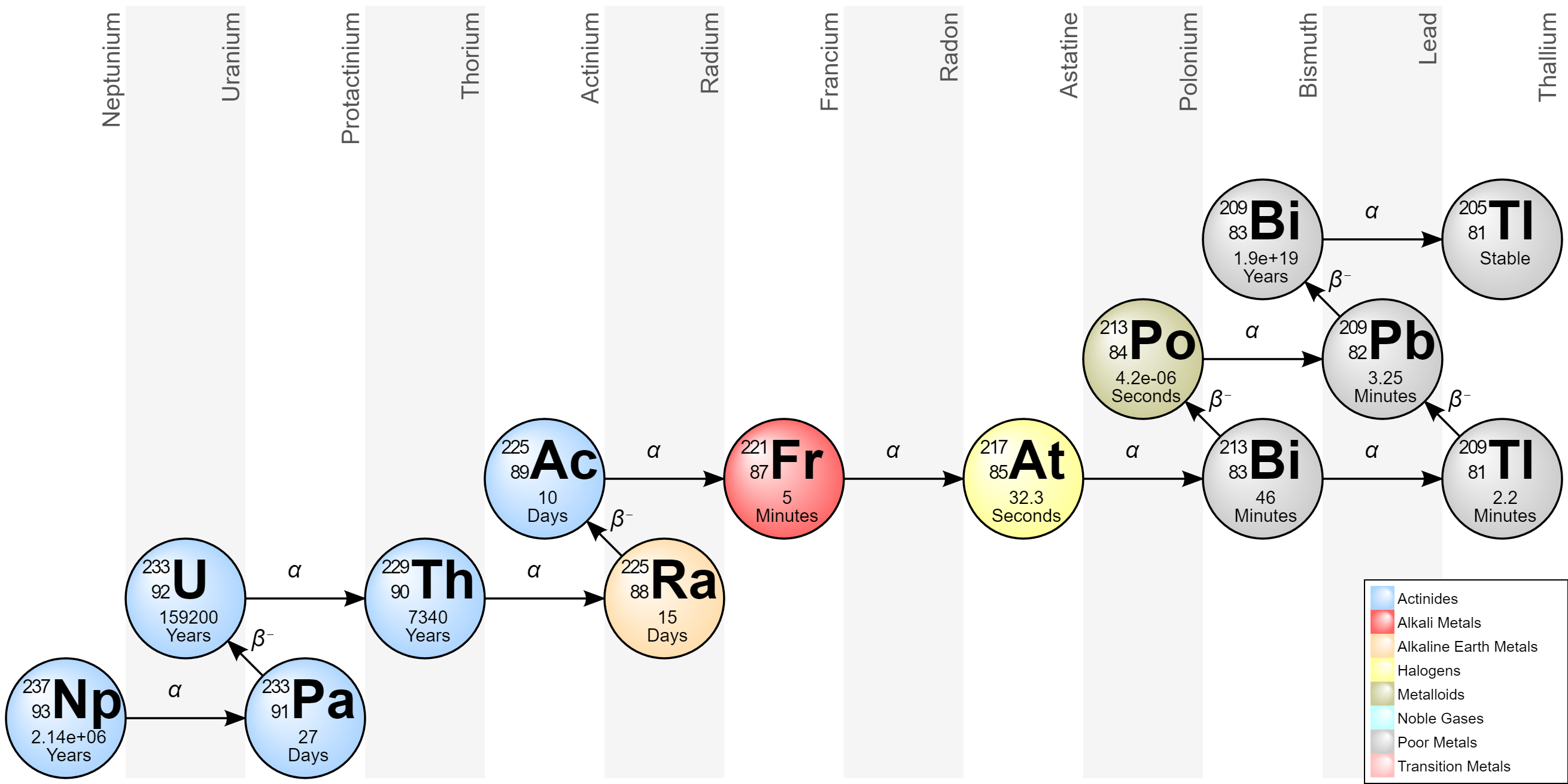
Anyway, I found a better image of neptunium-237 decay that might be easier to read and help you list them out much faster The only exception is that this diagram lists titanium-205 which isn't in your figure
 AZ:
AZ:
You won't even have to add the protons and neutrons from your figure since this image gives you it all. It even lists what sort of reaction it is (alpha or beta decay).
Join our real-time social learning platform and learn together with your friends!
VERNEISH:
Two objects are moving along separate linear paths where each path is described by position, d, and time, t.

 Maci:
what are the best stock apps for people who want to start investing?
Maci:
what are the best stock apps for people who want to start investing?
 Twaylor:
genuienly how do i get better self control i keep watcing youtube and theres this
Twaylor:
genuienly how do i get better self control i keep watcing youtube and theres this
 IzzyCookie:
|dw:1792074056138:dw| Uhm, I don't know where to ask this, but I'm in college welding at my community college, and I need help learning vertical welding for
IzzyCookie:
|dw:1792074056138:dw| Uhm, I don't know where to ask this, but I'm in college welding at my community college, and I need help learning vertical welding for

 thehearken:
not sure if this is considered spam, im sorry if it is, but does anyone have tips
thehearken:
not sure if this is considered spam, im sorry if it is, but does anyone have tips