
 Zari:
Zari:
The figure shows a pair of parallel line segments on a coordinate grid: A coordinate plane is shown. Line segment GH runs from -1 comma negative 1 to 3 comma negative 1. Line segment EF runs from negative 1 comma -2 to 3 comma negative 2. The line segments are translated 2 units to the right to form E′F′ and G′H′. Which statement describes E′F′ and G′H′? Line segments E′F′ and G′H′ do not intersect and are closer together than EF and GH. Line segments E′F′ and G′H′ intersect at (−2, 0) and are two times farther apart than EF and GH. Line segments E′F′ and G′H′ intersect at (0, −2) and are two times closer together than EF and GH. Line segments E′F′ and G′H′ do not intersect and are the same distance apart as EF and GH.
Zari:
@sailorneona
Zari:
@ilovespaghetti
 ILOVESPAGHETTI:
Could you provide a figure/ss?
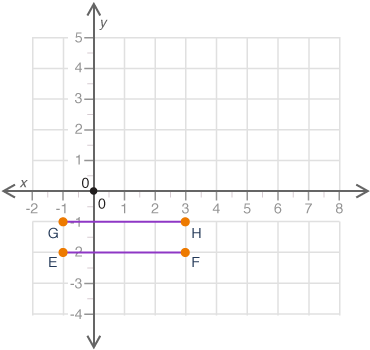
 Sailor:
Ok, these lines would not intersect because they are being moved right.
Zari:
Sailor:
So that cancels out the second and the third options.
ILOVESPAGHETTI:
They're paralle lines l I believe?
Sailor:
ILOVESPAGHETTI:
SMH parallel**
Sailor:
Now all we need to figure out is if they are the same distance apart or if they are closer together.
Zari:
Sailor:
The new coordinates for E'F' would be from (1,0) to (5,0) The new coordinates for G'H; would be from (1,1) to (5,1)
Sailor:
So, does translating these line segments 2 units to the right affect the distance apart?
Zari:
Sailor:
Ok, it doesn't because of the fact that the line segments aren't moved up or down. If they were moved up or down, it would have to be moved up or down 2 units in order for the distance to stay the same. Therefore, "Line segments E′F′ and G′H′ do not intersect and are the same distance apart as EF and GH." would be the answer.
Zari:
Sailor:
Did that help?
Zari:
Sailor:
Ok good. Glad I could help
Join our real-time social learning platform and learn together with your friends!
 VERNEISH:
Two objects are moving along separate linear paths where each path is described by position, d, and time, t.
VERNEISH:
Two objects are moving along separate linear paths where each path is described by position, d, and time, t.

 Maci:
what are the best stock apps for people who want to start investing?
Maci:
what are the best stock apps for people who want to start investing?
 Twaylor:
genuienly how do i get better self control i keep watcing youtube and theres this
Twaylor:
genuienly how do i get better self control i keep watcing youtube and theres this
 IzzyCookie:
|dw:1792074056138:dw| Uhm, I don't know where to ask this, but I'm in college welding at my community college, and I need help learning vertical welding for
IzzyCookie:
|dw:1792074056138:dw| Uhm, I don't know where to ask this, but I'm in college welding at my community college, and I need help learning vertical welding for

 thehearken:
not sure if this is considered spam, im sorry if it is, but does anyone have tips
thehearken:
not sure if this is considered spam, im sorry if it is, but does anyone have tips