
 KyledaGreat:
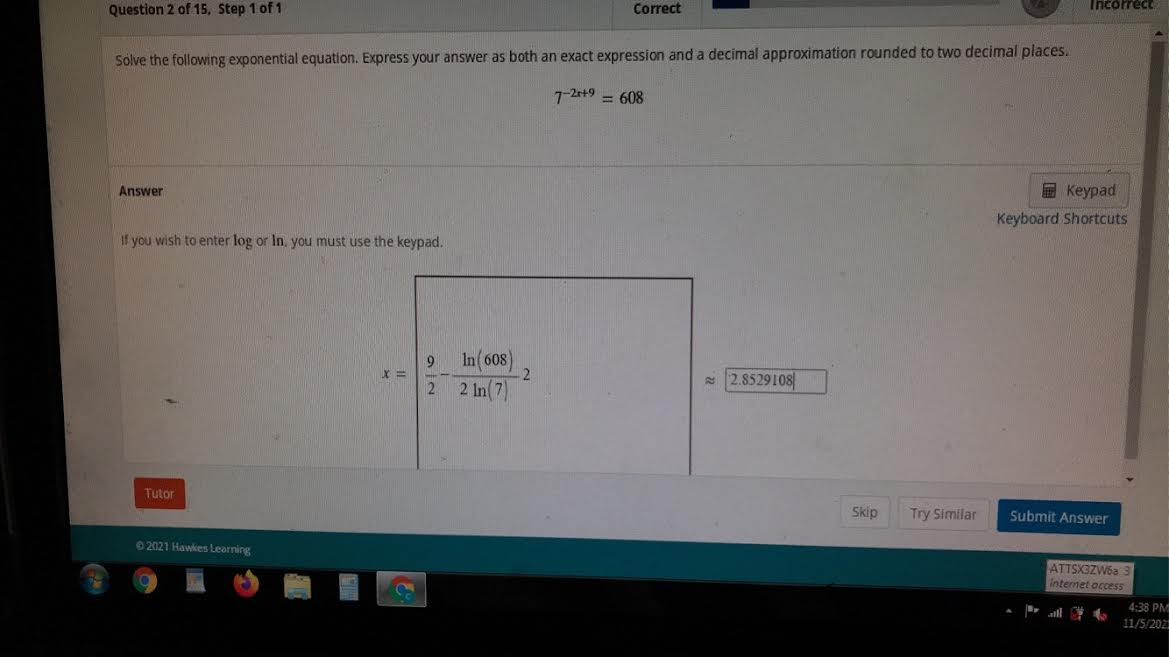
Solve the following exponential equation. Express your answer as both an exact expression and a decimal approximation rounded to two decimal places. 7^−2x+9 = 608
 KyledaGreat:
@vocaloid
 Vocaloid:
two things - there's an extra 2 at the end that shouldn't be there I assume you got to this part correctly -2x = ln(608)/ln(7) - 9 dividing both sides by -2 gives us x = 9/2 - ln(608)/ (2 * ln(7)) also, it says to round to 2 decimal places, so 2.8529108 needs to be rounded to 2.85
KyledaGreat:
do it what i have on the left is right ?
Vocaloid:
you need to get rid of that last 2 at the end, then it's right
KyledaGreat:
oh i'm sorry you right
KyledaGreat:
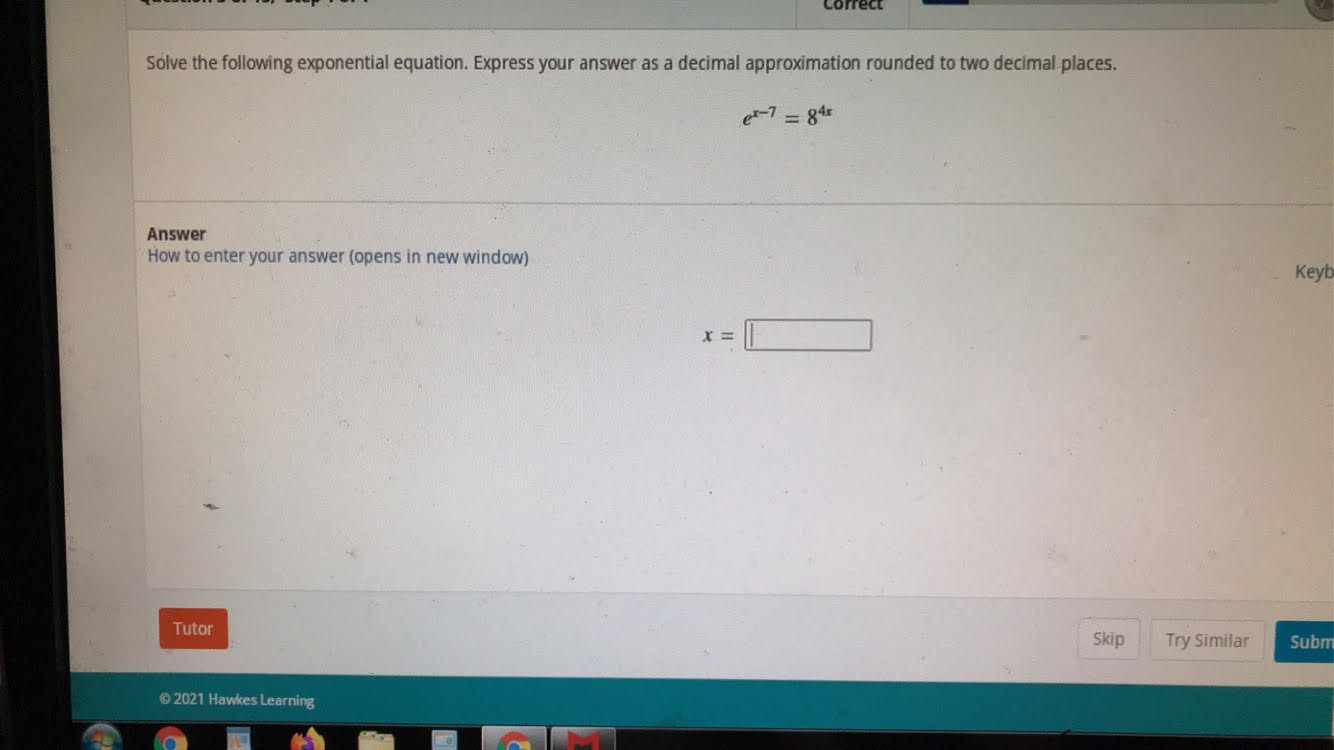
Solve the following exponential equation. Express your answer as a decimal approximation rounded to two decimal places. e^x−7 = 84x x = __________
Vocaloid:
is the x in 84 x also an exponent?
KyledaGreat:
yes
 Vocaloid:
e^(x-7) = 8^(4x) taking the natural log of both sides will eliminate the e on the left side and give us ln(8^(4x)) on the right side x - 7 = ln ( 8^(4x) ) using our log rules, you can bring that 4x down from inside the log, to right in front of the log x - 7 = 4x * ln(8) can you take it from here? move your x terms to one side, factor out x, solve for x
KyledaGreat:
x - xln (2097152)
Vocaloid:
hm? how did you get this answer?
KyledaGreat:
by simplifying
Vocaloid:
would recommend reviewing how to solve 1-variable equations when you get a chance from here: x - 7 = 4x * ln(8) we can move our x-terms to one side by subtracting 4x*ln(8) from both sides we can also add 7 to both sides to move the 7 to the other side, giving us: x - 4x(ln8) = 7 factoring out x x(1-4ln(8)) = 7 dividing both sides by (1-4ln(8)) x = 7/(1-4ln(8))
KyledaGreat:
-0.95657606987
Vocaloid:
yeah just remember to round to 2 places
KyledaGreat:
-0.95 ?
Vocaloid:
review rounding when you get a chance -0.956... look at the 2nd decimal place. then we look at the next number, 6. because 6 is greater than 5, we round up to -0.96
KyledaGreat:
oh i see
KyledaGreat:
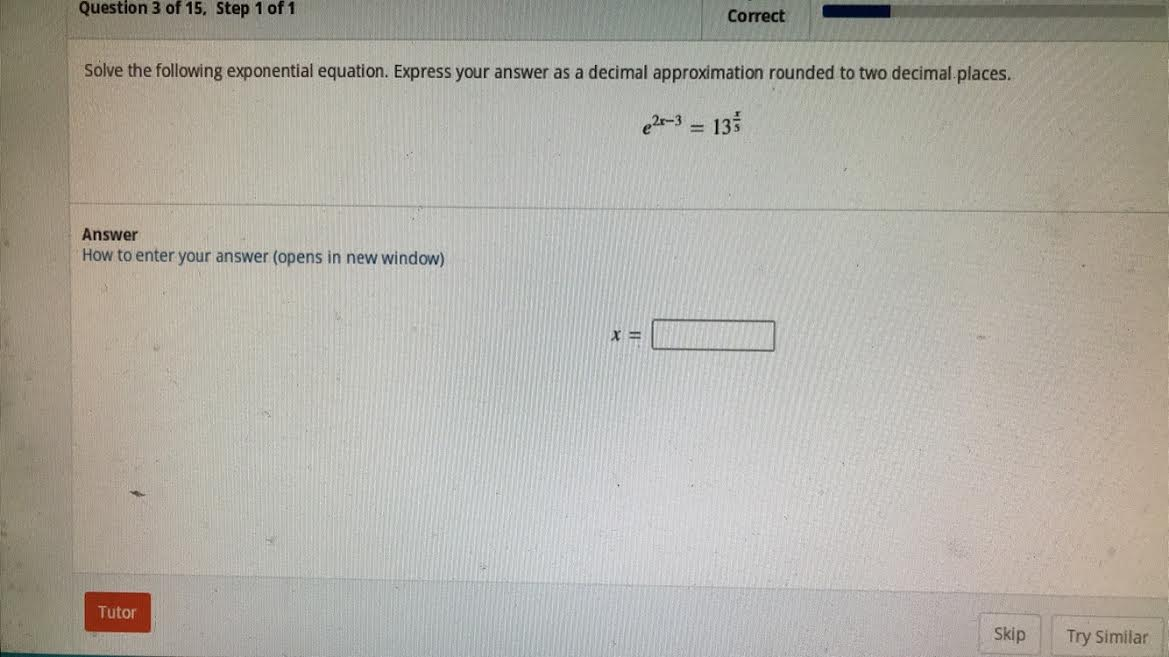
Solve the following exponential equation. Express your answer as a decimal approximation rounded to two decimal places. e^2x−3 = 13^x/5
KyledaGreat:
x = 2.01747112
Vocaloid:
good, but remember to round to 2 places 2.017 ---> 7 is greater than 5 so we round up to 2.02
 KyledaGreat:
just you can see how it looks
Join our real-time social learning platform and learn together with your friends!
 VERNEISH:
Two objects are moving along separate linear paths where each path is described by position, d, and time, t.
VERNEISH:
Two objects are moving along separate linear paths where each path is described by position, d, and time, t.

 Maci:
what are the best stock apps for people who want to start investing?
Maci:
what are the best stock apps for people who want to start investing?
 Twaylor:
genuienly how do i get better self control i keep watcing youtube and theres this
Twaylor:
genuienly how do i get better self control i keep watcing youtube and theres this
 IzzyCookie:
|dw:1792074056138:dw| Uhm, I don't know where to ask this, but I'm in college welding at my community college, and I need help learning vertical welding for
IzzyCookie:
|dw:1792074056138:dw| Uhm, I don't know where to ask this, but I'm in college welding at my community college, and I need help learning vertical welding for

 thehearken:
not sure if this is considered spam, im sorry if it is, but does anyone have tips
thehearken:
not sure if this is considered spam, im sorry if it is, but does anyone have tips