
 KyledaGreat:
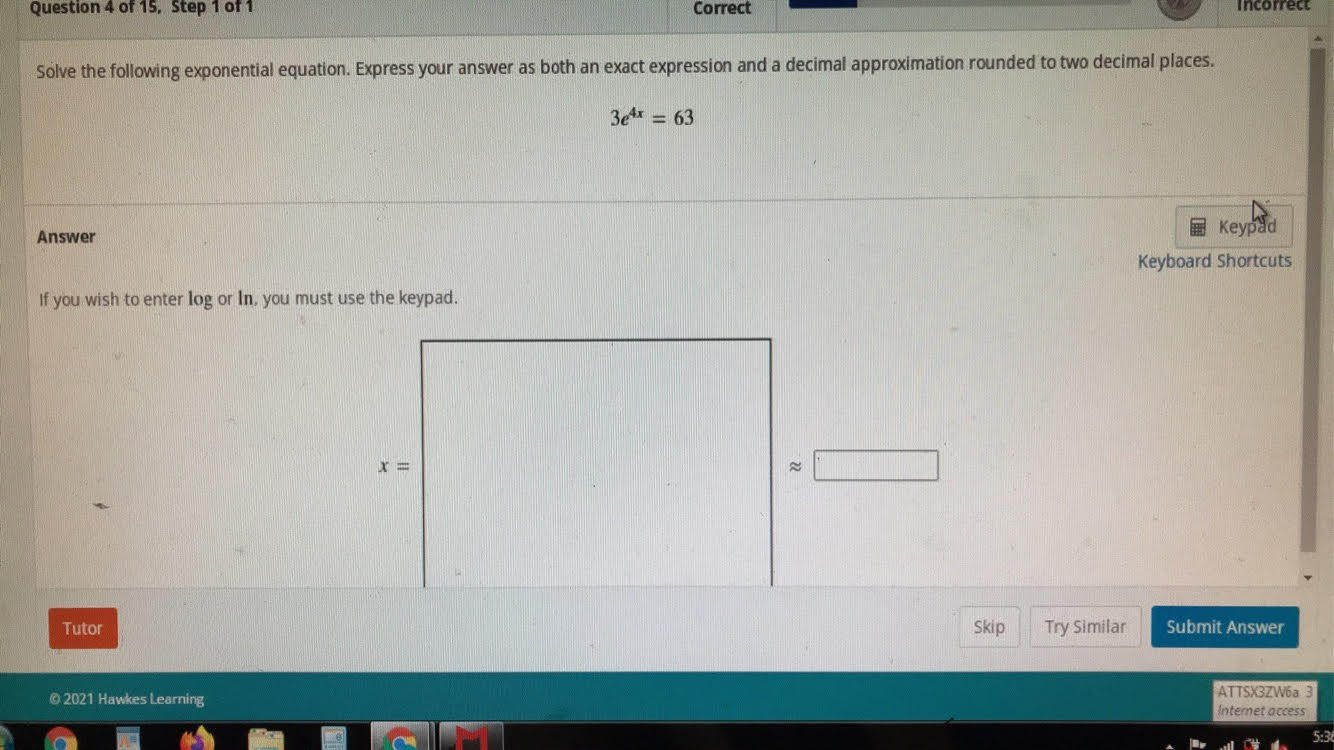
Solve the following exponential equation. Express your answer as both an exact expression and a decimal approximation rounded to two decimal places. 3e^4x = 63
KyledaGreat:
If you wish to enter log or ln, you must use the keypad. x = _____________ ≈ __________
 Vocaloid:
is it 3e^(4x) = 6^3? or 63? or can you take a screencap?
 Vocaloid:
this one is one of the simpler ones divide both sides by 3 e^(4x) = 63/3 take the natural log of both sides to eliminate e, divide both sides by 4 to isolate x
KyledaGreat:
x = ln(21)/4
Vocaloid:
perfect for the decimal part, we can just chug it into a calculator and get x = 0.76113 which rounds to 0.76
 KyledaGreat:
Solve the following logarithmic equation. Express your answer as either an exact expression or a decimal approximation rounded to four decimal places. If there is no solution, indicate "No Solution (∅)." log_6(x−4)+log_6(x+1)=log_6(x+3) If you wish to enter log or ln, you must use the keypad. If there is more than one solution, separate your answers with a comma. Selecting a radio button will replace the entered answer value(s) with the radio button value. If the radio button is not selected, the entered answer is used. x = ____________________ No Solution (∅)
Vocaloid:
log rules - when you have two logs of the same base being added together, you can combine them, multiplying what's inside in other words: log_6(x−4)+log_6(x+1) ---> combine these two log base 6, multiply what's inside both logs ---> log_6( (x-4)*(x+1) ) setting both sides equal again log_6( (x-4)*(x+1) ) = log_6(x+3) notice how you have the same log base 6 on both sides, so you can raise both sides to the base of 6 and eliminate all the logs (x-4)(x+1) = (x+3) FOIL the left side, combine terms, either factor or use the quadratic formula to get your x-values
KyledaGreat:
\[x = 2 + {\sqrt{11}}\]
Vocaloid:
almost, for this quadratic equation we have 2 solutions (when you use the quadratic formula there's a +/- sign) x = 2 + sqrt(11) and x = 2 - sqrt(11)
KyledaGreat:
that's true
KyledaGreat:
it said wrong The answer you submitted, 2+√11,2−√11, is incorrect. It appears you have correctly used the quadratic formula to calculate possible solutions, but have made an error substituting these values back into log_6(x−4)+log_6(x+1)=log_6(x+3) to check them. You may wish to check your work. For a step-by-step guide to solving this problem, select Step By Step.
KyledaGreat:
i can still do it
Vocaloid:
ahh sorry, I forgot - logs can only take positive values in their input 2 - sqrt(11) doesn't work because it would make log(x+1) negative so it's only 2 + sqrt(11)
KyledaGreat:
it's okay
KyledaGreat:
correct
KyledaGreat:
another one is the same but different
KyledaGreat:
Solve the following logarithmic equation. Express your answer as either an exact expression or a decimal approximation rounded to four decimal places. If there is no solution, indicate "No Solution (∅)." log_4(x+1)−log_4(x−1)=2
KyledaGreat:
x = 17/15
KyledaGreat:
is that right
Vocaloid:
yup that's what I got too
KyledaGreat:
i knew it
KyledaGreat:
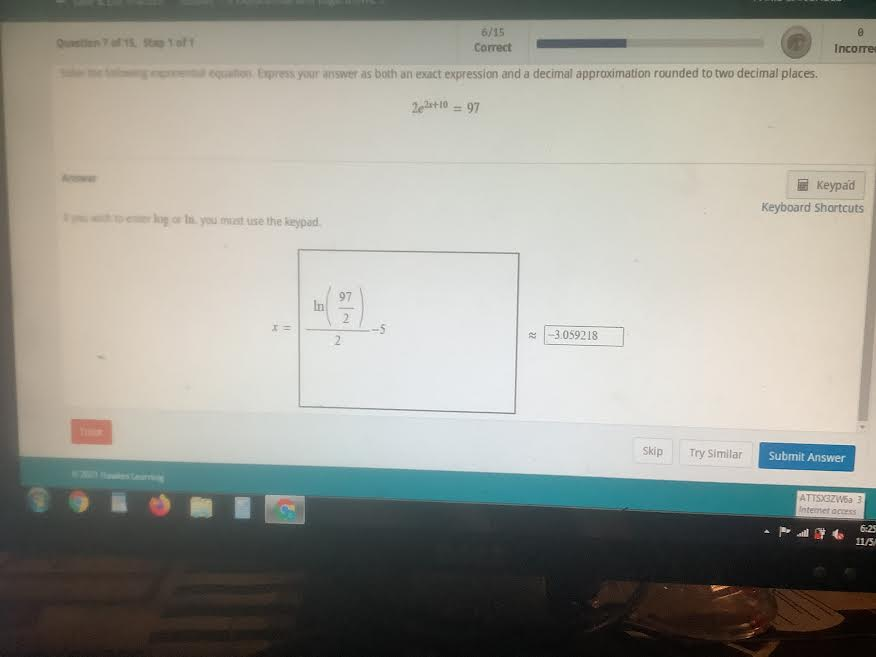
Solve the following exponential equation. Express your answer as both an exact expression and a decimal approximation rounded to two decimal places. 2^e2x + 10 = 97 x = _____________ ≈ __________ ln(97/2) / 2 -5 ≈ __________ -3.05921810
Vocaloid:
can you take a screengrab of the equation?
KyledaGreat:
ummm i don't think so , my phone acting stupid but i could try
Vocaloid:
can you try adding parentheses around the exponents? I just need to know what's in the exponent or not
KyledaGreat:
right , of course. excuse me one moment
 KyledaGreat:
i'm sorry if it's blurry , i had to use an ipad
KyledaGreat:
i tried to focus it
Vocaloid:
good just remember to round to 2 places -3.059 rounds up to -3.06
KyledaGreat:
Solve the following logarithmic equation. Express your answer as either an exact expression or a decimal approximation rounded to four decimal places. If there is no solution, indicate "No Solution (∅)." ln(x−4)=ln(5x)
Vocaloid:
they're both ln, so you can raise both sides to base e and eliminate the logs (x-4) = 5x, should be straightforward from there
KyledaGreat:
i think it's no solution
Vocaloid:
good, since x is negative ln(5x) becomes undefined, so that's correct
KyledaGreat:
Solve the following logarithmic equation. Express your answer as either an exact expression or a decimal approximation rounded to four decimal places. If there is no solution, indicate "No Solution (∅)." log_3(2x−5)+log_3(x)=log_3(5)
KyledaGreat:
\[x = \frac{ 5 + \sqrt{65}}{ 4}\]
Vocaloid:
good
KyledaGreat:
Solve the following exponential equation. Express your answer as both an exact expression and a decimal approximation rounded to two decimal places. Use e=2.71828182845905. e^2x+3 = 4^3x/7 x = _____________ ≈ __________
KyledaGreat:
-x = -21/14-ln(64) -2.13390412 are these right
Vocaloid:
yeah just make sure to round to -2.13
KyledaGreat:
Solve the following exponential equation. Express your answer as both an exact expression and a decimal approximation rounded to two decimal places. Use e=2.71828182845905. e^2x−2 = 132^4x+8 x = _____________ ≈ __________
KyledaGreat:
-x = -1+4 ln(132)/2ln(132) - 1 -2.34224681
Vocaloid:
I think you made a sign error in the left part should be -1 - 4ln(132) in the numerator other than that, good, make sure to round the decimal part -2.34
KyledaGreat:
okay you might be right
KyledaGreat:
no , i was right with the +
KyledaGreat:
Damon is saving up money for a down payment on a motorcycle. He currently has $5371, but knows he can get a loan at a lower interest rate if he can put down $6197. If he invests the $5371 in an account that earns 4.2% annually, compounded monthly, how long will it take Damon to accumulate the $6197? Round your answer to two decimal places, if necessary.
Vocaloid:
A = P(1 + r/n)^(nt) P is the principal (5371), r is the interest rate as a decimal (4.2%, so r = 0.042), n is the # of times compounded per year (monthly compounding, so n = 12), t is time (which you'll solve for). plug in and solve for t.
Vocaloid:
oh right, since he wants $6197, set A = 6197
KyledaGreat:
6197 years ?
Vocaloid:
no, t is time which is what you want to solve for. A is the amount he wants. set A = 6197 in the equation and solve for t.
KyledaGreat:
Oh sorry
KyledaGreat:
how could i set it up
KyledaGreat:
A = 6197 and 12 is the time right
Vocaloid:
the problem is asking how long the account will take to reach 6197, which means time is unknown, meaning you need to solve for t A = P(1 + r/n)^(nt) A = the final amount = 6197 P = principal = 5371 r = interest rate = 0.042 n = # of times compounded per year = 12 plug these in and solve for t
KyledaGreat:
5371(1 + 0.042/12)^(12t) ?
KyledaGreat:
is that right ?
Vocaloid:
yeah but you'd set that equal to the A-value, 6197 6197 = 5371(1 + 0.042/12)^(12t)
KyledaGreat:
oh okay
KyledaGreat:
t = 3.41193778
Vocaloid:
good just make sure to round to 3.41
KyledaGreat:
Tyron is saving up money for a down payment on a motorcycle. He currently has $3256, but knows he can get a loan at a lower interest rate if he can put down $3988. If he invests the $3256 in an account that earns 5.6% annually, compounded continuously, how long will it take Tyron to accumulate the $3988? Round your answer to two decimal places, if necessary.
Vocaloid:
continuous compounding is a bit different, there's a different formula A = Pe^(rt) A is the final amount (3988), P is the principal (3256), r is the interest rate (0.056), e is euler's constant, t is time, solve for t
KyledaGreat:
A = P(1 + r/n)^(nt) A = the final amount = 3988 P = principal = 3256 r = interest rate = 0.056
KyledaGreat:
3988 = 3256(1 + 0.056/12)^(12t)
Vocaloid:
this is a continuous compounding problem, so the formula is different
KyledaGreat:
3988 = 3256e^(0.056t) is that right
Vocaloid:
yes
KyledaGreat:
t = 3.62125721
KyledaGreat:
is that right
Vocaloid:
yeah just be sure to round to 3.62
KyledaGreat:
In chemistry, the pH of a solution is a measure of the acidity or alkalinity of a solution. Water has a pH of 7 and, in general, acids have a pH less than 7 and alkaline solutions have a pH greater than 7. Find the pH of a solution with a hydronium ion concentration of 5.1×10^−6 moles/liter. Round your answer to two decimal places, if necessary. pH =
Vocaloid:
pH is -log(hydronium concentration), so it's just -log(5.1×10^−6), plug into a calculator and round appropriately
Join our real-time social learning platform and learn together with your friends!
 VERNEISH:
Two objects are moving along separate linear paths where each path is described by position, d, and time, t.
VERNEISH:
Two objects are moving along separate linear paths where each path is described by position, d, and time, t.

 Maci:
what are the best stock apps for people who want to start investing?
Maci:
what are the best stock apps for people who want to start investing?
 Twaylor:
genuienly how do i get better self control i keep watcing youtube and theres this
Twaylor:
genuienly how do i get better self control i keep watcing youtube and theres this
 IzzyCookie:
|dw:1792074056138:dw| Uhm, I don't know where to ask this, but I'm in college welding at my community college, and I need help learning vertical welding for
IzzyCookie:
|dw:1792074056138:dw| Uhm, I don't know where to ask this, but I'm in college welding at my community college, and I need help learning vertical welding for

 thehearken:
not sure if this is considered spam, im sorry if it is, but does anyone have tips
thehearken:
not sure if this is considered spam, im sorry if it is, but does anyone have tips