
 KyledaGreat:
Find (f∘g)(2) for the following functions. f(x)=x^3+x^2 and g(x)=x^2−5 (f∘g)(2) =
KyledaGreat:
@vocaloid
 Vocaloid:
(f∘g)(2) first calculate g(2) by plugging x = 2 into g(x) = x^2−5 take the end value from that, plug that into f(x)
KyledaGreat:
g(2) = x^2 - 5
KyledaGreat:
= -1
KyledaGreat:
f(-1) = x^2-5 ?
Vocaloid:
check your math again f(x)=x^3+x^2 f(-1) = (-1)^3 + (-1)^2 = -1 + 1 = 0
KyledaGreat:
f(x)=|x| and g(x)=x^2/3 Find the formula for (f/g)(x) and simplify your answer. (f/g)(x) =
Vocaloid:
you have to enter an absolute value sign for this one f(x)=|x| g(x) = x^2 - 3 so f/g is simply \[\frac{ |x| }{ x^{2}-3 }\]
KyledaGreat:
that's not right
Vocaloid:
ah sorry g(x) is x^(2/3) \[\frac{ |x| }{ x^{2/3} }\] please check to make sure the denominator matches your g(x)
KyledaGreat:
that's right
KyledaGreat:
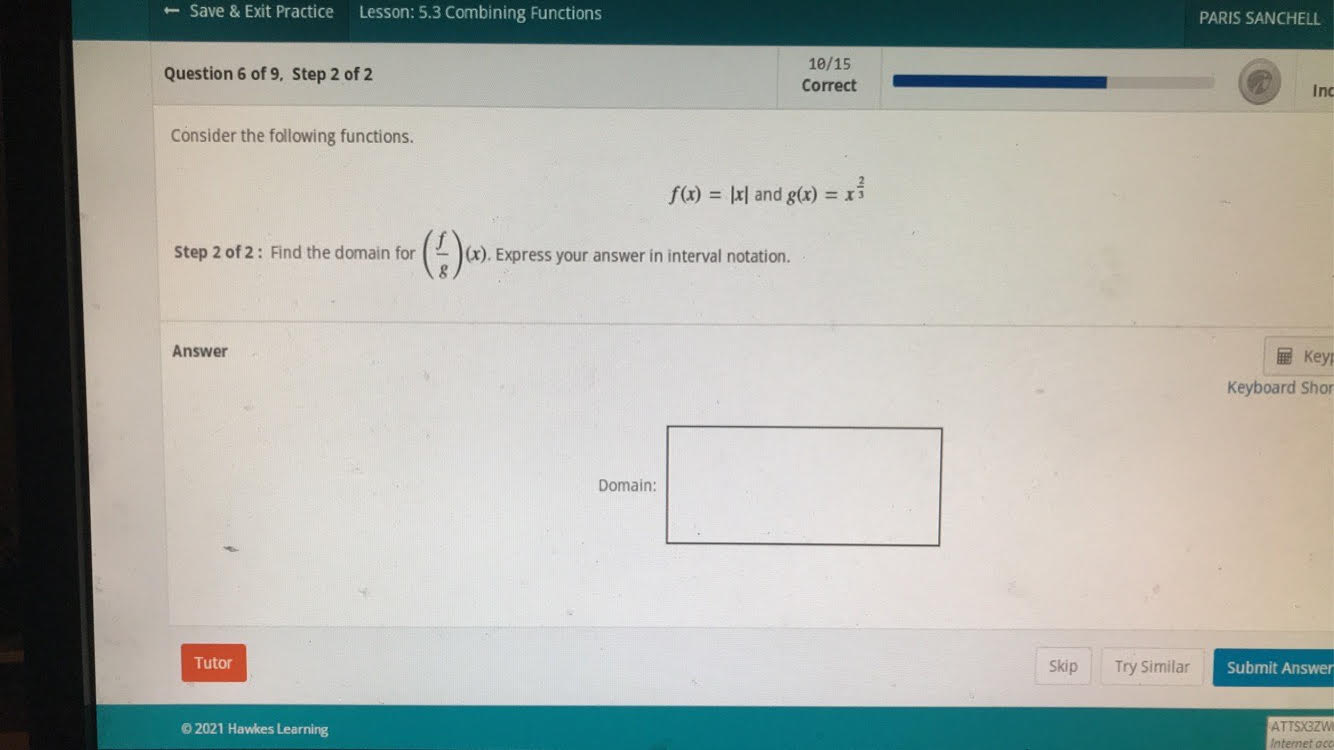
Consider the following functions. f(x)=|x| and g(x)=x^2/3 Find the domain for (fg)(x). Express your answer in interval notation.
Vocaloid:
fg(x) is f multiplied with g so fg is simply |x| * (x^2/3) |x| has no restrictions on domain because you can enter any x-value into it x^(2/3) is a bit different. we can re-write this as \[\sqrt[3]{x^{2}}\] the inside of the square root must be at least 0, so x must be at least 0
KyledaGreat:
i thought it was (-∞, ∞)
Vocaloid:
yeah nvm that's right, you can enter any value into x^(2/3) so there are no restrictions on domain
KyledaGreat:
mines wasn't right
KyledaGreat:
it says interval notation in domain
Vocaloid:
what did you enter? this? (-∞, ∞)
KyledaGreat:
yes
Vocaloid:
can you take a screengrab of the problem
KyledaGreat:
okay
 Vocaloid:
ohh there was a division sign because x^(2/3) is in the denominator, x^(2/3) cannot be 0, and thus x cannot be 0 so the domain is every value *except* 0 or (-∞, 0) ∪ (0, ∞)
KyledaGreat:
the last one was right
KyledaGreat:
Find (f∘g)(1) for the following functions. Round your answer to two decimal places, if necessary. \[f(x) = \sqrt{x+3} \] and \[g(x) = 4 + \sqrt{x}\]
Vocaloid:
(f∘g)(1) calculate g(1) by plugging in x = 1 into g(x) then take the end result from that, plug it into f(x)
KyledaGreat:
6
Vocaloid:
check your arithmetic again g(1) = 4 + sqrt(1) = 5 f(5) = sqrt(5 + 3) = sqrt(8) = 2sqrt(2)
KyledaGreat:
okay the answer is 8
Vocaloid:
no, not just 8, it's sqrt(8) or 2.82 rounded
KyledaGreat:
they won't allow me sqrt8
Vocaloid:
you can convert it to a decimal, which would be 2.83
KyledaGreat:
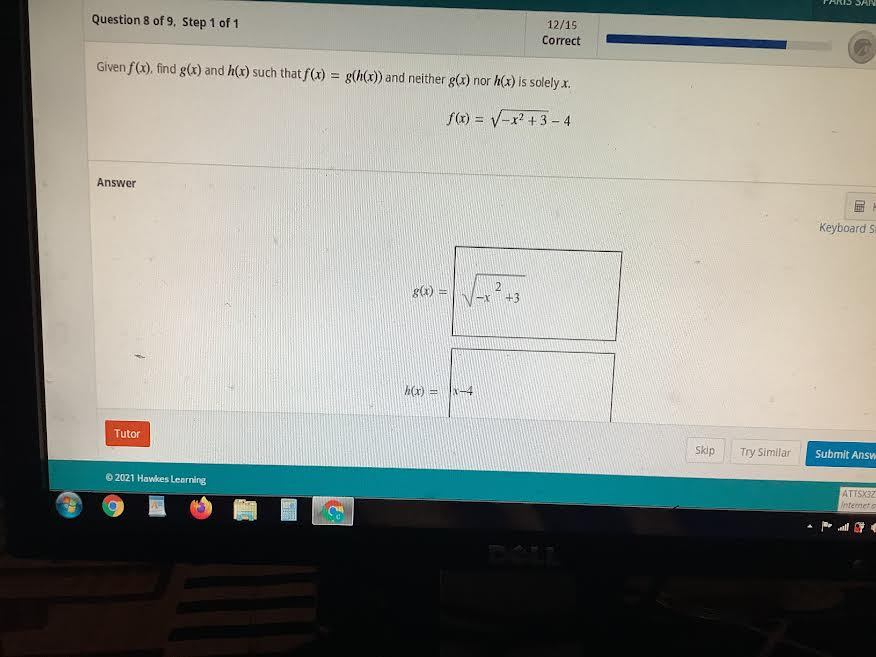
Given f(x), find g(x) and h(x) such that f(x)=g(h(x)) and neither g(x) nor h(x) is solely x. \[f(x) = \sqrt{-x^2 + 3} - 4\]
KyledaGreat:
g(x) = h(x) =
Vocaloid:
think of the whole function as being made of two parts sqrt(-x^2 + 3) and the -4 part if we let h(x) = \[\sqrt{-x^{2}+3}\]then we can simply let g(x) = x - 4 to get f(x) = g(h(x)) = \[\sqrt{-x^{2}+3}-4\]
KyledaGreat:
it's not working
Vocaloid:
did you enter h(x) = sqrt(-x^2 + 3) and g(x) = x - 4
KyledaGreat:
yes but it said try again
Vocaloid:
is the function you typed exactly as it appears in the problem?
KyledaGreat:
yes i'll send a pic
 Vocaloid:
the order matters, you swapped h and g
KyledaGreat:
oh i'm sorry
KyledaGreat:
no wonder it was wrong
KyledaGreat:
Consider the following functions. \[f(x) = \sqrt{x+2} \] and \[g(x) = \frac{ x+2 }{ 3 }\] Find the formula for (f∘g)(x) and simplify your answer. Then find the domain for (f∘g)(x). Round your answer to two decimal places, if necessary.
KyledaGreat:
(f∘g)(x) = Domain =
KyledaGreat:
Domain : [-8, ∞)
KyledaGreat:
if i'm right
Vocaloid:
domain looks good what did you get as the function?
KyledaGreat:
i didn't get one , i tried to solve it but it didn't look like it
Vocaloid:
remember, (f∘g)(x) means take g(x), plug it into f(x) g(x) = (x+2) / 3 now take f(x) = sqrt(x+2), plug in x = (x+2) / 3, simplify
KyledaGreat:
f(x) = sqrt(x+2) / 3 like this ?
Vocaloid:
\[f(x) = \sqrt{x+2} \] and \[g(x) = \frac{ x+2 }{ 3 }\] plugging in g(x) into f(x) gives us \[f(g(x))=\sqrt{\frac{ x+2 }{ 3 }+2}\] simplify
KyledaGreat:
f = sqrt3(x + 8)/3gx
Vocaloid:
your solution should not have the letter g in it anywhere, just x's. review operations with fractions when you get a chance. \[f(g(x))=\sqrt{\frac{ x+2 }{ 3 }+2}\] \[f(g(x))=\sqrt{\frac{ x+2 }{ 3 }+\frac{ 2*3 }{ 3 }}\] \[f(g(x))=\sqrt{\frac{ x+2 }{ 3 }+\frac{ 6 }{ 3 }}\] combining the fractions \[f(g(x))=\sqrt{\frac{ x+2+6 }{ 3 }}\] distributing \[f(g(x))=\sqrt{\frac{ x+8 }{ 3 }}\]
KyledaGreat:
oh okay , i see your point
KyledaGreat:
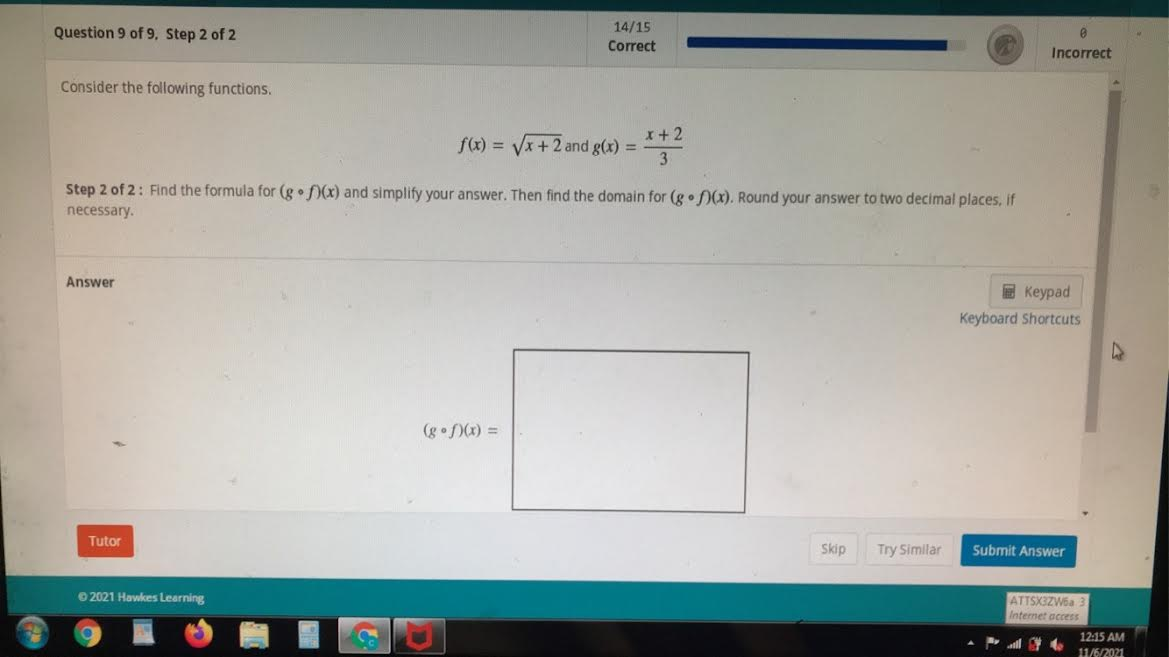
Consider the following functions. f(x)= √x+2 and g(x)=x+2/3 Find the formula for (g∘f)(x) and simplify your answer. Then find the domain for (g∘f)(x). Round your answer to two decimal places, if necessary.
KyledaGreat:
(g∘f)(x) = Domain =
Vocaloid:
similar logic, but make sure to pay attention to the order: because it's (g∘f)(x) (with g first) it means you take f(x) and plug it into g(x).
KyledaGreat:
Domain : [-8, ∞)
KyledaGreat:
(g∘f)(x) = f(g(x)) = x+5/3
Vocaloid:
your square root sign shouldn't have disappeared when you plugged f(x) into g(x)
Vocaloid:
also can you take a screengrab of this problem
 Vocaloid:
ok, so let's start with g(x) \[g(x)=\frac{ x+2 }{ 3 }\] now, let's replace that x, by plugging in f(x) = sqrt(x+2) where the x is \[g(f(x))=\frac{ \sqrt{x+2}+2 }{ 3 }\]
Vocaloid:
can you try finding the domain from that? remember that square root of something must be 0 or greater
KyledaGreat:
[-2, ∞)
Vocaloid:
good
Join our real-time social learning platform and learn together with your friends!
 VERNEISH:
Two objects are moving along separate linear paths where each path is described by position, d, and time, t.
VERNEISH:
Two objects are moving along separate linear paths where each path is described by position, d, and time, t.

 Maci:
what are the best stock apps for people who want to start investing?
Maci:
what are the best stock apps for people who want to start investing?
 Twaylor:
genuienly how do i get better self control i keep watcing youtube and theres this
Twaylor:
genuienly how do i get better self control i keep watcing youtube and theres this
 IzzyCookie:
|dw:1792074056138:dw| Uhm, I don't know where to ask this, but I'm in college welding at my community college, and I need help learning vertical welding for
IzzyCookie:
|dw:1792074056138:dw| Uhm, I don't know where to ask this, but I'm in college welding at my community college, and I need help learning vertical welding for

 thehearken:
not sure if this is considered spam, im sorry if it is, but does anyone have tips
thehearken:
not sure if this is considered spam, im sorry if it is, but does anyone have tips