
 KyledaGreat:
Donnie is saving up money for a down payment on a motorcycle. He currently has $4086, but knows he can get a loan at a lower interest rate if he can put down $4962. If he invests the $4086 in an account that earns 5.9% annually, compounded monthly, how long will it take Donnie to accumulate the $4962? Round your answer to two decimal places, if necessary.
KyledaGreat:
@vocaloid
 xXQuintonXx:
@darkknight
 Vocaloid:
Compound interest formula A = P(1 + r/n)^(nt) P is your principal (4086), r is interest rate (0.059), n is the number of times compounded per year (it compounds monthly, so n = 12), A is the final amount (4962) and t is time. plug in and solve for t.
KyledaGreat:
A = P(1 + r/n)^(nt) 4962 = 4086(1 + 0.059/12)^(12t) right ?
Vocaloid:
yes
KyledaGreat:
t = ln(827/681) / 12ln (1.004916)
Vocaloid:
4962/4086 = (1 + 0.059/12)^(12t) take the ln of both sides ln(4962/4086) = ln((1 + 0.059/12)^(12t)) bring the 12t down ln(4962/4086) = 12t * ln((1 + 0.059/12) divide both sides by 12 * ln((1 + 0.059/12) t = ln(4962/4086) / (12 * ln((1 + 0.059/12)) = about 3.30
KyledaGreat:
Consider the following functions. \[f(x) = \sqrt[3]{x}\] and \[g(x) = \sqrt{x-1}\] Find the formula for (f+g)(x) and simplify your answer. Then find the domain for (f+g)(x). Round your answer to two decimal places, if necessary.
Vocaloid:
add the two functions (it just ends up being cube root x + sqrt(x-1), you can't really simplify further than that) for the domain, there's no restrictions on the cube root part, but the part inside the square root must be at least 0
KyledaGreat:
f(sqrtx-1) = 6sqrtx-1\[f({\sqrt{x-1}}) = \sqrt[6]{x-1}\]
Vocaloid:
you cannot combine different roots like that it's just f(x) + g(x) = \[\sqrt{x}+\sqrt[3]{x-1}\] that's it, you cannot combine a square root and a cube root
KyledaGreat:
Domain : [1, ∞)
KyledaGreat:
oh i see
Vocaloid:
domain is correct
Vocaloid:
*correction on my previous work
Vocaloid:
I swapped the roots it's just f(x) + g(x) = \[\sqrt{x-1}+\sqrt[3]{x}\]
KyledaGreat:
Find the formula for (f/g)(x) and simplify your answer. Then find the domain for (f/g)(x). Round your answer to two decimal places, if necessary.
KyledaGreat:
it's the same problem
Vocaloid:
\[f(x) = \sqrt[3]{x}\] and \[g(x) = \sqrt{x-1}\] so (f/g)(x) is simply \[\frac{ \sqrt[3]{x} }{ \sqrt{x-1} }\], that's really as far as you can simplify due to the different roots for domain: remember two things: the square root cannot be negative, **and** the denominator cannot be 0. be sure to consider both factors when determining your domain.
KyledaGreat:
Domain : [1, ∞)
Vocaloid:
not quite because the denominator cannot be 0, that means x cannot be 1 therefore, (1, infinity) with an open bracket around the 1
KyledaGreat:
oh okay
KyledaGreat:
Find (f∘g)(−2) for the following functions. f(−13)=11 and g(−2)=−13
Vocaloid:
(f∘g)(−2) means f(g(-2)), which means we take the value of g at -2, then we take that value and plug it into f(x) g(-2) = -13 so f(g(-2)) = f(-13), which the problem already says f(-13) = 11, so (f∘g)(−2) = 11
KyledaGreat:
Consider the following functions. f={(−4,0),(1,−1),(−3,4)} and g={(−2,1),(0,2),(1,−4)} Find (f+g)(1).
Vocaloid:
f(1) means the value of f for x = 1 let's look at the list of points in f={(−4,0),(1,−1),(−3,4)} (1,-1) is the point we want, since this is where x = 1. (1,-1) means x = 1 and f(x) = -1. so f(1) = -1. now, using this same logic, find g(1) by looking at the list of points in g. then add f(1) and g(1).
KyledaGreat:
g(1) = 2
Vocaloid:
hmm not quite, let's look at the points in g g={(−2,1),(0,2),(1,−4)} since we want g(1), we look at (1,-4), which means g(1) = -4 not 2 so if f(1) = -1 and g(1) = -4 then (f+g)(1) = -1 - 4 = -5
KyledaGreat:
Consider the following functions. f={(1,−1),(−3,−2)} and g={(−2,0),(0,1),(1,3),(4,−2)} Find (f−g)(1).
KyledaGreat:
f(1) = -2 g(1) = -2
Vocaloid:
f contains the point (1,-1) so f(1) = -1 g contains the point (1,3) so g(1) = 3 so f(1) - g(1) = -1 - 3 = -4
KyledaGreat:
Consider the following functions. f={(1,−1),(−3,−2)} and g={(−2,0),(0,1),(1,3),(4,−2)} Find (fg)(1).
KyledaGreat:
f(1) = -1 g(1) = 3
KyledaGreat:
if i'm not mistaken
Vocaloid:
yup so for (fg)(1) you would just multiply them, (-1)(3) = -3
KyledaGreat:
Consider the following functions. f={(1,−1),(−3,−2)} and g={(−2,0),(0,1),(1,3),(4,−2)} Find (f/g)(1).
KyledaGreat:
i believe the answer is -2 ?
Vocaloid:
(f/g)(1) means divide f(1)/g(1) f(1) = -1 g(1) = 3 so (f/g)(1) = -1/3
KyledaGreat:
Given f(x), find g(x) and h(x) such that f(x)=g(h(x)) and neither g(x) nor h(x) is solely x. \[f(x) = \frac{ 2 }{ -x+3 }\] g(x) = h(x) =
Vocaloid:
when you have a function f(x) = a/b (one part divided by another part) you can make h(x) the bottom part (-x+3) and g(x) can be the top part/x (so 2/x) that way, when you take g(h(x)), you'll get the top part/bottom part
KyledaGreat:
3, 0
Vocaloid:
you're looking for functions here. g(x) and h(x) are functions, not just numbers. like I said, when you have a function f(x) = a/b (notice how we have f(x) = 2/(-x+3), so it fits the pattern we make h(x) = -x + 3 and g(x) = 2/x so that when we take g(h(x)), we get 2/(-x+3)
KyledaGreat:
oh ok
KyledaGreat:
Find (f∘g)(4) for the following functions. \[f(x) = 4x - 4 \] and \[g(x) = x^2 + 1\]
Vocaloid:
(f∘g)(4) is a composite function. calculate g(4) by plugging in x = 4 into g(x). then take the result from that, plug it into f(x)
KyledaGreat:
16
Vocaloid:
check your arithmetic again g(x) = x^2 + 1 so g(4) = 4^2 + 1 = 17 from there, f(17) = 4(17) - 4 = 64
KyledaGreat:
Consider the following functions. \[f(x) = \sqrt{x+5}\] and \[g(x) = \frac{ x-4 }{ 3 }\] Find the formula for (f∘g)(x) and simplify your answer. Then find the domain for (f∘g)(x). Round your answer to two decimal places, if necessary.
KyledaGreat:
Domain : [-11, ∞)
Vocaloid:
ok, that's right, what about the formula for (f∘g)(x)
KyledaGreat:
\[\sqrt{x+5} + \sqrt{x-4}\]
KyledaGreat:
i think i'm wrong
Vocaloid:
take g(x) and plug it into f(x) \[f(x) = \sqrt{x+5}\] and \[g(x) = \frac{ x-4 }{ 3 }\] plugging (x-4)/3 into f(x), we get \[\sqrt{\frac{ x-4 }{ 3 }+5}\] \[\sqrt{\frac{ x-4 }{ 3 }+\frac{5*3}{3}}\] \[\sqrt{\frac{ x-4+15 }{ 3 }}\] \[\sqrt{\frac{ x-11}{ 3 }}\]
KyledaGreat:
it turned out wrong , i try another one
KyledaGreat:
Consider the following functions. f(x)=1/x and g(x)=x−4/2 Find the formula for (f∘g)(x) and simplify your answer. Then find the domain for (f∘g)(x). Round your answer to two decimal places, if necessary.
KyledaGreat:
Consider the following functions. f(x)=1/x and g(x)=x−4/2 Find the formula for (f∘g)(x) and simplify your answer. Then find the domain for (f∘g)(x). Round your answer to two decimal places, if necessary.
Vocaloid:
same logic, take g(x) and plug it into f(x)
KyledaGreat:
\[f(\frac{ x-4 }{2 })\]
Vocaloid:
you're almost there, now take f(x) = 1/x, replace "x" in the denominator with (x-4)/2
KyledaGreat:
Domain : \[(-\infty , 4) \cup (4,\infty )\]
KyledaGreat:
i almost had it but it failed
KyledaGreat:
\[f(x) = \]
Vocaloid:
\[f(x)=\frac{ 1 }{ x }\] we just replace the "x" with (x-4)/2 \[f(x)=\frac{ 1 }{ \frac{ x-4 }{ 2 } }=\frac{ 2 }{ x-4 }\]
KyledaGreat:
ok what do we do here
Vocaloid:
that's it, you plug in (x-4)/2 into f(x) and that's what you get after simplifying, 2/(x-4)
KyledaGreat:
oh ok, what about the domain up top ?
Vocaloid:
domain is correct, since we have x - 4 in the denominator, x is all values except 4
KyledaGreat:
your answer was right but the domain wasn't it was \[(-\infty, 4) \cup (4, \infty)\]
KyledaGreat:
Consider the following functions. f(x)=1/x and g(x)=x−4/2 Find the formula for (g∘f)(x) and simplify your answer. Then find the domain for (g∘f)(x). Round your answer to two decimal places, if necessary.
Vocaloid:
yes, (−∞,4)∪(4,∞) is interval notation for "all real values except 4"
Vocaloid:
anyway for this next problem, (g∘f)(x), take f(x) and plug it into g(x)
KyledaGreat:
oh wait , i think i put it in wrong by mistake by applying the infinity signs twice
KyledaGreat:
1-4x/2x
KyledaGreat:
Domain : (−∞,0)∪(0,∞)
Vocaloid:
g(x) = (x-4)/2 so we replace the "x" with 1/x \[g(f(x))=\frac{ \frac{ 1 }{ x }-4 }{ 2 }=\frac{ 1 }{ 2x }-2\] your domain is correct
KyledaGreat:
it's 1/2x - 2 ?
Vocaloid:
yes.
KyledaGreat:
Consider the following functions. f(x) = x^2/3 and g(x) = -4x Find the formula for (fg)(x) and simplify your answer.
Vocaloid:
(fg)(x) means multiply the two functions
KyledaGreat:
f(-4x) = (-4)^2/3x^2/3
Vocaloid:
there's no open circle on this one, you just multiply the two functions, you don't plug one into the other
KyledaGreat:
-4x^5/3
Vocaloid:
good x^(5/3) = the cube root of x^5, since these are odd roots there's no restrictions on domain, so the domain is (-infinity, infinity)
KyledaGreat:
they don't ask for the domain
KyledaGreat:
do i enter x^(5/3)
Vocaloid:
the product is -4x^5/3 as you determined earlier
KyledaGreat:
oh ok
KyledaGreat:
it wasn't right
KyledaGreat:
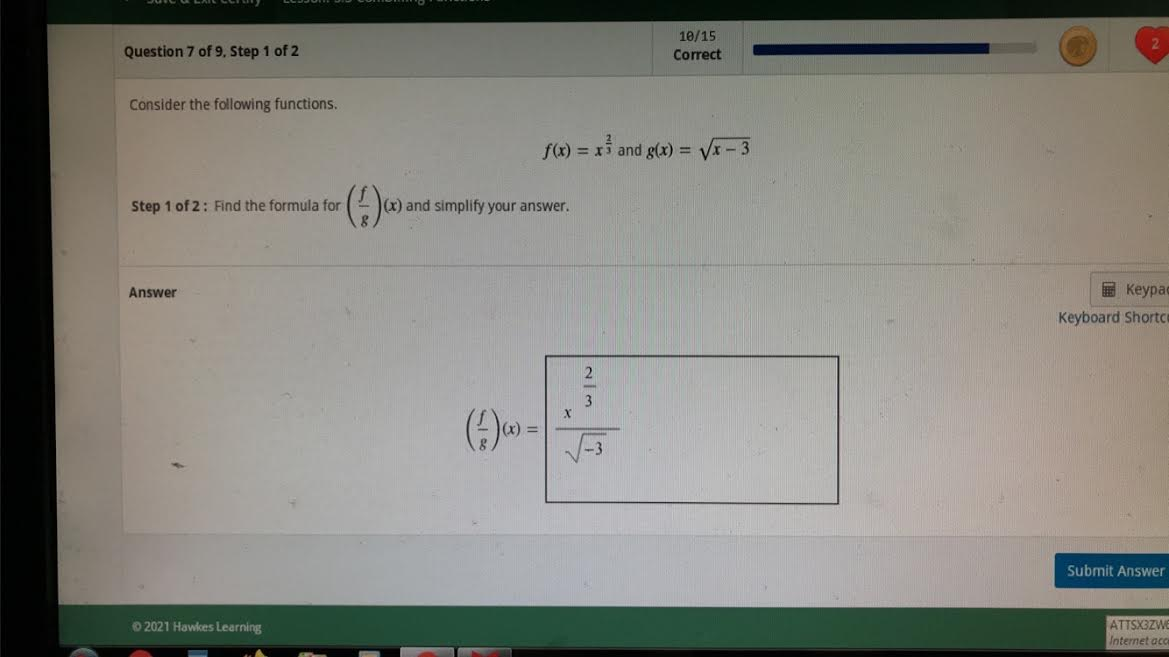
Consider the following functions. f(x)=x^2/3 and g(x)=√x−3 Find the formula for (fg)(x) and simplify your answer.
Vocaloid:
so it is just fg(x), right, no open circle?
KyledaGreat:
\[f(x) = x^{\frac{ 2 }{ 3 }}\] \[g(x) = \sqrt{x-3}\]
KyledaGreat:
(f/g)(x) =
Vocaloid:
make sure to include the appropriate sign (addition, multiplication, division, etc.). (f/g)(x) is f divided by g, so f/g(x) = x^(2/3) / sqrt(x-3). can't really simplify beyond that.
 Vocaloid:
make sure to put sqrt(x-3) in the denominator not just sqrt(-3)
KyledaGreat:
i can't
KyledaGreat:
oh wait
KyledaGreat:
no i can't
Vocaloid:
... strange. I don't think there's another way to write the function.
KyledaGreat:
the answer was \[\frac{ x^{{\frac{ 2 }{ 3 }}} }{\sqrt{x-3}}\]
KyledaGreat:
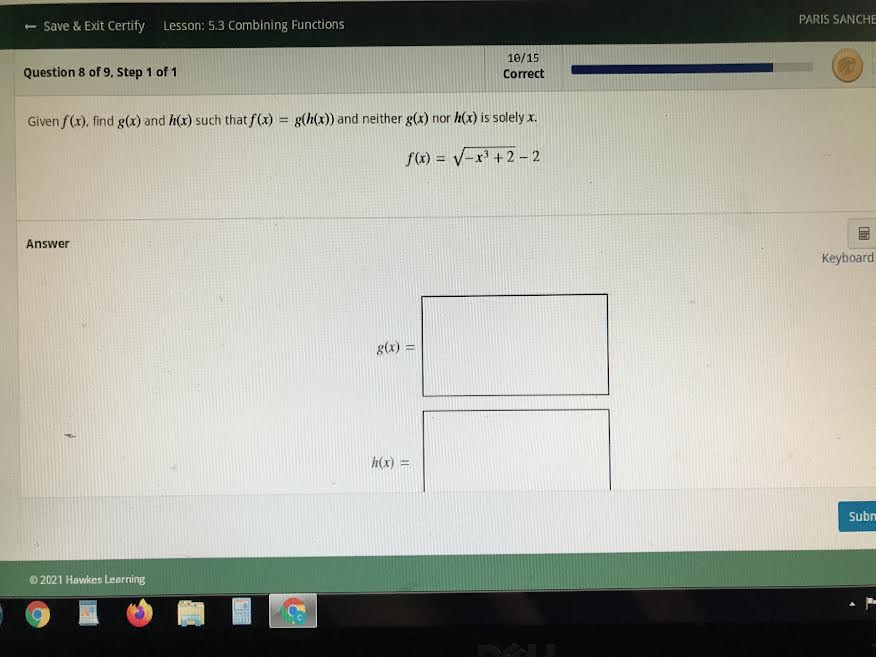
Given f(x), find g(x) and h(x) such that f(x)=g(h(x)) and neither g(x) nor h(x) is solely x. f(x)=√−x^3+2 - 2
KyledaGreat:
g(x) = h(x) =
Vocaloid:
can you take an image of this?
 Vocaloid:
when you have f(x) as two parts (a-b) you can make h(x) the first part (a) and g(x) the second part (x - b) h(x) = sqrt(-x^3+2) and g(x) = x - 2 that way, when you put them together, g(h(x)) becomes the original function
KyledaGreat:
Find (f∘g)(1) for the following functions. Round your answer to two decimal places, if necessary. \[f(x) = \sqrt{x+3}\] and \[g(x) = 4 + \sqrt{x}\]
Vocaloid:
(f∘g)(1) calculate g(1) by plugging in x = 1 then take that end result, plug it into f(x)
KyledaGreat:
18
Vocaloid:
check your arithmetic again g(1) = 4 + sqrt(1) = 5 f(5) = sqrt(5+3) = sqrt(8) = 2.83
KyledaGreat:
oh that's right , i did it wrong
Join our real-time social learning platform and learn together with your friends!
 VERNEISH:
Two objects are moving along separate linear paths where each path is described by position, d, and time, t.
VERNEISH:
Two objects are moving along separate linear paths where each path is described by position, d, and time, t.

 Maci:
what are the best stock apps for people who want to start investing?
Maci:
what are the best stock apps for people who want to start investing?
 Twaylor:
genuienly how do i get better self control i keep watcing youtube and theres this
Twaylor:
genuienly how do i get better self control i keep watcing youtube and theres this
 IzzyCookie:
|dw:1792074056138:dw| Uhm, I don't know where to ask this, but I'm in college welding at my community college, and I need help learning vertical welding for
IzzyCookie:
|dw:1792074056138:dw| Uhm, I don't know where to ask this, but I'm in college welding at my community college, and I need help learning vertical welding for

 thehearken:
not sure if this is considered spam, im sorry if it is, but does anyone have tips
thehearken:
not sure if this is considered spam, im sorry if it is, but does anyone have tips