
 KyledaGreat:
The total revenue for Jane's Vacation Rentals is given as the function R(x)=100x−0.25x^2, where x is the number of villas rented. What number of villas rented produces the maximum revenue?
KyledaGreat:
@vocaloid
 Vocaloid:
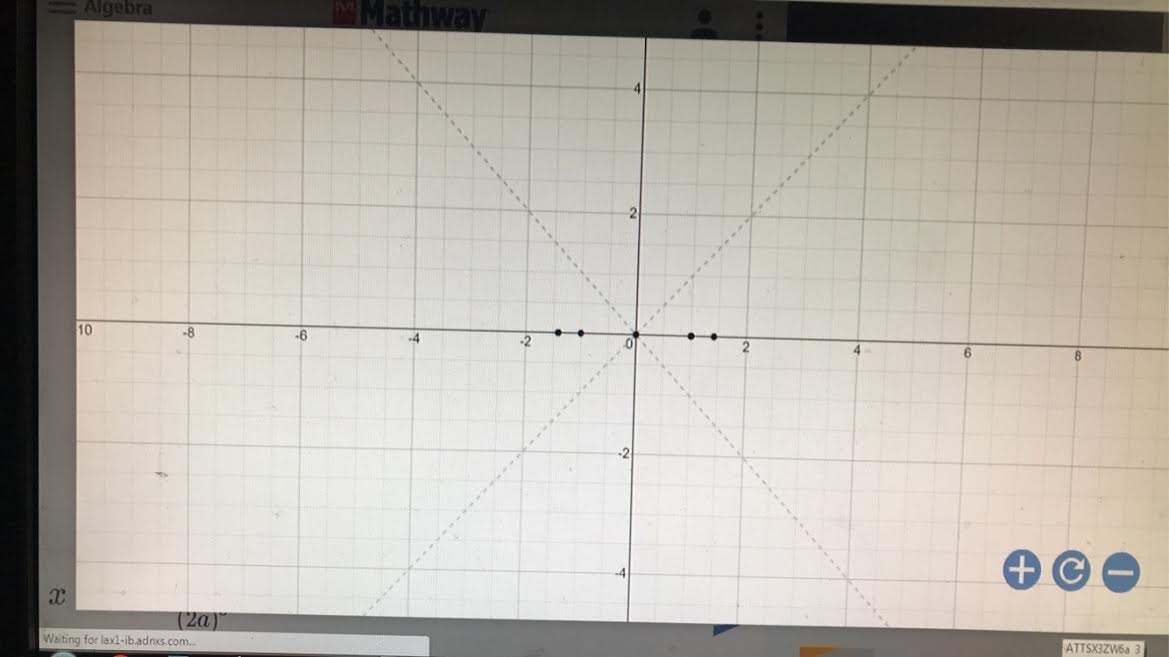
graphing would be the easiest way to solve this, simply graph and look where the vertex is alternate method: when you have a quadratic equation ax^2 + bx + c a is the coefficient of the x^2 term, b is the coefficient of the x term, c is the constant the x-coordinate of the vertex is x = -b/(2a)
 Vocaloid:
if you're using mathway: enter the function 100x−0.25x^2, find the maximum/minimum value, take the x-coordinate since that's the # of villas
KyledaGreat:
(200,10000)
Vocaloid:
good, and since it's asking for the # of villas, you would just take the x-coordinate 200
KyledaGreat:
The total cost of producing a type of truck is given by C(x)=17000−90x+0.2x^2, where x is the number of trucks produced. How many trucks should be produced to incur minimum cost?
Vocaloid:
similar logic, enter the function, look for the minimum, take the x-value
KyledaGreat:
(225,−8425)
Vocaloid:
good, and since x = number of trucks, you only want the x-coordinate 225
KyledaGreat:
Consider the following function. t(x)=(x−4)^2−9 Find the x-intercepts, if any. Express the intercept(s) as ordered pair(s). How many x-intercepts does this function have ? A. None B. One C. Two
KyledaGreat:
it looks like 2
Vocaloid:
good
KyledaGreat:
Consider the following function. t(x)=(x−4)^2−9 Find two points on the graph of the parabola other than the vertex and x-intercepts. A : ( , ) B : ( , )
Vocaloid:
it's in vertex form (x-h)^2 - k, where (h,k) is the vertex, so the vertex is (4,9) to find the x-intercepts, we set t(x) = 0 and solve for x 0 = (x-4)^2 - 9 9 = (x-4)^2 square root of both sides x-4 = 3 x - 4 = -3 so x = 7 or x = 1 ****however*** it is asking for points **other than** the vertex and x-intercepts, so you have to plug in any x-value ***Except*** 1, 4, and 7 so you could plug in x = 2 and x = 3 to get your two points
KyledaGreat:
x = 2 and x = 9 ?
Vocaloid:
yes, you could use x = 2 and x = 9, but you have to plug them into the function t(x)=(x−4)^2−9 to get the two points
Vocaloid:
calculate the value of the function at x = 2 and x = 9
KyledaGreat:
t(2)=(9−4)^2−9
Vocaloid:
good, keep going
KyledaGreat:
16
Vocaloid:
good, so (9,16) is one possible point repeat with x = 2
KyledaGreat:
okay, where i do i apply x = 2 in it ?
KyledaGreat:
and is (9, 16) for A ?
Vocaloid:
just like you plugged in x = 9, plug in x = 2 into the function. yes, you plug in point A as (9,16)
KyledaGreat:
oh i see what you mean
KyledaGreat:
23
Vocaloid:
check your arithmetic again t(x)=(x−4)^2−9 x = 2, so t(x) = (2-4)^2 - 9 = 4 - 9 = -5 so (2,-5) is the second point B
KyledaGreat:
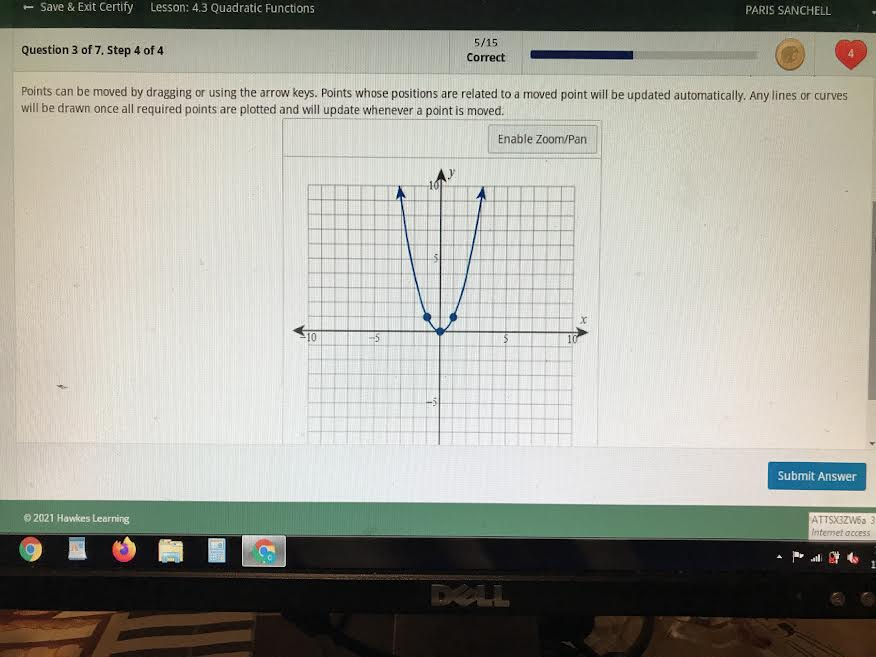
Consider the following function. t(x)=(x−4)^2−9 Graph the parabola.
 Vocaloid:
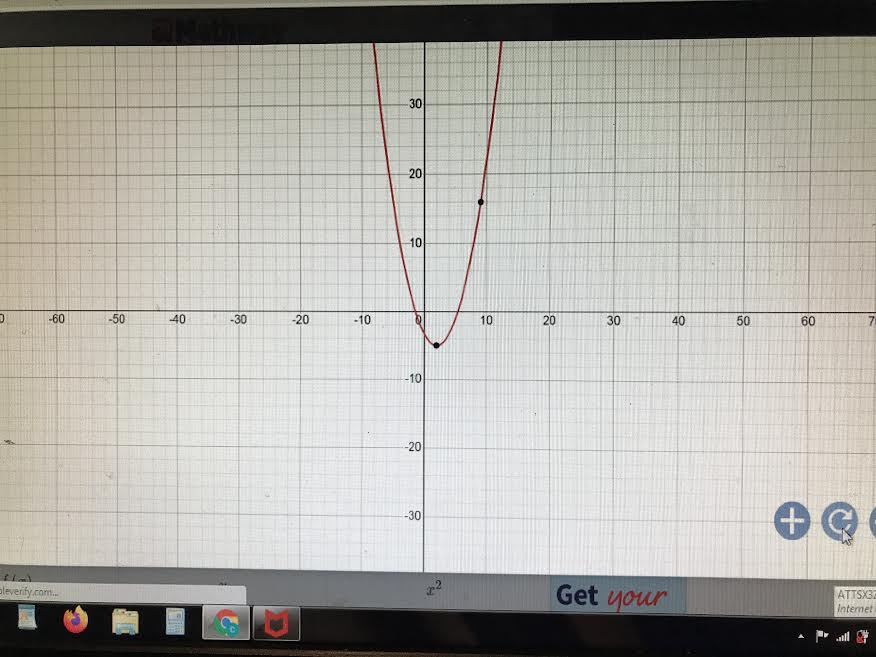
going off the points we've calculated so far: the intercepts (1,0) and (7,0) and the two points we just calculated: (9,16) and (2,-5), plot these points, draw the parabola through them
 KyledaGreat:
i'm not sure how this can be plotted on the graph on mine
KyledaGreat:
Among all rectangles that have a perimeter of 84, find the dimensions of the one whose area is largest. Write your answers as fractions reduced to lowest terms.
Join our real-time social learning platform and learn together with your friends!
 VERNEISH:
Two objects are moving along separate linear paths where each path is described by position, d, and time, t.
VERNEISH:
Two objects are moving along separate linear paths where each path is described by position, d, and time, t.

 Maci:
what are the best stock apps for people who want to start investing?
Maci:
what are the best stock apps for people who want to start investing?
 Twaylor:
genuienly how do i get better self control i keep watcing youtube and theres this
Twaylor:
genuienly how do i get better self control i keep watcing youtube and theres this
 IzzyCookie:
|dw:1792074056138:dw| Uhm, I don't know where to ask this, but I'm in college welding at my community college, and I need help learning vertical welding for
IzzyCookie:
|dw:1792074056138:dw| Uhm, I don't know where to ask this, but I'm in college welding at my community college, and I need help learning vertical welding for

 thehearken:
not sure if this is considered spam, im sorry if it is, but does anyone have tips
thehearken:
not sure if this is considered spam, im sorry if it is, but does anyone have tips