
 LostLegacy06:
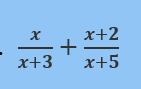
Can someone attempt to explain this: x/(x+3)+(x+2)/(x+5)
 minustempo:
Since the denominators are different, you need to first find a common denominator
 LostLegacy06:
Ok-
minustempo:
Here the least common denominator is just (x+3)(x+5)
LostLegacy06:
wouldn't i need to multiply that to the top?
minustempo:
you would need to multiply something on the top to get the denominator to (x+3)(x+5), yes
LostLegacy06:
ultimate confusion
minustempo:
so you know that a/b + c/d is not equal to (a+c)/(b+d) right?
LostLegacy06:
mhm
minustempo:
It's equal to (ad + bc)/(bd)
minustempo:
because if you want the common denominator as bd, then a/b becomes ad/bd, and c/d becomes bc/bd Now both denominators are equal, so you can add ad/bd + bc/bd = (ad+bc)/bd
minustempo:
so x/(x+3) + (x+2)/(x+5) = (x(x+5) + (x+2)(x+3)/((x+3)(x+5))
LostLegacy06:
I somewhat understand...but im still confused-
LostLegacy06:
so the x(x+5) is by itself?
minustempo:
Sorry I don't know latex It's x(x+5) + (x+2)(x+3)
(x+3)(x+5)
LostLegacy06:
ohhhh ok that looks and makes more sense
LostLegacy06:
makeshift fraction sign did wonders
minustempo:
lol
LostLegacy06:
so I can cross out the (x+5) and (x+3) from the top and bottom right?
minustempo:
You don't cross out, you divide the top and bottom by the same number. but you can't do that here because the x(x+5) term doesn't have an (x+3) and the (x+2)(x+3) term doesn't have an (x+5) term
LostLegacy06:
yeah I've hit rock bottom
minustempo:
lol
LostLegacy06:
i'm going to try to figure out how to do this based on what you said and if I do I will let you know, gracias <3
minustempo:
I don't think you can simplify any farther though, but sure
LostLegacy06:
well yeah I still have to figure out how you got there xD
minustempo:
Sure lmao
Join our real-time social learning platform and learn together with your friends!
 VERNEISH:
Two objects are moving along separate linear paths where each path is described by position, d, and time, t.
VERNEISH:
Two objects are moving along separate linear paths where each path is described by position, d, and time, t.

 Maci:
what are the best stock apps for people who want to start investing?
Maci:
what are the best stock apps for people who want to start investing?
 Twaylor:
genuienly how do i get better self control i keep watcing youtube and theres this
Twaylor:
genuienly how do i get better self control i keep watcing youtube and theres this
 IzzyCookie:
|dw:1792074056138:dw| Uhm, I don't know where to ask this, but I'm in college welding at my community college, and I need help learning vertical welding for
IzzyCookie:
|dw:1792074056138:dw| Uhm, I don't know where to ask this, but I'm in college welding at my community college, and I need help learning vertical welding for

 thehearken:
not sure if this is considered spam, im sorry if it is, but does anyone have tips
thehearken:
not sure if this is considered spam, im sorry if it is, but does anyone have tips