
 KyledaGreat:
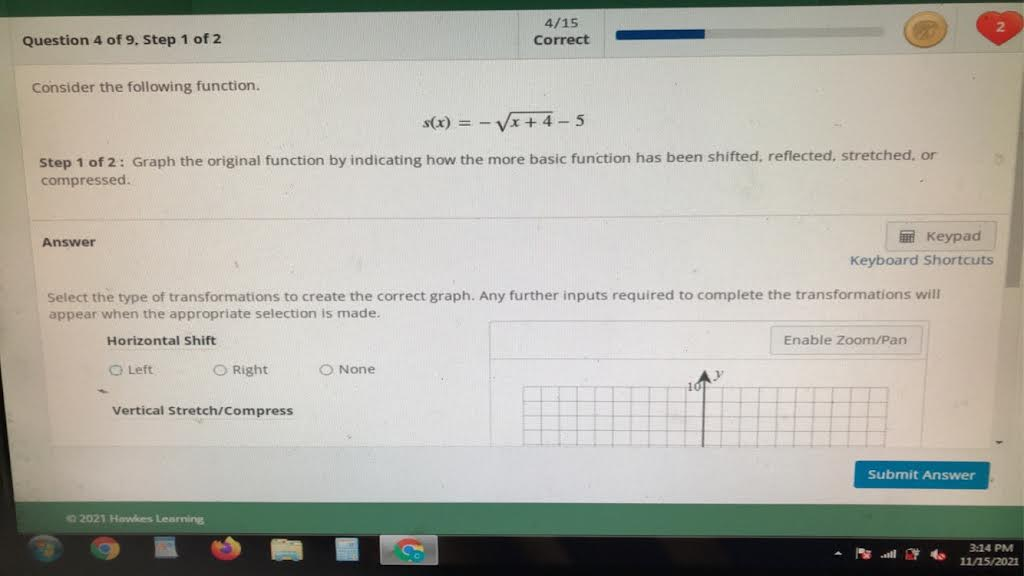
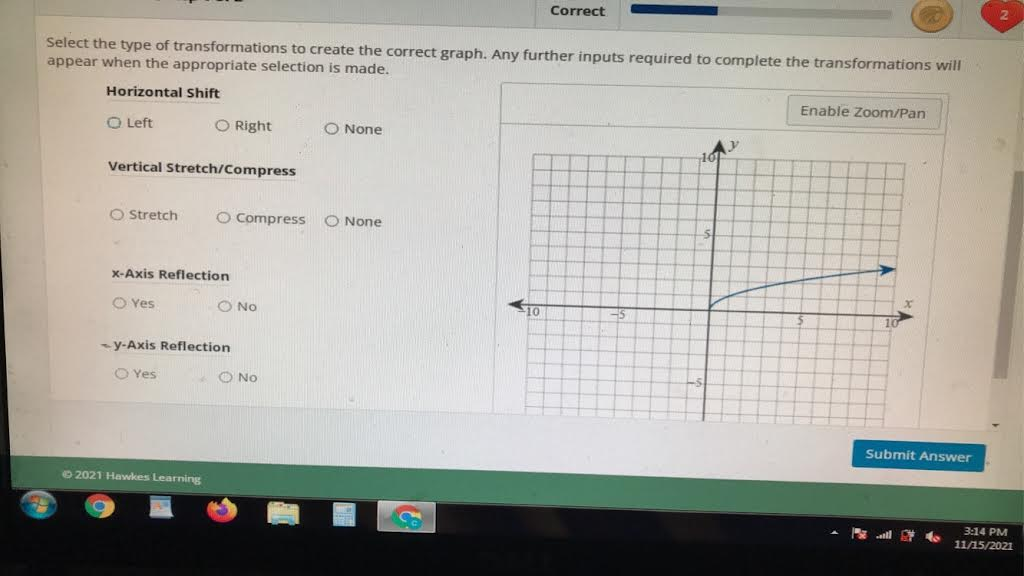
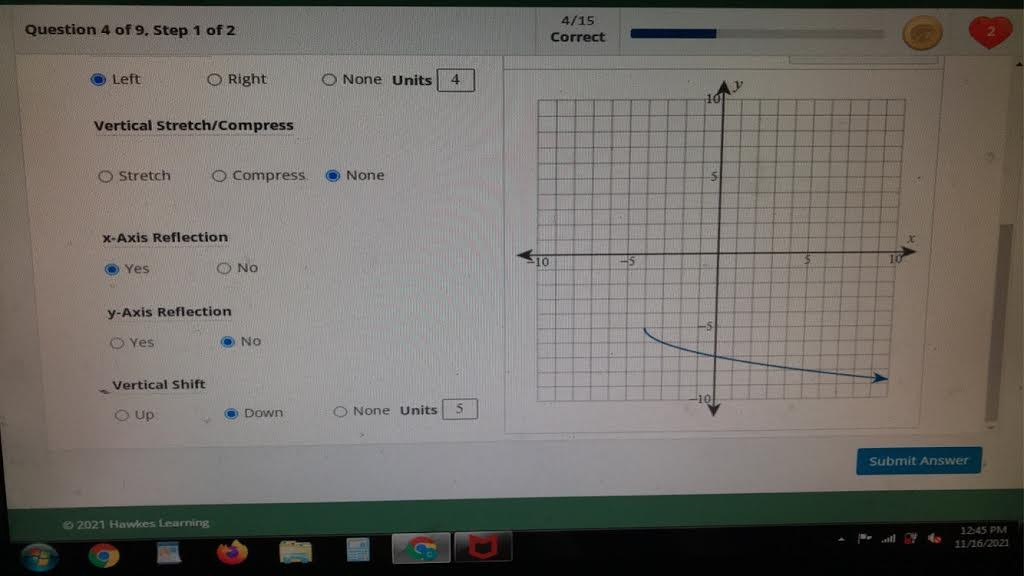
Graph the original function by indicating how the more basic function has been shifted, reflected, stretched, or compressed.
 KyledaGreat:
@extrinix @vocaloid
 Extrinix:
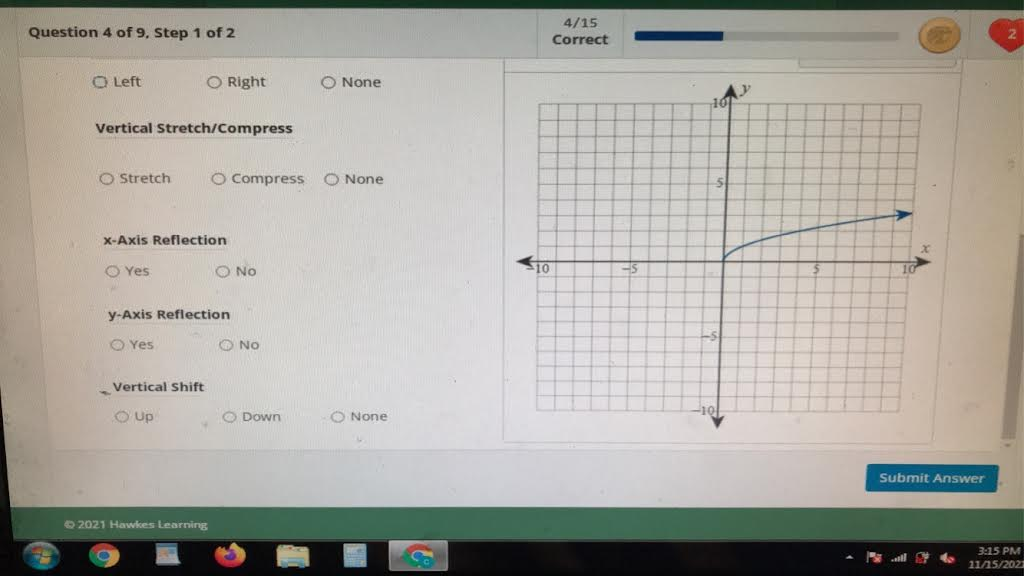
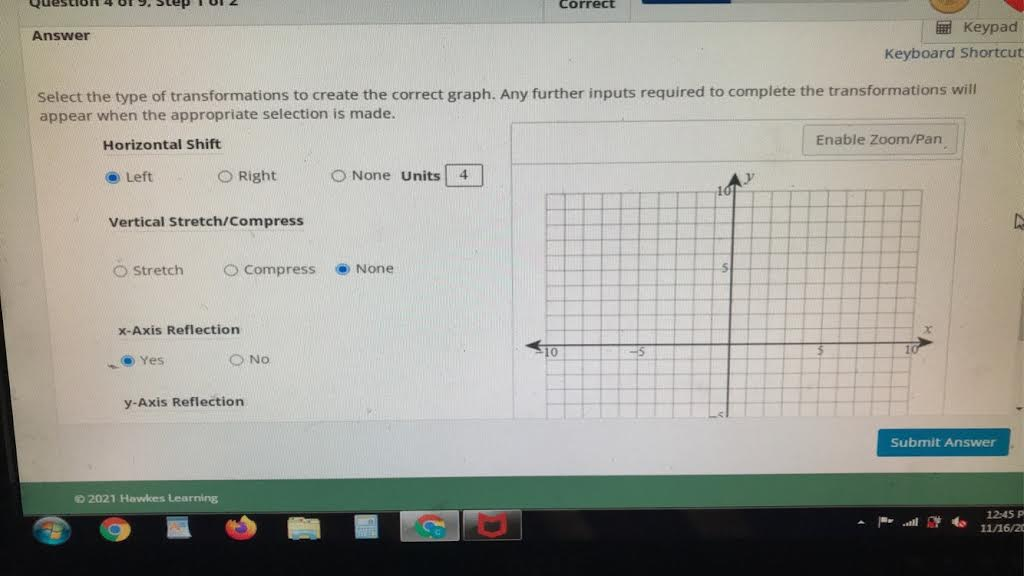
Okay so you understand that the quadratic equation looks like this \(f(x)=\sqrt{x-h}+k\) With \(h\) being the opposite of it's seen value, and \(k\) being it's seen value In this equation it shows this \(s(x)=-\sqrt{x+4}-5\) So, you can see that \(h\) is \(4\), meaning that it's value on the graph is \(-4\), meaning it `shifts left 4` As well as that, you can see that \(k\) is \(-5\), meaning that the graph `shifts down 5` Now, there is a negative next to the square root, meaning that the graph is `flipped across the x-axis` Y-axis flips would only occur if \(s(x)\) was negative, meaning that there is `no change` in it's y-axis placement
KyledaGreat:
Okay , what about vertical stretch/compress and the vertical shift ?
KyledaGreat:
@extrinix
Extrinix:
As shown, the equation \(f(x)=a\sqrt{x-h}+k\) \(a\) represents the stretch or compression of the equation, but as \(a\) is equal to 1 on your equation, there is `no change` in it's stretch or compression
KyledaGreat:
okay good
 Extrinix:
👍👍
KyledaGreat:
Consider the following function. \[u(x) =-\sqrt{x+4}\] Determine the domain and range of the original function. Express your answer in interval notation.
Extrinix:
Use my previous post as an example and try it for yourself
Join our real-time social learning platform and learn together with your friends!
 VERNEISH:
Two objects are moving along separate linear paths where each path is described by position, d, and time, t.
VERNEISH:
Two objects are moving along separate linear paths where each path is described by position, d, and time, t.

 Maci:
what are the best stock apps for people who want to start investing?
Maci:
what are the best stock apps for people who want to start investing?
 Twaylor:
genuienly how do i get better self control i keep watcing youtube and theres this
Twaylor:
genuienly how do i get better self control i keep watcing youtube and theres this
 IzzyCookie:
|dw:1792074056138:dw| Uhm, I don't know where to ask this, but I'm in college welding at my community college, and I need help learning vertical welding for
IzzyCookie:
|dw:1792074056138:dw| Uhm, I don't know where to ask this, but I'm in college welding at my community college, and I need help learning vertical welding for

 thehearken:
not sure if this is considered spam, im sorry if it is, but does anyone have tips
thehearken:
not sure if this is considered spam, im sorry if it is, but does anyone have tips