
 Vocaloid:
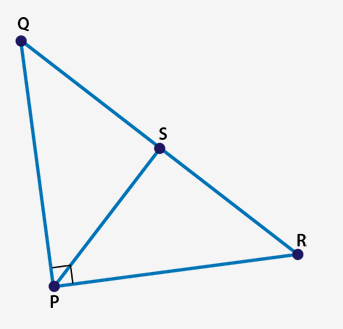
Seth is using the figure shown below to prove the Pythagorean Theorem using triangle similarity: In the given triangle PQR, angle P is 90° and segment PS is perpendicular to segment QR. The figure shows triangle PQR with right angle at P and segment PS. Point S is on side QR. Part A: Identify a pair of similar triangles. (2 points) Part B: Explain how you know the triangles from Part A are similar. (4 points) Part C: If RS = 4 and RQ = 16, find the length of segment RP. Show your work. (4 points)
Vocaloid:
posting on behalf of @iSuckAtMath101
 carmelle:
Alright, so we know triangle QPR is a right triangle. can you find another similar triangle which is a right triangle?
 iSuckAtMath101:
psq?
iSuckAtMath101:
wait no
iSuckAtMath101:
QPR?
carmelle:
correct, it would be QSP So you already have the answer to part A. △QPR ~ △QSP
carmelle:
understood?
iSuckAtMath101:
yes
carmelle:
ok, so now lets prove how these two triangles are similar. are you familar with the AA similarity theorem?
iSuckAtMath101:
angle angle?
carmelle:
yes, can you define it?
iSuckAtMath101:
when two angles are congruent it means that the triangles are similar?
carmelle:
correct, The formal definition is: `In two triangles, if two pairs of corresponding angles are congruent, then the triangles are similar.` So now, what two angles in these two triangles are similar? I suggest you to draw it out so you can have a visual of how the triangles look like.
iSuckAtMath101:
q and r?
carmelle:
Are you sure...? look at this drawing, which angles are similar? |dw:1639519999401:dw|
iSuckAtMath101:
p and s?
carmelle:
thats right, can you find another pair?
iSuckAtMath101:
r and p
iSuckAtMath101:
or q and q
carmelle:
yep, those can work, so for part B, just state 2 pairs of angles that are similar and your reasoning will be based off of the AA similarity theorem
iSuckAtMath101:
alright
iSuckAtMath101:
Part B: angles P and S, and R and P are congruent because of the AA similarity theorem
carmelle:
Now for part C, we will have to set up a proportion with the side lengths that are given... do you have an idea of what the proportion will be/look like, or do you want me to walk you through it?
carmelle:
iSuckAtMath101:
you can walk me through it please
carmelle:
alright, so we are given RS (which is 4) and RQ (which is 16) and we need to find RP Our proportion will look like: \[\frac{ RQ }{ RP } = \frac{ RP }{ RS }\] it might seem hard but just trust me here... just substitute the variables that are given and solve... \[\frac{ 16 }{ RP } = \frac{ RP }{ 4 }\] its easier to look at it like this \[\frac{ 16 }{ x } = \frac{ x }{ 4 }\] Now we just solve for x, can you do that? `(if you are having difficulty, just remember to cross multiply)`
iSuckAtMath101:
64 = x(squared)? then square root of 64 = 8?
carmelle:
yep, you got it, great job :D `x = 8 which means RP = 8` just remember to show your work and you'll be done :)
iSuckAtMath101:
ty so much, and ty for not giving me the answer and making me work for it lol. It helped me and now I know how to do it!!
carmelle:
carmelle:
Join our real-time social learning platform and learn together with your friends!
VERNEISH:
Two objects are moving along separate linear paths where each path is described by position, d, and time, t.

 Maci:
what are the best stock apps for people who want to start investing?
Maci:
what are the best stock apps for people who want to start investing?
 Twaylor:
genuienly how do i get better self control i keep watcing youtube and theres this
Twaylor:
genuienly how do i get better self control i keep watcing youtube and theres this
 IzzyCookie:
|dw:1792074056138:dw| Uhm, I don't know where to ask this, but I'm in college welding at my community college, and I need help learning vertical welding for
IzzyCookie:
|dw:1792074056138:dw| Uhm, I don't know where to ask this, but I'm in college welding at my community college, and I need help learning vertical welding for

 thehearken:
not sure if this is considered spam, im sorry if it is, but does anyone have tips
thehearken:
not sure if this is considered spam, im sorry if it is, but does anyone have tips