
 lolokrat:
anyone knowledgeable in relative purchasing power parity (relative ppp) in macroeconomics?
 LiquidCandy:
It is just the exchange and inflation rates in two countries that should over a period of time equal out eventually.
lolokrat:
im just having a hard time figuring out a graph of relative ppp, think you can help?
lolokrat:
@liquidcandy
LiquidCandy:
can i see the graph you are looking at. or is it just in general?
 lolokrat:
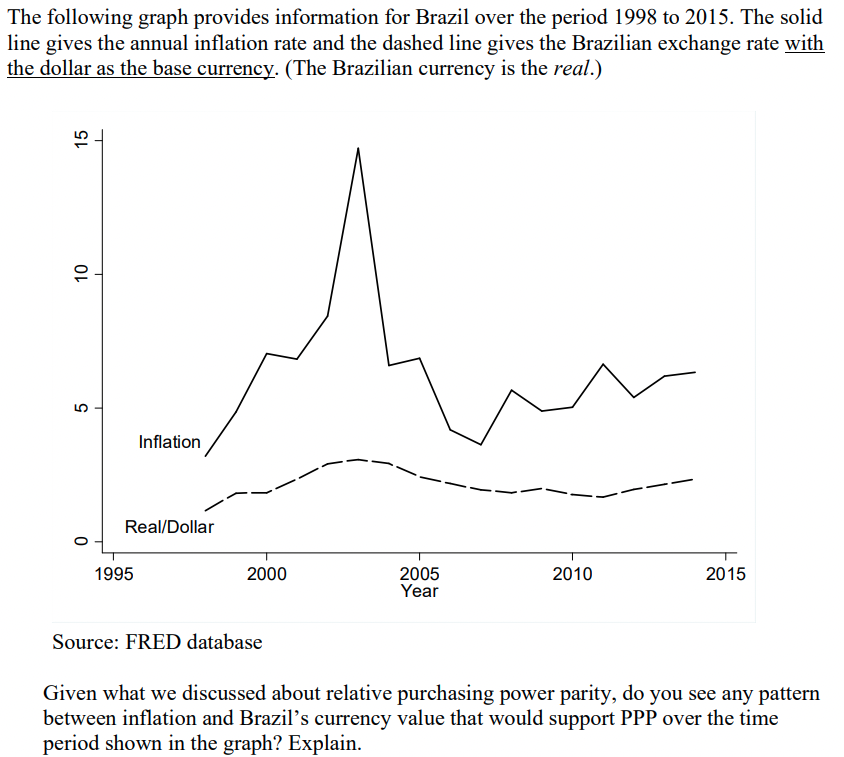
the textbook for my course says, "The key implication of this concept is that a country’s high inflation over time will put depreciation pressure on its currency. It also suggests that low and stable inflation will support a stronger currency while higher and more volatile inflation will weaken a currency’s value." based on what i'm seeing in the graph, when the inflation spiked in 2003ish, the currency spiked as well. shouldn't it have decreased since volatile inflation weakens currency's value?
lolokrat:
@liquidcandy
LiquidCandy:
Well, currency appreciation decreases inflation so yes it should have decreased.
lolokrat:
how does that not happen? is it often for the inflation to go up but currency's value continues to increase?
lolokrat:
is relative ppp more of a predictive effect and something that is not guaranteed to occur everytime?
lolokrat:
does the "with the dollar as the base currency" have something to do with it?
LiquidCandy:
No, when inflation goes up the value goes down. It is how the government works. And for predictability yes and no. You see if you trying to predict the short-term relative ppp it might be true but it can be very unpredictable unless you do a lot of research and just know how this kind of thing works. Usually, if you're predicting a long-term relative ppp you will get it correct with just understanding what data is given to you.
LiquidCandy:
It sucks because every dollar the Federal Reserve makes, the currency value of a dollar depreciates.
lolokrat:
ok gotchya, i thought i was crazy because i thought the question was formed in the space that the graph did support relative ppp and i just had to explain how it did. so im glad i got a second set of eyes on it
LiquidCandy:
the second set follows the curves of the first it is just a smaller incline and decline.
lolokrat:
right, but it should be doing the opposite, correct?
LiquidCandy:
no, it still goes up but it does not go up as high as the first second. You can never take away money once it is put out. Unless you burn it but people would get mad. So it goes up but not as much, it has a more slant in it.
LiquidCandy:
If you really want to know about this stuff you should look into learning about stocks.
LiquidCandy:
Stock shareholding literally is what separates the rich from the poor and it is all about what this concept is.
LiquidCandy:
If you can read this graph and understand how a company is doing. And predict if it will grow then you can make millions.
lolokrat:
thats rlly interesting, im trying to get into stocks but holding off on going all in till i research more on it and understand all the graphs n such
lolokrat:
but i mean for the context of this question, you said it goes up but not as much? sorry if im repeating but like i said in 2003 there was a drastic spike. as per relative ppp it should have went down, not increased at all, right?
LiquidCandy:
Where the spike it is where it flattens out on the second set. then decreased as though the second set
lolokrat:
also what relevance does the information about the brazilian/$ exchange rate give in the context of the graph? why does it matter? if relative ppp says inflation goes up & currency exchanges go down, what context does telling us which is which give? only asking bc my prof usually doesnt put fluff in his hw questions, usually all the info is relevant so i just want to be sure im not missing anything
LiquidCandy:
The information about the brazilian/$ exchange rate is just for an example the is no relevance. It just provides that. It could be any country. And what do you mean by the second question?
lolokrat:
oh ok, the 2nd question was pretty much asking the same as the first, just worded diff
lolokrat:
so just to clarify : there isn't a pattern between inflation and Brazil's currency value that would support PPP over the time period?
LiquidCandy:
No, The pattern it shows is that when the inflation increases so does the real/dollar. and when then inflation decreases the real/dollar decreased. The real/dollar does it much gradually than the inflation's rigid spikes.
LiquidCandy:
The Relative ppp is as simple as this. "increased inflation will reduce the real purchasing power of a nation's currency and same for the oppisite.".
lolokrat:
omg wait i may have this all wrong i am so sorry pls say if i am wrong, in my head, low inflation=strong currency value high inflation=weak currency value
lolokrat:
so in ur comment above, r u saying there IS a pattern, it just does not support relative ppp?
LiquidCandy:
This is correct. low inflation=weak currency value high inflation=high currency value that is the pattern
LiquidCandy:
to have relative ppp u need two different nations
LiquidCandy:
this shows one so you can infer that your prof want you to find the pattern in this one nation
LiquidCandy:
So moer inflation equal more real/dollar and low inflation equal low real/money
LiquidCandy:
more*
lolokrat:
so "low inflation=weak currency value high inflation=high currency value" is the pattern for THIS graph, but not the pattern if this graph were showing true relative ppp?
lolokrat:
whoever you are i apologize for my confusion & have much gratitude for ur knowledge
LiquidCandy:
That is the pattern yes. This graph shows one nation BRAZIL. So yes if you have two nations it depends on their data. But it always flows in an up-down way.
lolokrat:
gotchya, thank you so much!
LiquidCandy:
No problem.
Join our real-time social learning platform and learn together with your friends!
 VERNEISH:
Two objects are moving along separate linear paths where each path is described by position, d, and time, t.
VERNEISH:
Two objects are moving along separate linear paths where each path is described by position, d, and time, t.

 Maci:
what are the best stock apps for people who want to start investing?
Maci:
what are the best stock apps for people who want to start investing?
 Twaylor:
genuienly how do i get better self control i keep watcing youtube and theres this
Twaylor:
genuienly how do i get better self control i keep watcing youtube and theres this
 IzzyCookie:
|dw:1792074056138:dw| Uhm, I don't know where to ask this, but I'm in college welding at my community college, and I need help learning vertical welding for
IzzyCookie:
|dw:1792074056138:dw| Uhm, I don't know where to ask this, but I'm in college welding at my community college, and I need help learning vertical welding for

 thehearken:
not sure if this is considered spam, im sorry if it is, but does anyone have tips
thehearken:
not sure if this is considered spam, im sorry if it is, but does anyone have tips