
 kekeman:
More chem please help: https://snipboard.io/bU8BrY.jpg
 WhoIsArii:
..
kekeman:
The link don't work?
kekeman:
@tranquility
WhoIsArii:
nope
 Tranquility:
Are those the only three answer choices
kekeman:
Yes indeed
Tranquility:
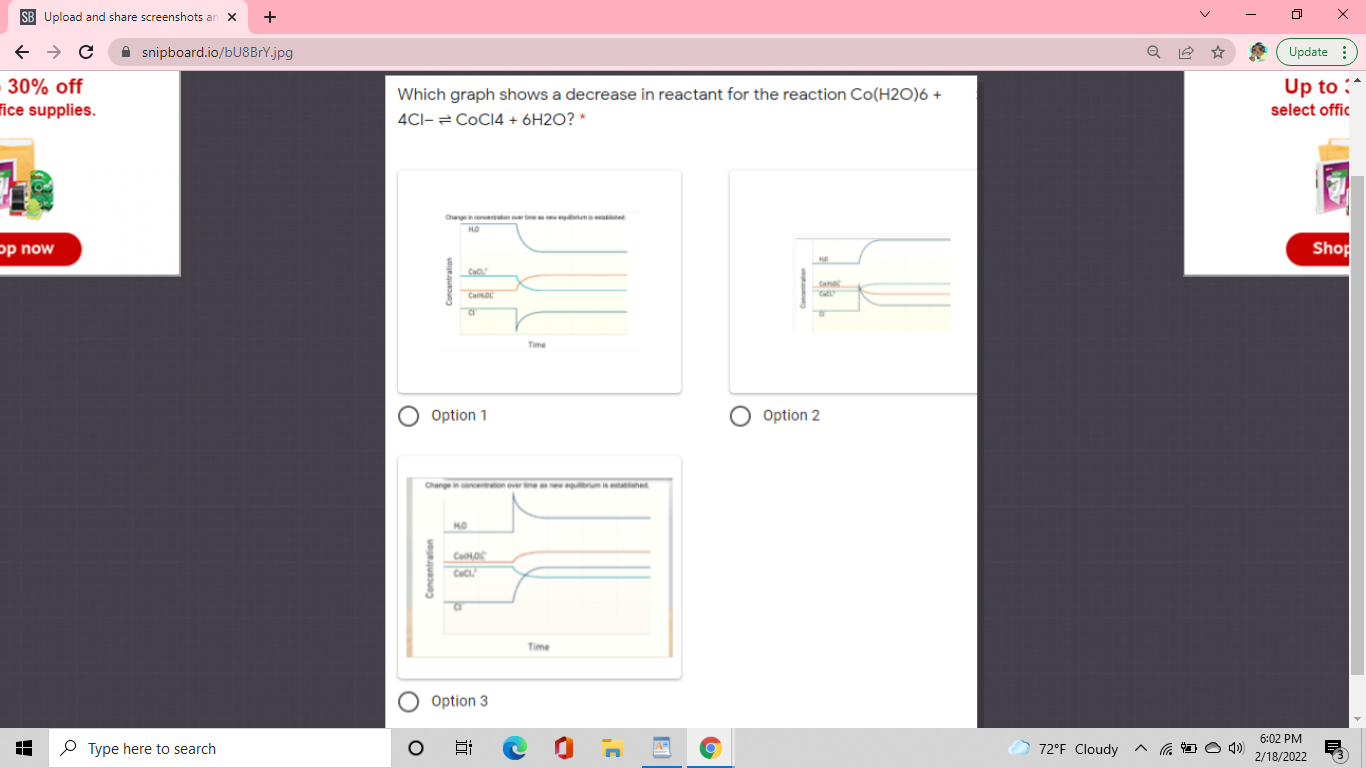
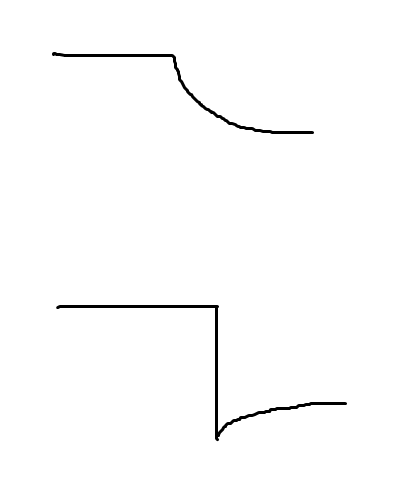
The equation is Co(H2O)6 + 4Cl- <----> CoCl4 + 6 H2O We have two reactants Co(H2O)6 and Cl- We want to see a decrease in either Co(H2O)6 OR in Cl- The way we see decreases are by the sharp straight line and it has to go downwards to signify that it is decreasing
Tranquility:
So I drew out the two possible ways we see a decrease The first one tells us that the other reactant was added into the reaction and so the equilibrium shifts towards the other side and that's why whatever compound it is is being used up to form more products. The bottom one tells us that something was removed and thus the equilibrium shifted towards it. So if you remove a reactant, then it's concentration would decrease sharply (thus the straight line) but now the equilibrium is disturbed and it's going to start forming more of it which is why the line starts to go back up slowly
 Tranquility:
Does that make sense?
kekeman:
Ohhhh i see
Tranquility:
Basically, when the equation is in equilibrium all four line should just be a straight horizontal line
But then when you decrease the reactant, the line of that reactant will sharply decrease first and then the equilibrium will shift towards it and cause the reactant to increase again in concentration
kekeman:
Alright so with this information it sounds like its going to be option 1
Tranquility:
So in that drawing I drew, you want to find the answer choice that looks like the bottom one for either Co(H2O)6 or for Cl-
Tranquility:
kekeman:
Ohhhhh okkkk i get it nowww
Tranquility:
That's great! We can move on to your next question now
Join our real-time social learning platform and learn together with your friends!
 VERNEISH:
Two objects are moving along separate linear paths where each path is described by position, d, and time, t.
VERNEISH:
Two objects are moving along separate linear paths where each path is described by position, d, and time, t.

 Maci:
what are the best stock apps for people who want to start investing?
Maci:
what are the best stock apps for people who want to start investing?
 Twaylor:
genuienly how do i get better self control i keep watcing youtube and theres this
Twaylor:
genuienly how do i get better self control i keep watcing youtube and theres this
 IzzyCookie:
|dw:1792074056138:dw| Uhm, I don't know where to ask this, but I'm in college welding at my community college, and I need help learning vertical welding for
IzzyCookie:
|dw:1792074056138:dw| Uhm, I don't know where to ask this, but I'm in college welding at my community college, and I need help learning vertical welding for

 thehearken:
not sure if this is considered spam, im sorry if it is, but does anyone have tips
thehearken:
not sure if this is considered spam, im sorry if it is, but does anyone have tips