
 Kyky232:
plz help
 carmelle:
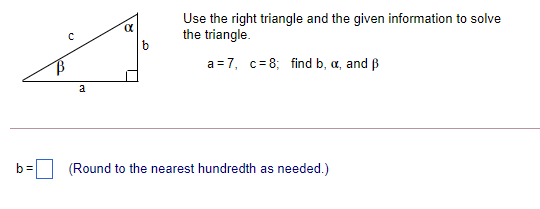
To find b, you have to use the pythagorean theorem. \[a ^{2}+b ^{2}=c ^{2}\] So plug in the values you know and solve for what you dont know. I'll start off... \[7 ^{2}+b ^{2}=8 ^{2}\] \[49+b ^{2}=64\] Can you solve it from there?
Kyky232:
carmelle:
yeah! that's right
 Kyky232:
how do i do this one???
carmelle:
Alright, so did you see my explaination for the other question you asked? I answered it a few minutes ago. Its the same concept as this one, but i'll still help you with this one.
Kyky232:
wait lemme check
carmelle:
|dw:1646866662147:dw| alright, lemme draw out the picture. Remember the 3 trig funtions are: Sine = Opposite / Hypotenuse Cosine = Adjacent / Hypotenuse Tangent = Opposite / Adjacent Which should we use here?
Kyky232:
tan?
carmelle:
Yes, you would use tan here. Then, to find the angle measurement, you'd find the inverse of tan which is: \[\tan^{-1} \]
Join our real-time social learning platform and learn together with your friends!
 VERNEISH:
Two objects are moving along separate linear paths where each path is described by position, d, and time, t.
VERNEISH:
Two objects are moving along separate linear paths where each path is described by position, d, and time, t.

 Maci:
what are the best stock apps for people who want to start investing?
Maci:
what are the best stock apps for people who want to start investing?
 Twaylor:
genuienly how do i get better self control i keep watcing youtube and theres this
Twaylor:
genuienly how do i get better self control i keep watcing youtube and theres this
 IzzyCookie:
|dw:1792074056138:dw| Uhm, I don't know where to ask this, but I'm in college welding at my community college, and I need help learning vertical welding for
IzzyCookie:
|dw:1792074056138:dw| Uhm, I don't know where to ask this, but I'm in college welding at my community college, and I need help learning vertical welding for

 thehearken:
not sure if this is considered spam, im sorry if it is, but does anyone have tips
thehearken:
not sure if this is considered spam, im sorry if it is, but does anyone have tips