
 24abreedy:
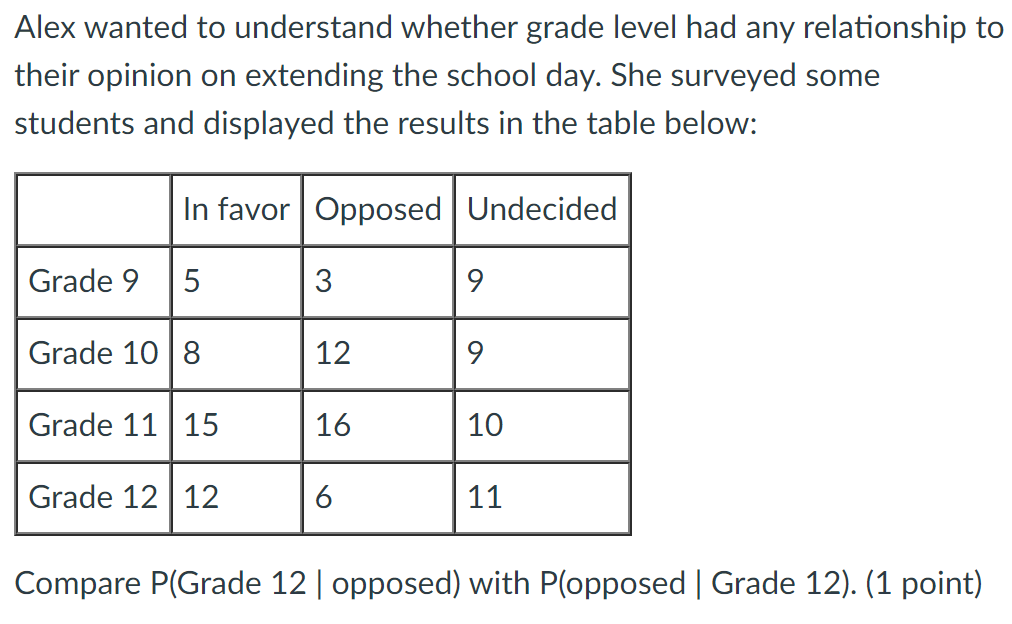
Alex wanted to understand whether grade level had any relationship to their opinion on extending the school day. She surveyed some students and displayed the results in the table below: In favor Opposed Undecided Grade 9 5 3 9 Grade 10 8 12 9 Grade 11 15 16 10 Grade 12 12 6 11 Compare P(Grade 12 | opposed) with P(opposed | Grade 12).
 Fortish:
@astrid1
24abreedy:
above is the chart and the answer options are: P(Grade 12 | opposed) = P(opposed | Grade 12) P(Grade 12 | opposed) > P(opposed | Grade 12) P(Grade 12 | opposed) < P(opposed | Grade 12) There is not enough information.
Fortish:
@joe348
 SmokeyBrown:
Hi and welcome to QuestionCove! P(Grade 12 | opposed) is the probability that the student is in grade 12, given that they oppose extending the school day. We can calculate this probability by taking ([Number of students in grade 12 AND oppose extending the school day]/[Number of students who oppose extending the school day]) The chart shows that 6 students are in grade 12 AND oppose extending the school day. The chart shows that 37 students total oppose extending the school day. So, P(Grade 12 | opposed) = 6/37 P(opposed | Grade 12) is the probability that the student opposes extending the school day, given that they are in grade 12. We can calculate this probability by taking ([Number of students in grade 12 AND oppose extending the school day]/[Number of students who are in grade 12]) Like before, 6 students are in grade 12 AND oppose extending the school day. We also see that there are 29 total students in grade 12. So, P(Grade 12 | opposed) = 6/29 Which of these two probabilities is greater?
Join our real-time social learning platform and learn together with your friends!
VERNEISH:
Two objects are moving along separate linear paths where each path is described by position, d, and time, t.

 Maci:
what are the best stock apps for people who want to start investing?
Maci:
what are the best stock apps for people who want to start investing?
 Twaylor:
genuienly how do i get better self control i keep watcing youtube and theres this
Twaylor:
genuienly how do i get better self control i keep watcing youtube and theres this
 IzzyCookie:
|dw:1792074056138:dw| Uhm, I don't know where to ask this, but I'm in college welding at my community college, and I need help learning vertical welding for
IzzyCookie:
|dw:1792074056138:dw| Uhm, I don't know where to ask this, but I'm in college welding at my community college, and I need help learning vertical welding for

 thehearken:
not sure if this is considered spam, im sorry if it is, but does anyone have tips
thehearken:
not sure if this is considered spam, im sorry if it is, but does anyone have tips