
 OronSH:
A hunter and an invisible rabbit play a game in the Euclidean plane. The rabbit's starting point, $A_0,$ and the hunter's starting point, $B_0$ are the same. After $n-1$ rounds of the game, the rabbit is at point $A_{n-1}$ and the hunter is at point $B_{n-1}.$ In the $n^{\text{th}}$ round of the game, three things occur in order: i. The rabbit moves invisibly to a point $A_n$ such that the distance between $A_{n-1}$ and $A_n$ is exactly $1.$ ii. A tracking device reports a point $P_n$ to the hunter. The only guarantee provided by the tracking device to the hunter is that the distance between $P_n$ and $A_n$ is at most $1.$ iii. The hunter moves visibly to a point $B_n$ such that the distance between $B_{n-1}$ and $B_n$ is exactly $1.$ Is it always possible, no matter how the rabbit moves, and no matter what points are reported by the tracking device, for the hunter to choose her moves so that after $10^9$ rounds, she can ensure that the distance between her and the rabbit is at most $100?$
 ChooseAUsename:
trivial
OronSH:
but can you prove it
ChooseAUsename:
Yes
OronSH:
what is your proof
ChooseAUsename:
bump again
OronSH:
where is your proof \[x=\frac{-b\pm\sqrt{b^2-4ac}}{2a}\] bruh imagien dollar signs don't work for latex
OronSH:
how do i type inline latex bruh
OronSH:
bruh \$\frac12+\frac13=\frac56\$ why does this not work
ChooseAUsename:
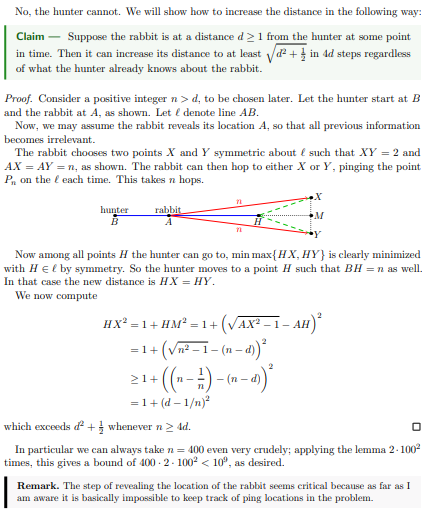
Consider a positive integer \(n>d\), to be chosen later. Let the hunter start at \(B\) and the rabbit at \(A\), as shown. Let \(\ell\) denote line \(AB\). Now, we may assume the rabbit reveals its location \(A\), so that all previous information becomes irrelevant. The rabbit chooses two points \(X\) and \(Y\) symmetric about \(l\) such that \(XY=2\) and \(AX=AY=n\), as shown. The rabbit can then hop to either \(X\) or \(Y\), pinging the point \(P_n\) on the \(\ell\) each time. This takes \(n\) hops. Now among all points \(H\) the hunter can go to, \(\min \max\{HX,HY\}\) is clearly minimized with \(H\in\ell\) by symmetry. So the hunter moves to a point \(H\) such that \(BH=n\) as well. In that case the new distance is \(HX=HY\). We now compute \begin{align*}HX^2&=1+HM^2=1+(\sqrt{AX^2+1}-AH)^2\\&=1+(\sqrt{n^2-1}-(n-d))^2\\&\ge1+\left(\left(n-\frac1n\right)-(n-d)\right)^2\\&=1+(d-1/n)^2\end{align*} which exceeds \(d^2+\frac12\) whenever \(n\ge4d\).\(\qquad\square\)
OronSH:
oh wait does \(this work\) o it's \(
OronSH:
OronSH:
you didn't even finish the problem
 Fortish:
Fortish:
OronSH:
ok but where's evan's diagram
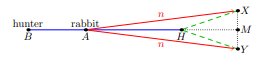 OronSH:
bruh not even asymptote so bad
OronSH:
 Extrinix:
OronSH:
ok
OronSH:
ChooseAUsename:
 Fortish:
@thisgirlpretty are you able to lock this question, ppl keep spamming.
Fortish:
@vocaloid can you lock.
Join our real-time social learning platform and learn together with your friends!
VERNEISH:
Two objects are moving along separate linear paths where each path is described by position, d, and time, t.

 Maci:
what are the best stock apps for people who want to start investing?
Maci:
what are the best stock apps for people who want to start investing?
 Twaylor:
genuienly how do i get better self control i keep watcing youtube and theres this
Twaylor:
genuienly how do i get better self control i keep watcing youtube and theres this
 IzzyCookie:
|dw:1792074056138:dw| Uhm, I don't know where to ask this, but I'm in college welding at my community college, and I need help learning vertical welding for
IzzyCookie:
|dw:1792074056138:dw| Uhm, I don't know where to ask this, but I'm in college welding at my community college, and I need help learning vertical welding for

 thehearken:
not sure if this is considered spam, im sorry if it is, but does anyone have tips
thehearken:
not sure if this is considered spam, im sorry if it is, but does anyone have tips