
 Ferrari:
HELP PLEASE
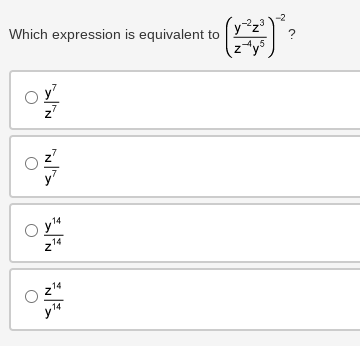 Ferrari:
please please help
 Extrinix:
So what you wanted to do here is use the rule of `a power in a power`, which is this: \(\sf\color{gray}{\text{If a base is raised to a power that is then raised to another power} \\ \text{you multiply the two powers together}}\) Using this rule, you use the -2 power associated on the outside of the parenthesis and multiply every power inside of it by -2.
Ferrari:
okay i don't really understand that i have to do this quickly
Ferrari:
i'll just do it tomorrow :|
Ferrari:
????????
 Juss1Jordan:
With what?
 jhonyy9:
use this \[x^{-2} = \frac{ 1 }{ x^{2} }\]
Extrinix:
Here, I'll draw up the equations \(\color{gray}{\sf{\huge{(}}\dfrac{y^{-2}z^3}{z^{-4}y^5}{\huge{)^{-2}}}}\) That's what it normally looks like, but this is what the -2 does \(\color{gray}{\sf{\huge{(}}\dfrac{y^{4}z^{-6}}{z^{8}y^{-10}}{\huge{)}}}\) Now from that, you can divide both of them, using the rule of power division, which is below \(\sf{\color{gray}{\text{If an exponent with the same base variable is divided by a similar variable, } \\ \text{the exponent of the numerator is subtracted by the exponent of the denominator.}}}\) This would give you \(\sf\color{gray}{y^{(4)-(-10)} z^{(-6)-(8)}}\)
Extrinix:
Whoops sorry jhonyy, didn't see you typing
jhonyy9:
jhonyy9:
Ferrari:
yes thank you very much both
Join our real-time social learning platform and learn together with your friends!
 VERNEISH:
Two objects are moving along separate linear paths where each path is described by position, d, and time, t.
VERNEISH:
Two objects are moving along separate linear paths where each path is described by position, d, and time, t.

 Maci:
what are the best stock apps for people who want to start investing?
Maci:
what are the best stock apps for people who want to start investing?
 Twaylor:
genuienly how do i get better self control i keep watcing youtube and theres this
Twaylor:
genuienly how do i get better self control i keep watcing youtube and theres this
 IzzyCookie:
|dw:1792074056138:dw| Uhm, I don't know where to ask this, but I'm in college welding at my community college, and I need help learning vertical welding for
IzzyCookie:
|dw:1792074056138:dw| Uhm, I don't know where to ask this, but I'm in college welding at my community college, and I need help learning vertical welding for

 thehearken:
not sure if this is considered spam, im sorry if it is, but does anyone have tips
thehearken:
not sure if this is considered spam, im sorry if it is, but does anyone have tips