
 joancrawford:
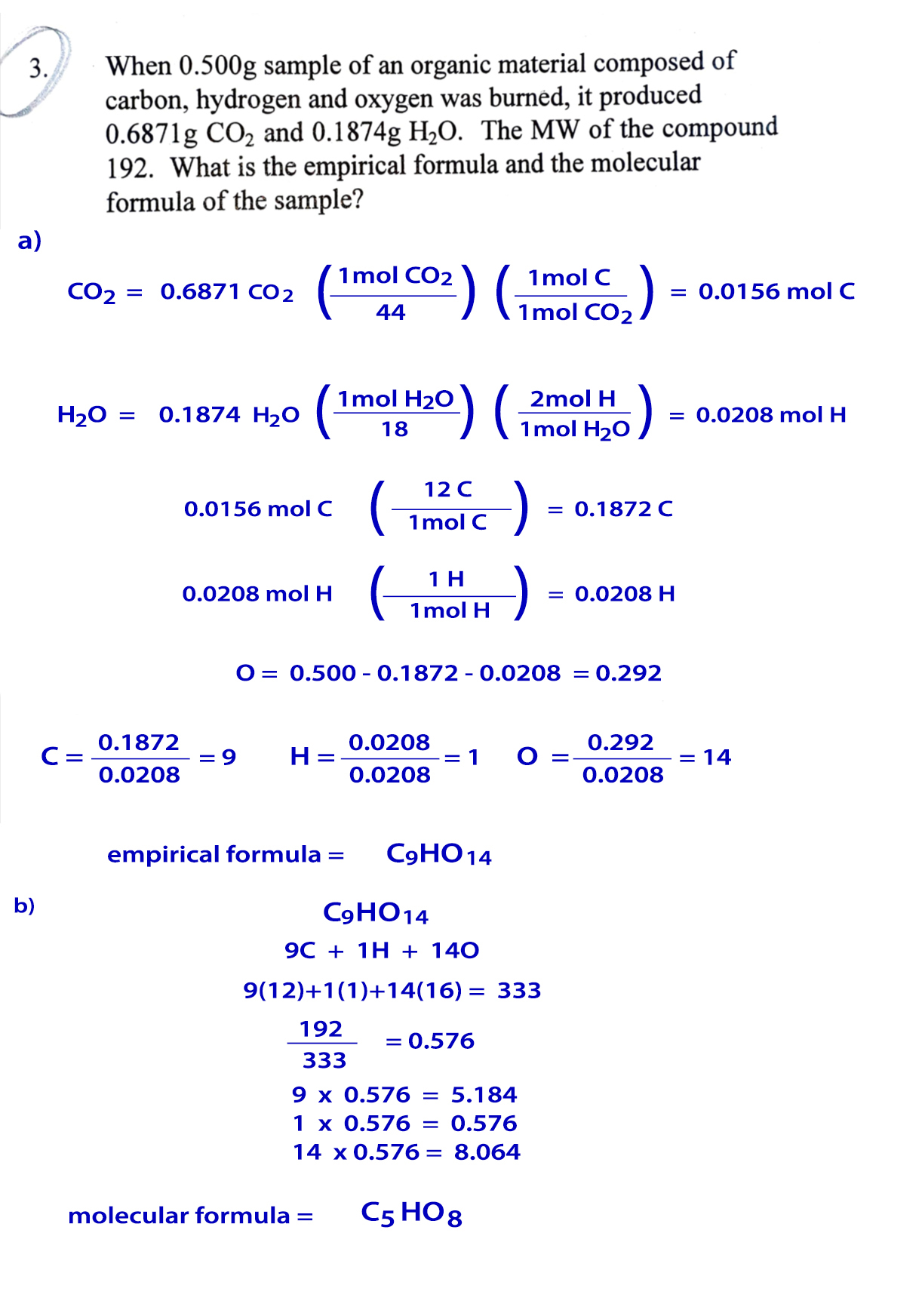
When 0.500g sample of an organic material composed of carbon, hydrogen and oxygen was burned, it produced 0.6871g CO2 and 0.1874g H2O. The MW of the compound 192. What is the empirical formula and the molecular formula of the sample? check below!
joancrawford:
hi, i've been stuck with this question for 9 days now.. this is the solution that i managed. but i think it's wrong. can someone please correct me?
 Vocaloid:
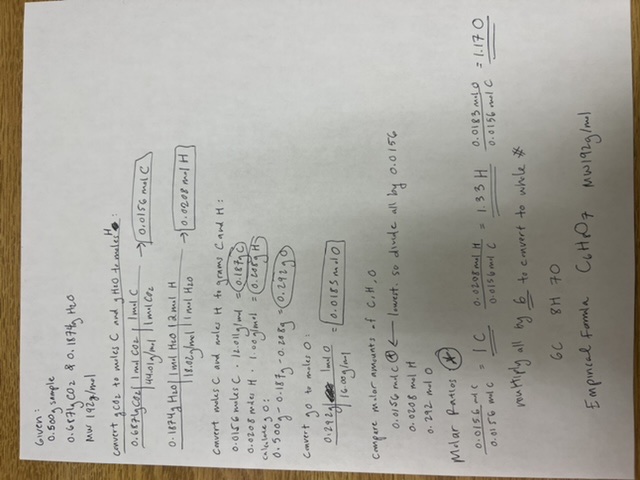
I would recommend always writing units after numbers in your calculations. It helps prevent confusion and makes it clear what you’re working with. You correctly converted 0.6871g CO2 and 0.1874g H2O to moles C and moles H. You correctly calculated grams of oxygen. However, at the next step you’re trying to divide grams of each element by the moles of each element. This will *not* give you the molar ratio. To get the molar ratio, convert 0.292g O to moles. Find the lowest molar amount between moles C, moles H, and moles O. Divide all three molar quantities by the lowest molar amount. The results will be the ratio between C H and O.
Vocaloid:
I’m actually getting weird numbers for this problem so I’ll try to revisit my calculations in a bit
joancrawford:
Vocaloid:
Also something to keep in mind, the molecular formula will always be a whole number multiple of the empirical formula (all the subscripts from the empirical formula should be multiplied by some constant integer to get the molecular formula). So right off the bat I can see something’s up with your molecular formula too.
Vocaloid:
See attached. I put a star by the molar ratio section because I think that’s where you’re getting confused. For this problem, notice how the empirical formula gives us a compound with MW 192g/mol. This matches the MW given in the problem. So for this compound, the molecular formula is actually the same as the empirical formula.
 joancrawford:
Join our real-time social learning platform and learn together with your friends!
 DoltonCarlee:
what are y'all's options on S A T essays because honestly their not that bad
DoltonCarlee:
what are y'all's options on S A T essays because honestly their not that bad

 thereneelg:
Can someone give me a summary of article 231, The war guilt clause?? I need to explain what it is, but I can't find any shortened version of what it is and
thereneelg:
Can someone give me a summary of article 231, The war guilt clause?? I need to explain what it is, but I can't find any shortened version of what it is and
 luisaam2:
What should you do when the person you want to talk to the most is the one making
luisaam2:
What should you do when the person you want to talk to the most is the one making
 Breathless:
https://medal.tv/games/roblox/clips/nAYivIl6oXB6q9QAI?invite=cr-MSxCSk4sMTY4OTA4N
Breathless:
https://medal.tv/games/roblox/clips/nAYivIl6oXB6q9QAI?invite=cr-MSxCSk4sMTY4OTA4N
 Twaylor:
I'm not that good at law can someone fact check this without bias? June 29, 2026, the Supreme Court decided Chatrie v.
Twaylor:
I'm not that good at law can someone fact check this without bias? June 29, 2026, the Supreme Court decided Chatrie v.
 Demon25:
For a hoco proposal with a cheerleader and football player, what else should be a
Demon25:
For a hoco proposal with a cheerleader and football player, what else should be a
