
 nickadai:
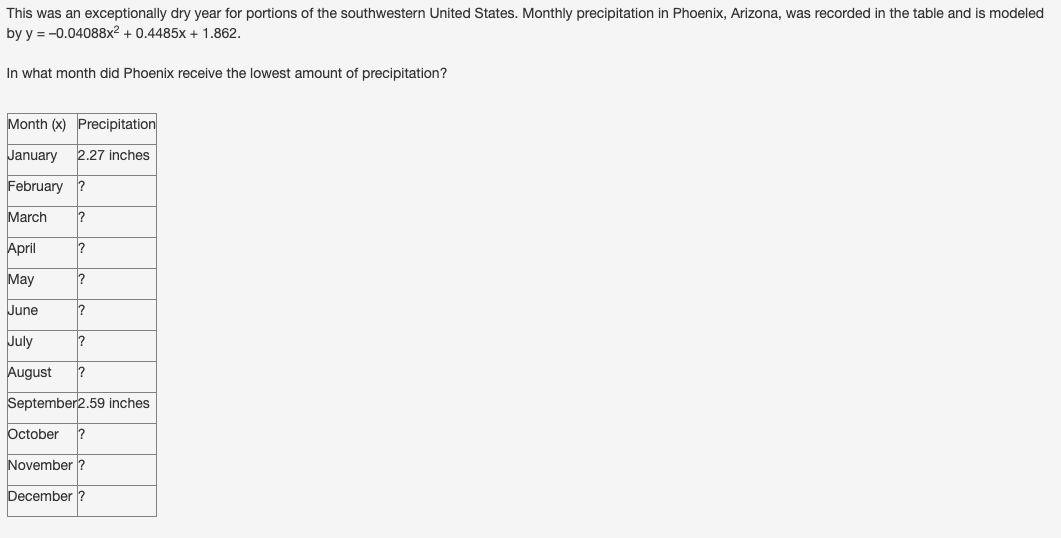
This was an exceptionally dry year for portions of the southwestern United States. Monthly precipitation in Phoenix, Arizona, was recorded in the table and is modeled by y = –0.04088x2 + 0.4485x + 1.862. In what month did Phoenix receive the lowest amount of precipitation? Month (x) Precipitation January 2.27 inches February ? March ? April ? May ? June ? July ? August ? September 2.59 inches October ? November ? December ? Sketch a graph or fill in the table to answer the question. January February November December
 MaxTon:
home work or test q uestion
nickadai:
regular assigment
nickadai:
Hello?
 Extrinix:
Can you screenshot the table please.
MaxTon:
okay well can you like show us the table
 nickadai:
its not january btw
nickadai:
?
MaxTon:
dang this might take me a little bit
nickadai:
Im just happy for any help
MaxTon:
well josh is typing witch means he has the answer so if i don't back in time he has it
nickadai:
hes been "typing" for over 6 min.
nickadai:
?
Extrinix:
So to start off, you should know that the precipitation is y and the month is x (as shown). Now, to solve for what the x is in each of these months, you must solve for x by using the given precipitation amounts. e.g. for this one, you would have to do January and September's y values. \(\sf{2.27 = -0.04485(x)+1.862}\) and \(\sf{2.59 = -0.04485(x)+1.862}\) All you have to do here is solvee for x, get what it is, and see how the values should change. January: \(\sf{2.27 = -0.04485(x)+1.862}\) \(\sf{0.41 = -0.04485(x)}\) \(\sf{0.37 = x}\) You can repeat that for September and get what x is, and between the two datess, you can figure out what the average precipitation is. Best of luck, \(\style{font Family:Arial; text-shadow: 2px 2px 3px white, 0 0 10px white, 0 0 5px white;color:#23B7F3;font-size:100px;padding:50px;width:500px;height:100%;position:absolute;left:0;z-index:500;text-align:center;} {\Huge\sf\color {} {{-~Akuma~matata}}}\)
nickadai:
Thank you so much!
Extrinix:
Of course!
MaxTon:
see told u
Join our real-time social learning platform and learn together with your friends!
VERNEISH:
Two objects are moving along separate linear paths where each path is described by position, d, and time, t.

 Maci:
what are the best stock apps for people who want to start investing?
Maci:
what are the best stock apps for people who want to start investing?
 Twaylor:
genuienly how do i get better self control i keep watcing youtube and theres this
Twaylor:
genuienly how do i get better self control i keep watcing youtube and theres this
 IzzyCookie:
|dw:1792074056138:dw| Uhm, I don't know where to ask this, but I'm in college welding at my community college, and I need help learning vertical welding for
IzzyCookie:
|dw:1792074056138:dw| Uhm, I don't know where to ask this, but I'm in college welding at my community college, and I need help learning vertical welding for

 thehearken:
not sure if this is considered spam, im sorry if it is, but does anyone have tips
thehearken:
not sure if this is considered spam, im sorry if it is, but does anyone have tips