
 Axolotl:
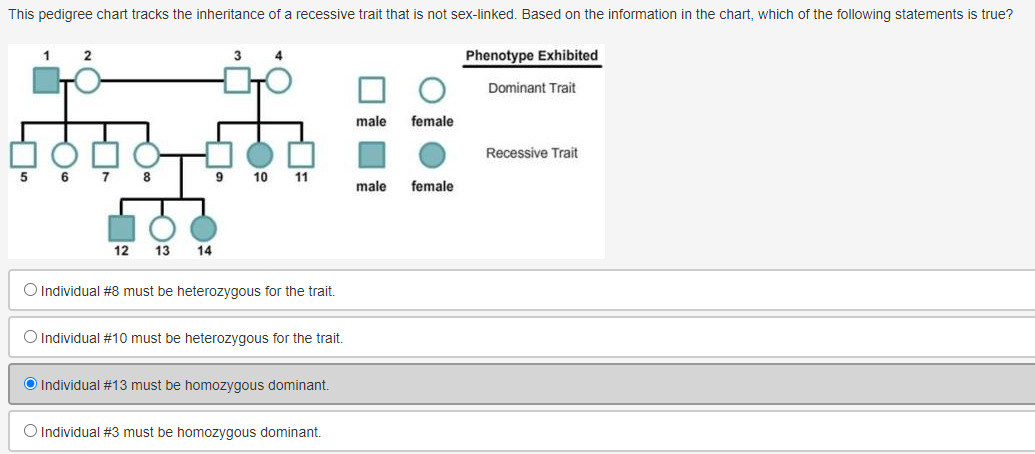
This pedigree chart tracks the inheritance of a recessive trait that is not sex-linked. Based on the information in the chart, which of the following statements is true? This pedigree chart shows three generations. The individuals are numbered from left to right, starting at the top left of the chart. Squares represent males and circles represent females. If the symbol is gray, that individual exhibits the recessive trait. If the symbol is white, the individual exhibits the dominant trait. On the first row there are two couples mated together. The first couple is made up of individuals #1 (recessive) and #2 (dominant). They have four offspring on the second row that all exhibit dominant traits: #5 (dominant), #6 (dominant), #7 (dominant), and #8 (dominant). The second couple in Generation #1 is made up of individual #3 (dominant) and individual #4 (dominant). They have three offspring in Generation 2: #9 (dominant), #10 (recessive), and #11 (dominant). Individual #8 from the first family and individual #9 from the second family mated together and produced three offspring in Generation 3. These offspring are #12 (recessive), #13 (dominant), and #14 (recessive). Individual #8 must be heterozygous for the trait. Individual #10 must be heterozygous for the trait. Individual #13 must be homozygous dominant. Individual #3 must be homozygous dominant.
 Vocaloid:
Thoughts? If offspring 12 and 14 are both homozygous recessive, they must have inherited one recessive allele from each parent. What does that tell you about their dominant parents 8 and 9?
Axolotl:
Vocaloid:
Good, so 8 must be heterozygous which means Answer choice A is correct Offspring 13 **can** be heterozygous *or* homozygous dominant depending on whether it inherits a recessive allele or not, which is why C doesn’t work.
Axolotl:
Join our real-time social learning platform and learn together with your friends!
 DoltonCarlee:
what are y'all's options on S A T essays because honestly their not that bad
DoltonCarlee:
what are y'all's options on S A T essays because honestly their not that bad

 thereneelg:
Can someone give me a summary of article 231, The war guilt clause?? I need to explain what it is, but I can't find any shortened version of what it is and
thereneelg:
Can someone give me a summary of article 231, The war guilt clause?? I need to explain what it is, but I can't find any shortened version of what it is and
 luisaam2:
What should you do when the person you want to talk to the most is the one making
luisaam2:
What should you do when the person you want to talk to the most is the one making
 Breathless:
https://medal.tv/games/roblox/clips/nAYivIl6oXB6q9QAI?invite=cr-MSxCSk4sMTY4OTA4N
Breathless:
https://medal.tv/games/roblox/clips/nAYivIl6oXB6q9QAI?invite=cr-MSxCSk4sMTY4OTA4N
 Twaylor:
I'm not that good at law can someone fact check this without bias? June 29, 2026, the Supreme Court decided Chatrie v.
Twaylor:
I'm not that good at law can someone fact check this without bias? June 29, 2026, the Supreme Court decided Chatrie v.
 Demon25:
For a hoco proposal with a cheerleader and football player, what else should be a
Demon25:
For a hoco proposal with a cheerleader and football player, what else should be a
