
 Axolotl:
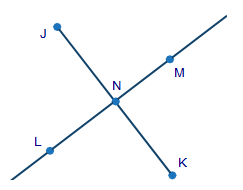
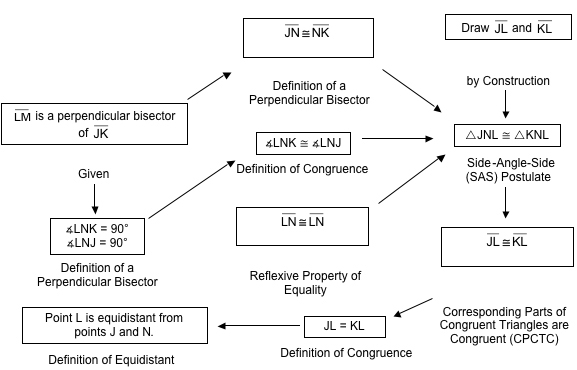
I need help with this now PLEASEEEE!!!! The following is an incorrect flowchart proving that point L, lying on line LM which is a perpendicular bisector of segment JK, is equidistant from points J and K: Segment JK intersects line LM at point N. Line LM is a perpendicular bisector of segment JK; Given. Two arrows are drawn from this statement to the following two statements. Segment JN is congruent to segment NK; Definition of a Perpendicular Bisector. Angle LNK equals 90 degrees, and angle LNJ equals 90 degrees; Definition of a Perpendicular Bisector. An arrow is drawn from this last statement to angle LNK is congruent to angle LNJ; Definition of Congruence. Segment LN is congruent to segment LN; Reflexive Property of Equality. Draw segment JL and segment KL; by Construction. Four arrows from the previous four statements are drawn to the statement triangle JNL is congruent to triangle KNL; Side Angle Side, SAS, Postulate. An arrow from this statement is drawn to the statement segment JL is congruent to segment KL; Corresponding Parts of Congruent Triangles are Congruent CPCTC. An arrow from this statement is drawn to JL equals KL; Definition of Congruence. An arrow from this statement is drawn to Point L is equidistant from points J and N; Definition of Equidistant. What is the error in this flowchart? JL and KL are equal in length, according to the definition of a midpoint. Point L is equidistant from endpoints J and K, not J and N. The arrow between ΔJNL ≅ ΔKNL and segment J L is congruent to segment K L points in the wrong direction. An arrow is missing between the given statement and ∠LNK ≅ ∠LNJ.
 Axolotl:
I think it is either A or B
Axolotl:
@jhonyy9
Axolotl:
I think it is B
Join our real-time social learning platform and learn together with your friends!
 DoltonCarlee:
what are y'all's options on S A T essays because honestly their not that bad
DoltonCarlee:
what are y'all's options on S A T essays because honestly their not that bad

 thereneelg:
Can someone give me a summary of article 231, The war guilt clause?? I need to explain what it is, but I can't find any shortened version of what it is and
thereneelg:
Can someone give me a summary of article 231, The war guilt clause?? I need to explain what it is, but I can't find any shortened version of what it is and
 luisaam2:
What should you do when the person you want to talk to the most is the one making
luisaam2:
What should you do when the person you want to talk to the most is the one making
 Breathless:
https://medal.tv/games/roblox/clips/nAYivIl6oXB6q9QAI?invite=cr-MSxCSk4sMTY4OTA4N
Breathless:
https://medal.tv/games/roblox/clips/nAYivIl6oXB6q9QAI?invite=cr-MSxCSk4sMTY4OTA4N
 Twaylor:
I'm not that good at law can someone fact check this without bias? June 29, 2026, the Supreme Court decided Chatrie v.
Twaylor:
I'm not that good at law can someone fact check this without bias? June 29, 2026, the Supreme Court decided Chatrie v.
 Demon25:
For a hoco proposal with a cheerleader and football player, what else should be a
Demon25:
For a hoco proposal with a cheerleader and football player, what else should be a
