
 Lars:
Lars:
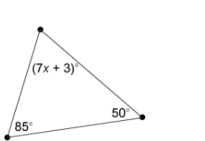
What is the value of x in the triangle to the right?
 Shadow:
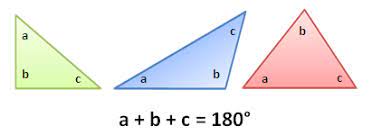
The sum of all angles in a triangle is 180. What equation can you therefore write?
 Lars:
Lars:
Shadow:
So that's two angles you're adding up. What's the third angle's value?
Lars:
Shadow:
The third angle value is 7x + 3
Shadow:
So if we were to add up all those angle values, what do we know for sure it would be equal to?
Lars:
Shadow:
Where did you get 138 from?
Lars:
Shadow:
So that would represent all the angles of the value being added up. Now, refer to what I said at the beginning of this post. What number is universally known as the sum of all angles of a triangle.
Lars:
Shadow:
Yes, therefore what equation could you write, knowing these two pieces of information. You have the sum of all angles of this triangle, and you have the sum of all angles of any given triangle.
Lars:
Shadow:
If the sum of all angles of a triangle is 180, doing 138 + 180 would create a shape much different than a triangle. Here we are trying to write a true equation, basically something that is a true statement about this situation. This will help us solve for x as we will be able to use algebra. So in this case, we could write: \[7x + 3 + 50 + 83 = 180\] Simplify the left side \[7x + 138 = 180\] Then continuing we can solve for x This above statement is true because the sum of all angles of this given triangle would equal the sum of all angles of any given triangle.
Shadow:
Does that make sense?
Lars:
Shadow:
Okay, good. Do you know how to solve for x here?
Lars:
Shadow:
Well, the goal is to leave x alone on one side of the equals sign, so we can get something that looks like: x = ____ This is what's known as 'isolating x'
Shadow:
The first step to isolating x here would be to subtract 138 from both sides of the equation.
Lars:
Shadow:
Remember to subtract it from both sides Cause if you subtract 138 from 138, aka, 138 - 138, you get 0. This helps to isolate x or leave it alone.
Lars:
Shadow:
No, it would look like this |dw:1677265438228:dw|
Shadow:
Since 7x + 138 = 180 is a true statement, we have to keep it true. So whatever you do to one side of the equal sign, you must do to the other.
Lars:
Shadow:
First figure out what 180 - 138 is
Lars:
Shadow:
Correct. So now we have 7x = 42 Now you asked what we're supposed to do with 7x. Keep in mind that when we had 1x + 138, we subtracted. That's because subtraction is the opposite operation of addition. Since 138 was being 'added' onto 7x, we needed to subtract from it. Now here we have 7x. This can be rewritten as 7 times x. What therefore do you think we should do to 7x?
Lars:
Shadow:
If you multiplied 7x by 42, you would get 294x. Then whatever you do to one side, you would have to do to the other side, so you would do 42 times 42 and get 1764. You would end up with 294x = 1764. Keep in mind that what you want to do is isolate x. In this case, you want to be removing numbers / making them smaller.
Shadow:
Lets go back to 7x = 42. What do you think we should do? Keep in mind what I said about opposite operations. We had addition with +138, so we did subtraction. What's the opposite operation of multiplication?
Lars:
Shadow:
Correct. As you may know, whenever you divide a number by itself, what do you get?
Lars:
Shadow:
Yes. Therefore what should we do to both sides of the equation? Looking at: 7x = 42
Shadow:
How do we get x alone?
Lars:
Multiply by 1?
Shadow:
If we multiply it by 1, we just get the same equation 7x = 42 If 7x is basically 7 times x, what can we do that would be the opposite of it, and turn it into x times 1?
Lars:
I'm stumped- I don't know. would we divide 7x times x
Shadow:
Almost. We want to divide both sides by 7. If we do 7x / 7, we get x, now it's completely alone.
Shadow:
All you have to do is do 42/7 |dw:1677266664384:dw|
Lars:
42 divided by 7 is 6
Shadow:
Correct, so now you have the value of x (:
Shadow:
|dw:1677266781706:dw|
Lars:
Ohh this makes so much more sense. Thank you for walking through that with me
Shadow:
No problem. I saw that you've been doing a lot of geometry + algebra so I wanted to give you a walkthrough, I think it'll help you a lot.
Shadow:
You can always bookmark this post and come back to it if you forget what steps to do.
Lars:
Okay I'll go ahead and do that. I really appreciate this :)
Shadow:
No problem. For most of geometry questions like this, it's just: 1. Creating a true equation 2. Solving for x by isolating it. Good luck in your math endeavors (:
Join our real-time social learning platform and learn together with your friends!
 VERNEISH:
Two objects are moving along separate linear paths where each path is described by position, d, and time, t.
VERNEISH:
Two objects are moving along separate linear paths where each path is described by position, d, and time, t.

 Maci:
what are the best stock apps for people who want to start investing?
Maci:
what are the best stock apps for people who want to start investing?
 Twaylor:
genuienly how do i get better self control i keep watcing youtube and theres this
Twaylor:
genuienly how do i get better self control i keep watcing youtube and theres this
 IzzyCookie:
|dw:1792074056138:dw| Uhm, I don't know where to ask this, but I'm in college welding at my community college, and I need help learning vertical welding for
IzzyCookie:
|dw:1792074056138:dw| Uhm, I don't know where to ask this, but I'm in college welding at my community college, and I need help learning vertical welding for

 thehearken:
not sure if this is considered spam, im sorry if it is, but does anyone have tips
thehearken:
not sure if this is considered spam, im sorry if it is, but does anyone have tips