
 Arieonna:
4/10
 Arieonna:
@oliver69 can u please help me
 OLIVER69:
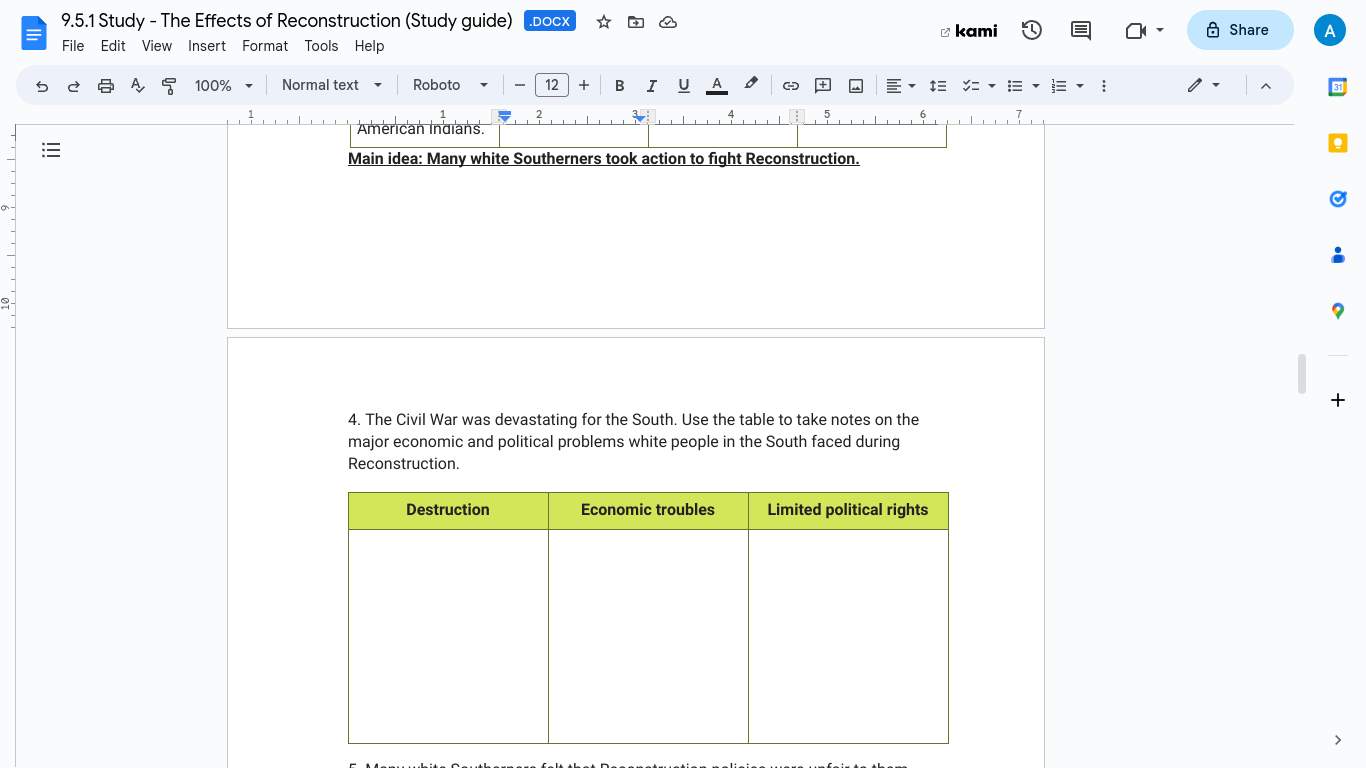
Destruction: - Violence is endemic in the South, from the end of the Civil War onwards. There was sporadic local violence in 1865-65: contract disputes, and disputes over etiquette. - A black guy doesn't tip his hat to a white and suddenly people are shooting each other. People refuse to get off the sidewalk to let someone else pass. - All sorts of local incidents produce amazing outbreaks of violence. The Freedman's Bureau in Texas has a register of murders with over a thousand in 1865-66 -- and they try to give the reason, you know. Economic troubles: - In the years after World War II, a new group of economic historians — many of them trained in economics departments — focused their energies on the explanation of economic growth and development in the United States. - his reconsideration of the Civil War by economic historians can be loosely grouped into four broad issues: the “economic” causes of the war; the “costs” of the war; the problem of financing the War; and a re-examination of the Hacker-Beard thesis that the War was a turning point in American economic history. Limited optical rights: - After the Civil War, with the protection of the Thirteenth, Fourteenth, and Fifteenth Amendments to the Constitution and the Civil Rights Act of 1866, African Americans enjoyed a period when they were allowed to vote, actively participate in the political process, acquire the land of former owners, seek their own employment, and use public accommodations. - Opponents of this progress, however, soon rallied against the former slaves' freedom and began to find means for eroding the gains for which many had shed their blood. (I hoped this helps, this website helped a lot https://www.loc.gov/exhibits/african-american-odyssey/reconstruction.html )
Join our real-time social learning platform and learn together with your friends!
 VERNEISH:
Two objects are moving along separate linear paths where each path is described by position, d, and time, t.
VERNEISH:
Two objects are moving along separate linear paths where each path is described by position, d, and time, t.

 Maci:
what are the best stock apps for people who want to start investing?
Maci:
what are the best stock apps for people who want to start investing?
 Twaylor:
genuienly how do i get better self control i keep watcing youtube and theres this
Twaylor:
genuienly how do i get better self control i keep watcing youtube and theres this
 IzzyCookie:
|dw:1792074056138:dw| Uhm, I don't know where to ask this, but I'm in college welding at my community college, and I need help learning vertical welding for
IzzyCookie:
|dw:1792074056138:dw| Uhm, I don't know where to ask this, but I'm in college welding at my community college, and I need help learning vertical welding for

 thehearken:
not sure if this is considered spam, im sorry if it is, but does anyone have tips
thehearken:
not sure if this is considered spam, im sorry if it is, but does anyone have tips