
 Gucchi:
geometry help
 Gucchi:
@vocaloid can you give some steps on how to do this
 Vocaloid:
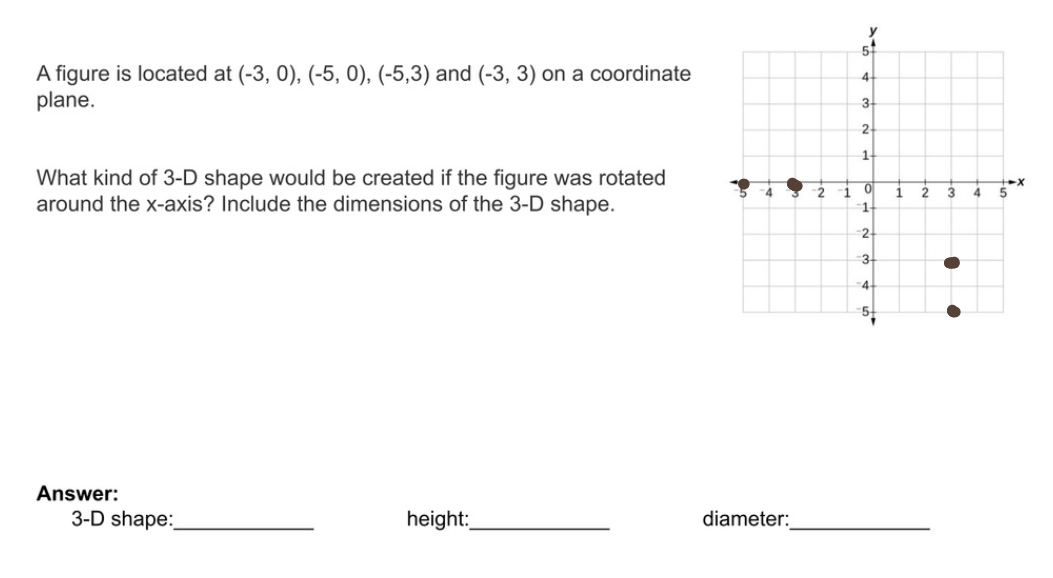
there are some mistakes in the points you've plotted. (-5,3) and (-3,3) are in quadrant II. |dw:1680304075347:dw| this will make a rectangle, which, as you've demonstrated in previous problem, will make a cylinder when rotated about the x-axis.
Vocaloid:
|dw:1680304200792:dw| should be straightforward to calculate the appropriate lengths from here
Gucchi:
wait so would the height be 2 and diameter 3?
Vocaloid:
notice how the x-axis goes along the diameter of the cylinder. consider one of the circles as the base of the cylinder. I'll use the right one as an example. the center of the circle is (-3,0). the circle's radius extends from (-3,0) to (-3,3) which has a distance of 3 points. (3 - 0 = 3). double that to get the diameter, 6. the height is 2 as you have correctly stated (5-3=2).
Gucchi:
Vocaloid:
|dw:1680305102521:dw|
Gucchi:
Join our real-time social learning platform and learn together with your friends!
 DoltonCarlee:
what are y'all's options on S A T essays because honestly their not that bad
DoltonCarlee:
what are y'all's options on S A T essays because honestly their not that bad

 thereneelg:
Can someone give me a summary of article 231, The war guilt clause?? I need to explain what it is, but I can't find any shortened version of what it is and
thereneelg:
Can someone give me a summary of article 231, The war guilt clause?? I need to explain what it is, but I can't find any shortened version of what it is and
 luisaam2:
What should you do when the person you want to talk to the most is the one making
luisaam2:
What should you do when the person you want to talk to the most is the one making
 Breathless:
https://medal.tv/games/roblox/clips/nAYivIl6oXB6q9QAI?invite=cr-MSxCSk4sMTY4OTA4N
Breathless:
https://medal.tv/games/roblox/clips/nAYivIl6oXB6q9QAI?invite=cr-MSxCSk4sMTY4OTA4N
 Twaylor:
I'm not that good at law can someone fact check this without bias? June 29, 2026, the Supreme Court decided Chatrie v.
Twaylor:
I'm not that good at law can someone fact check this without bias? June 29, 2026, the Supreme Court decided Chatrie v.
 Demon25:
For a hoco proposal with a cheerleader and football player, what else should be a
Demon25:
For a hoco proposal with a cheerleader and football player, what else should be a
