
 ElexusQuimby:
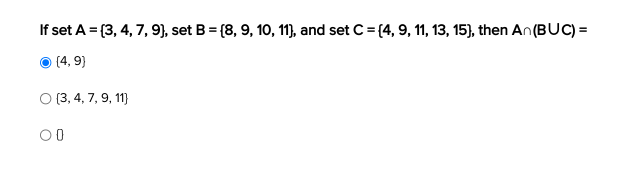
If set A = {3, 4, 7, 9}, set B = {8, 9, 10, 11}, and set C = {4, 9, 11, 13, 15}, then A∩(B∪C) =
 mikewwe13:
First, we need to find the union of sets B and C, which is the set of all elements that are in either B or C or both. B ∪ C = {4, 8, 9, 10, 11, 13, 15} Next, we need to find the intersection of set A and the union of sets B and C, which is the set of all elements that are in both A and (B ∪ C). A ∩ (B ∪ C) = {9} Therefore, A ∩ (B ∪ C) = {9}.
ElexusQuimby:
mikewwe13:
Hmph okay. I apologize for the confusion. Let's break down the problem to find the answer: A ∩ (B ∪ C) means the intersection of set A with the union of sets B and C. B ∪ C is the set of all elements that are in either B or C or both. B ∪ C = {4, 8, 9, 10, 11, 13, 15} Now, we need to find the intersection of set A with the set {4, 8, 9, 10, 11, 13, 15}. A ∩ (B ∪ C) = {9} since 9 is the only element that is in both set A and the set (B ∪ C). Therefore, the answer is {9}.
ElexusQuimby:
Okay. Thank you. So I am going to choose option A. the {4,9}
mikewwe13:
You’re welcome I'm sorry, but {4,9} is not the correct answer. The correct answer is {9}. Unless it’s together, okay choose that
ElexusQuimby:
So choose the last option the one that says {}?
mikewwe13:
No, the correct answer is not the option that says {}. The correct answer is {9}.
ElexusQuimby:
There is no Nine
 mikewwe13:
In that case, the closest answer option is {3, 4, 7, 9, 11}, since it contains the elements 4 and 9, which are both in the sets A and C respectively, and also contains the elements 3, 7, and 11 which are in either set A, B, or C. However, it's important to note that {3, 4, 7, 9, 11} is not the exact answer to the problem, since it includes elements that are not in the intersection A ∩ (B ∪ C). The only element in the intersection is 9, which means that {9} is the correct answer.
mikewwe13:
Let me know what you have
ElexusQuimby:
I did the last answer. But i don't know what it could be I got that question wrong so idk.
mikewwe13:
The very last one or mine
ElexusQuimby:
the very last one. Your answer wasnt there.
mikewwe13:
Oh ok
ElexusQuimby:
i kept saying it.
Join our real-time social learning platform and learn together with your friends!
 VERNEISH:
Two objects are moving along separate linear paths where each path is described by position, d, and time, t.
VERNEISH:
Two objects are moving along separate linear paths where each path is described by position, d, and time, t.

 Maci:
what are the best stock apps for people who want to start investing?
Maci:
what are the best stock apps for people who want to start investing?
 Twaylor:
genuienly how do i get better self control i keep watcing youtube and theres this
Twaylor:
genuienly how do i get better self control i keep watcing youtube and theres this
 IzzyCookie:
|dw:1792074056138:dw| Uhm, I don't know where to ask this, but I'm in college welding at my community college, and I need help learning vertical welding for
IzzyCookie:
|dw:1792074056138:dw| Uhm, I don't know where to ask this, but I'm in college welding at my community college, and I need help learning vertical welding for

 thehearken:
not sure if this is considered spam, im sorry if it is, but does anyone have tips
thehearken:
not sure if this is considered spam, im sorry if it is, but does anyone have tips