
 TinoTheTurtle:
need help pls!
 youngtringotringo:
ok
youngtringotringo:
nooonooooo
 Luigi0210:
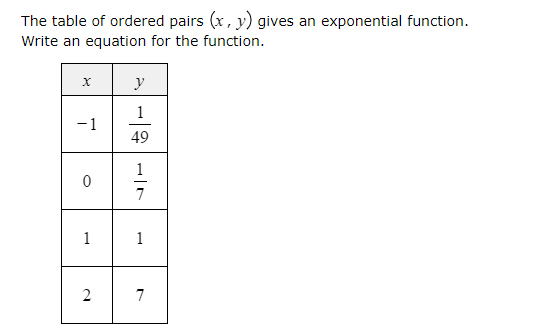
So what I came up with: \[\large y=7^{(x-1)}\] You can verify by pluggin in values: x=0 \[\large y= 7^{-1} = \frac{1}{7} \] x= 1 \[\large y=7^0 =1\] x= 2 \[\large y=7^1=7 \]
Luigi0210:
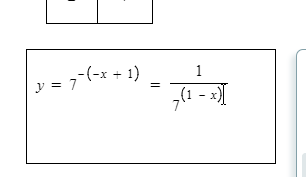
If you want it with a base of 1/7 you could factor out a negative: \[\large y=7^{-(-x+1)} = \frac{ 1}{7^{(1-x)}} \]
Luigi0210:
Honestly, you can start with any base, it doesn't necessarily have to be the value at x=0.
Luigi0210:
As long as it works, of course. Starting with the value at x=0 is just a way to have an idea of what it could be.
TinoTheTurtle:
@luigi0210 so.. which of the answers should i try
TinoTheTurtle:
theres only one correct answer btw, i shouldve mentioned that earlier
Luigi0210:
They are both the same function basically. But if you're looking for a function involving the base at x=0, then the fraction.
TinoTheTurtle:
it told me some parts of my expression were correct, and some were wrong
 TinoTheTurtle:
@luigi0210
Luigi0210:
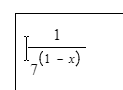
lol try just the fraction.
TinoTheTurtle:
it told me it was incorrect, is there any way you would like me to try it?
 Luigi0210:
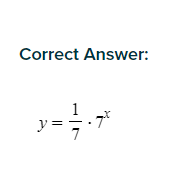
Try just the 7^ (x-1) If it's not that... then either I need to reevaluate my math skills or the answer key is wrong lol
 TinoTheTurtle:
thank god theres a "try another one" option
 TinoTheTurtle:
@luigi0210 HELP THICK BOI
Luigi0210:
That is literally the same function too, if you graph them side-by-side.. you should complain loll
TinoTheTurtle:
question mark
Luigi0210:
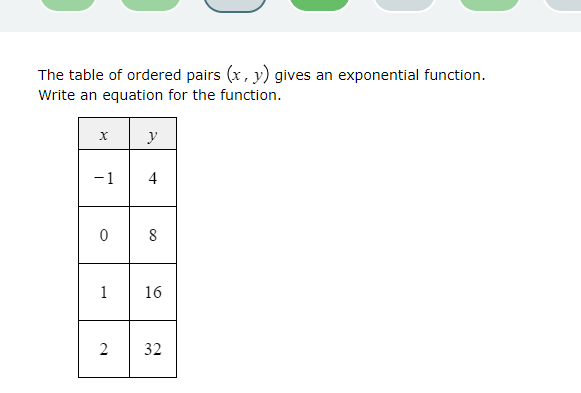
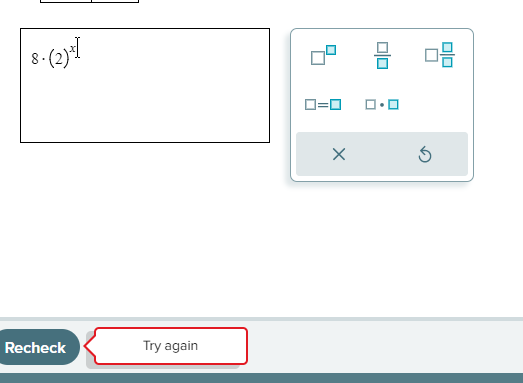
But okay, using the "format" they want I came up with this: \[\large 8*(2)^x \]
Luigi0210:
At -1, it becomes 8*(1/2) at 0 it is 8*1 at 1 it is 8*2 at 2 it is 8*4
TinoTheTurtle:
LOL ITS WRONG
TinoTheTurtle:
i think its me.... idk
 Luigi0210:
Ya know what, let's ask someone smarter lol @jhonyy9 @narad
TinoTheTurtle:
hes probably playing red dead, check his discord status
Join our real-time social learning platform and learn together with your friends!
 DoltonCarlee:
what are y'all's options on S A T essays because honestly their not that bad
DoltonCarlee:
what are y'all's options on S A T essays because honestly their not that bad

 thereneelg:
Can someone give me a summary of article 231, The war guilt clause?? I need to explain what it is, but I can't find any shortened version of what it is and
thereneelg:
Can someone give me a summary of article 231, The war guilt clause?? I need to explain what it is, but I can't find any shortened version of what it is and
 luisaam2:
What should you do when the person you want to talk to the most is the one making
luisaam2:
What should you do when the person you want to talk to the most is the one making
 Breathless:
https://medal.tv/games/roblox/clips/nAYivIl6oXB6q9QAI?invite=cr-MSxCSk4sMTY4OTA4N
Breathless:
https://medal.tv/games/roblox/clips/nAYivIl6oXB6q9QAI?invite=cr-MSxCSk4sMTY4OTA4N
 Twaylor:
I'm not that good at law can someone fact check this without bias? June 29, 2026, the Supreme Court decided Chatrie v.
Twaylor:
I'm not that good at law can someone fact check this without bias? June 29, 2026, the Supreme Court decided Chatrie v.
 Demon25:
For a hoco proposal with a cheerleader and football player, what else should be a
Demon25:
For a hoco proposal with a cheerleader and football player, what else should be a
