
 Bella18:
Ok so I'm on this math problem and I need help its 2/16× × =18/32
 Tbone:
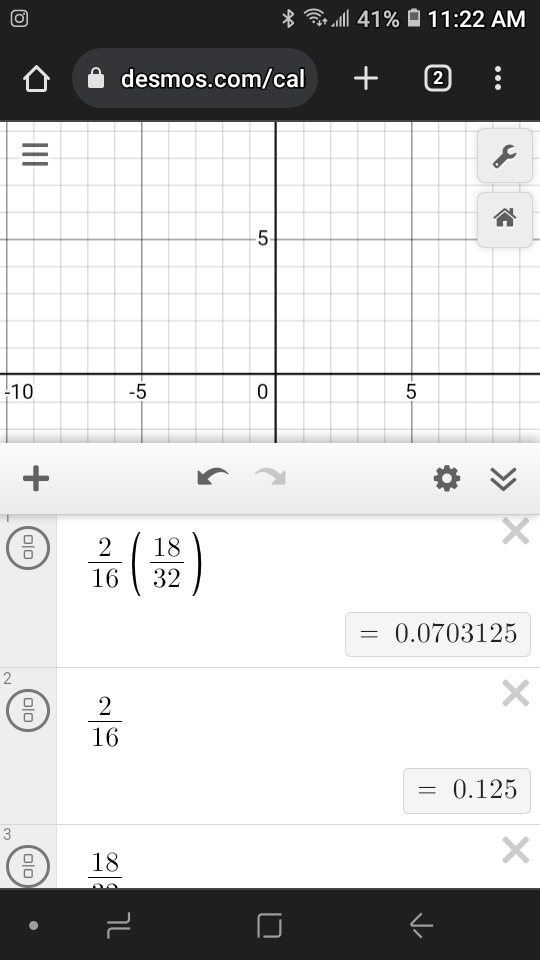
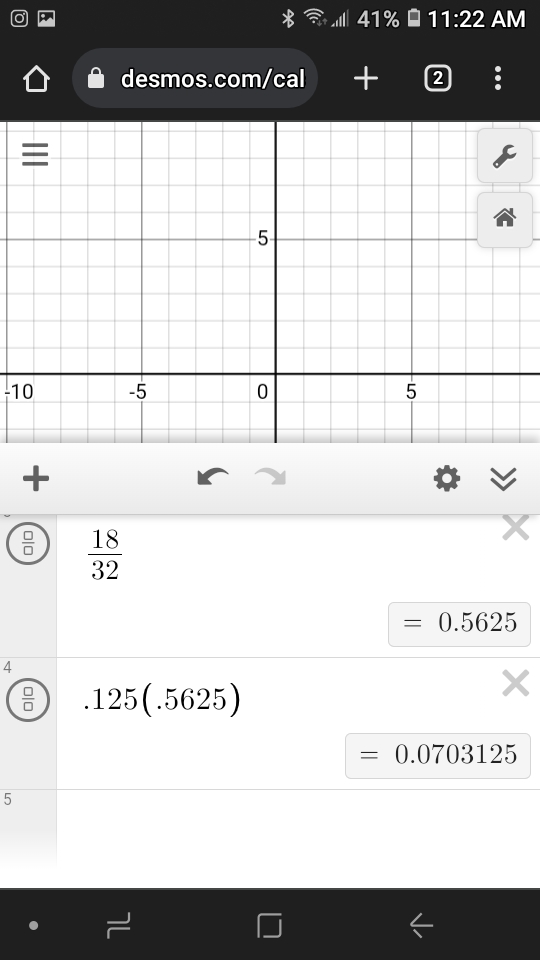
So you're going to want to do 2 over 16(18 over 32 heres how I did it. But I think you have to simplify
 Bella18:
Ok ty that helped
 idfkaa:
idfkaa:
Bella18:
Yes
 umm:
umm:
I don't feel like Tbone's response is what you were looking for... So I'll try my best to answer this.
umm:
Given: \[\frac{ 2 }{ 16 } \times x\] \[x = \frac{ 18 }{ 32 }\] It would look like this: \[\frac{ 2 }{ 16 }\left(\begin{matrix}18 \\ 32\end{matrix}\right)\] Now, if you apply the rule of \[(a)=a\] It would look like this: \[\left(\begin{matrix}18 \\ 32\end{matrix}\right) = \frac{ 18 }{ 32 }\] So therefore for part 1, it'd completely look like this:\[= \frac{ 2 }{ 16 } \times \frac{ 18 }{ 32 }\] Now, you'd just need to cancel the numbers: \[\frac{ 2 }{ 16 } = \frac{ 1 }{ 8 }\] \[\frac{ 1 }{ 8 } \times \frac{ 18 }{ 32 }\] In order to do that, we use factoring, which will look like this on the second fraction: \[\frac{ 18 }{ 32 } = \frac{ 9 }{ 16 }\] Factoring: \[18=2\times9\] \[=\frac{ 2\times9 }{ 32 }\] Factoring continued:\[32=2\times 16\] \[=\frac{ 2\times9 }{ 2\times16 }\] *Canceling the common factor: 2 \[=\frac{ 9 }{ 16 }\]\[=\frac{ 1 }{ 8 }\times \frac{ 9 }{ 16 }\] Applying the fraction rule; example: \[\frac{ a }{ b} \times \frac{ c }{ d }=\frac{ a \times c }{ b \times d }\] With our problem: \[=\frac{ 1 \times 9 }{ 8 \times 16}\] Multiplication: \[1 \times 9 = 9\] \[8 \times 16 = 128\] Which leaves you with your final answer: \[=\frac{ 9 }{ 128 }\] *For such terms as canceling for fractions, it's basically dividing a smaller number for both the top number and bottom number which is our common factor. Here's an example \[\frac{ 3 }{ 9 } = \frac{ 1 }{ 3 }\] Which leads 3 to be your common factor. Hope this has helped, and good luck! (:
Join our real-time social learning platform and learn together with your friends!
 DoltonCarlee:
what are y'all's options on S A T essays because honestly their not that bad
DoltonCarlee:
what are y'all's options on S A T essays because honestly their not that bad

 thereneelg:
Can someone give me a summary of article 231, The war guilt clause?? I need to explain what it is, but I can't find any shortened version of what it is and
thereneelg:
Can someone give me a summary of article 231, The war guilt clause?? I need to explain what it is, but I can't find any shortened version of what it is and
 luisaam2:
What should you do when the person you want to talk to the most is the one making
luisaam2:
What should you do when the person you want to talk to the most is the one making
 Breathless:
https://medal.tv/games/roblox/clips/nAYivIl6oXB6q9QAI?invite=cr-MSxCSk4sMTY4OTA4N
Breathless:
https://medal.tv/games/roblox/clips/nAYivIl6oXB6q9QAI?invite=cr-MSxCSk4sMTY4OTA4N
 Twaylor:
I'm not that good at law can someone fact check this without bias? June 29, 2026, the Supreme Court decided Chatrie v.
Twaylor:
I'm not that good at law can someone fact check this without bias? June 29, 2026, the Supreme Court decided Chatrie v.
 Demon25:
For a hoco proposal with a cheerleader and football player, what else should be a
Demon25:
For a hoco proposal with a cheerleader and football player, what else should be a
