
 ihatelifeFS420:
help
 ihatelifeFS420:
@sailor
ihatelifeFS420:
@dontsaymyname
ihatelifeFS420:
@laylalyssa
 carlosbigbain:
🧀
 demolisher1224:
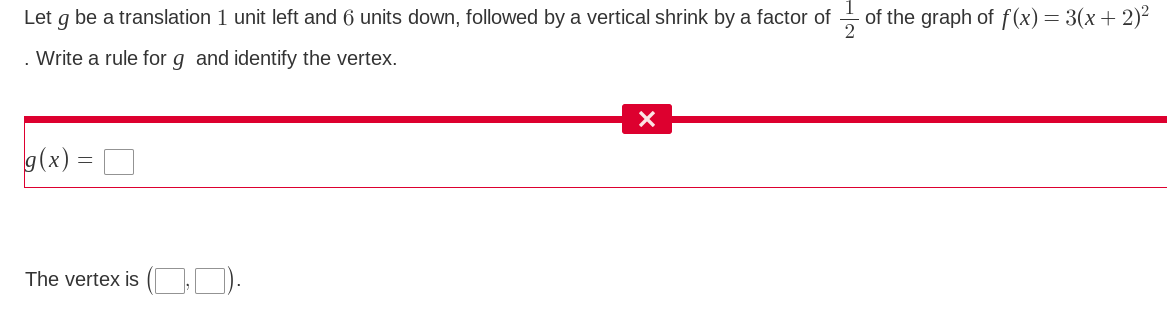
To write a rule for the transformation described, we can break it down into two parts: 1. Translation 1 unit left and 6 units down: This can be represented as g₁(x) = (x - 1, f(x) - 6). 2. Vertical shrink by a factor of 1/2: This can be represented as g₂(x) = (x, 1/2 * f(x)). Combining these two transformations, the rule for g is: g(x) = g₂(g₁(x)) = (x - 1, 1/2 * (f(x) - 6)) Now, let's identify the vertex of the transformed graph: The original function f(x) = 3(x + 2)² is in the form f(x) = a(x - h)² + k, where (h, k) represents the vertex of the parabola. Comparing this with the equation of our transformed graph, we see that the vertex of the transformed graph is obtained by applying the translation and shrinkage to the vertex of the original graph. So, the vertex of the transformed graph can be found by substituting x = -2 (the x-coordinate of the original vertex) into the rule of g: g(-2) = (-2 - 1, 1/2 * (f(-2) - 6)) = (-3, 1/2 * (3(-2 + 2)² - 6)) = (-3, 1/2 * (3(0) - 6)) = (-3, 1/2 * (-6)) = (-3, -3) Therefore, the vertex of the transformed graph is (-3, -3).
demolisher1224:
Hope this helps
ihatelifeFS420:
demolisher1224:
Your greatly welcome
ihatelifeFS420:
I don't know what i'm typing in wrong
Join our real-time social learning platform and learn together with your friends!
 DoltonCarlee:
what are y'all's options on S A T essays because honestly their not that bad
DoltonCarlee:
what are y'all's options on S A T essays because honestly their not that bad

 thereneelg:
Can someone give me a summary of article 231, The war guilt clause?? I need to explain what it is, but I can't find any shortened version of what it is and
thereneelg:
Can someone give me a summary of article 231, The war guilt clause?? I need to explain what it is, but I can't find any shortened version of what it is and
 luisaam2:
What should you do when the person you want to talk to the most is the one making
luisaam2:
What should you do when the person you want to talk to the most is the one making
 Breathless:
https://medal.tv/games/roblox/clips/nAYivIl6oXB6q9QAI?invite=cr-MSxCSk4sMTY4OTA4N
Breathless:
https://medal.tv/games/roblox/clips/nAYivIl6oXB6q9QAI?invite=cr-MSxCSk4sMTY4OTA4N
 Twaylor:
I'm not that good at law can someone fact check this without bias? June 29, 2026, the Supreme Court decided Chatrie v.
Twaylor:
I'm not that good at law can someone fact check this without bias? June 29, 2026, the Supreme Court decided Chatrie v.
 Demon25:
For a hoco proposal with a cheerleader and football player, what else should be a
Demon25:
For a hoco proposal with a cheerleader and football player, what else should be a
