
 ihatelifeFS420:
help
 ihatelifeFS420:
@oliver69
 HotPockets14:
Why don't you ask the teacher for help
 OLIVER69:
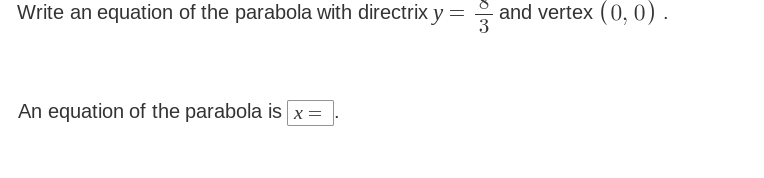
The equation of a parabola is \[x=\frac{ 1 }{ 4(f−h) }(y−k)^2+h\], where (h,k) is the vertex and (f,k) is the focus. Thus, h=0, k=0. The distance from the focus to the vertex is equal to the distance from the vertex to the directrix: f−h=h−8/3. Solving the system {h=0, k=0, f−h=h−83 we get that h=0, k=0, f=−8/3 The axis of symmetry is the line perpendicular to the directrix that passes through the vertex and the focus: y=0. The focal length is the distance between the focus and the vertex: 8/3. The focal parameter is the distance between the focus and the directrix: 16/3 The latus rectum is parallel to the directrix and passes through the focus: x=−8/3 The endpoints of the latus rectum can be found by solving the system {3/2x+3y^2=0 The endpoints of the latus rectum are (−8/3,−16/3)(-8/3,16/3) The length of the latus rectum (focal width) is four times the distance between the vertex and the focus: 32/3 The eccentricity of a parabola is always 1 The x-intercepts can be found by setting y=0 in the equation and solving for x x-intercept: (0,0) The y-intercepts can be found by setting x=0 in the equation and solving for y: y-intercept: (0,0) In standard form the answer is \[x=−\frac{ 3y^2 }{ 32 }\] (Fyi I'm glad I can help and I don't care what other's say lol)
HotPockets14:
ihatelifeFS420:
says it's not right
OLIVER69:
ihatelifeFS420:
Join our real-time social learning platform and learn together with your friends!
 DoltonCarlee:
what are y'all's options on S A T essays because honestly their not that bad
DoltonCarlee:
what are y'all's options on S A T essays because honestly their not that bad

 thereneelg:
Can someone give me a summary of article 231, The war guilt clause?? I need to explain what it is, but I can't find any shortened version of what it is and
thereneelg:
Can someone give me a summary of article 231, The war guilt clause?? I need to explain what it is, but I can't find any shortened version of what it is and
 luisaam2:
What should you do when the person you want to talk to the most is the one making
luisaam2:
What should you do when the person you want to talk to the most is the one making
 Breathless:
https://medal.tv/games/roblox/clips/nAYivIl6oXB6q9QAI?invite=cr-MSxCSk4sMTY4OTA4N
Breathless:
https://medal.tv/games/roblox/clips/nAYivIl6oXB6q9QAI?invite=cr-MSxCSk4sMTY4OTA4N
 Twaylor:
I'm not that good at law can someone fact check this without bias? June 29, 2026, the Supreme Court decided Chatrie v.
Twaylor:
I'm not that good at law can someone fact check this without bias? June 29, 2026, the Supreme Court decided Chatrie v.
 Demon25:
For a hoco proposal with a cheerleader and football player, what else should be a
Demon25:
For a hoco proposal with a cheerleader and football player, what else should be a
