
 clon800t:
help! 4 questions



 Treeko:
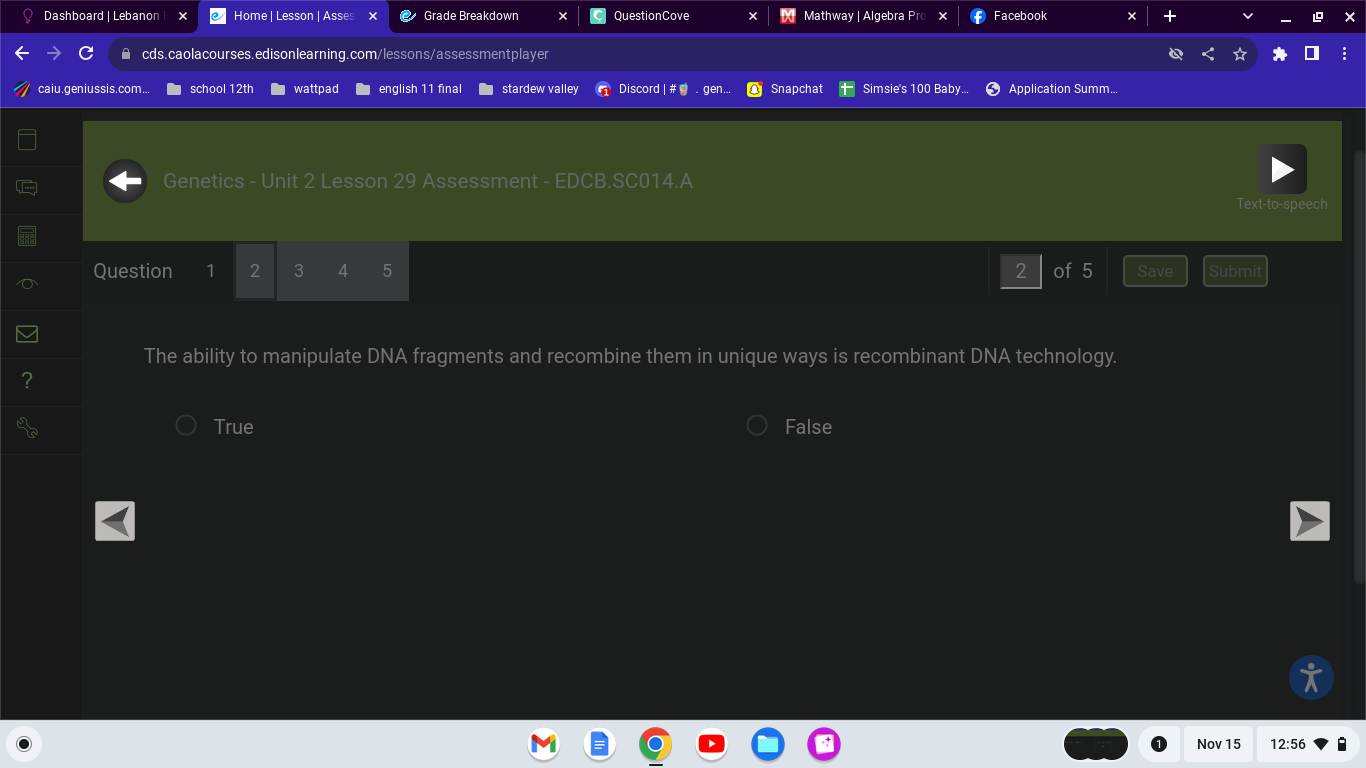
Okay so, 1. Recombinant DNA technology involves using enzymes and various laboratory techniques to manipulate and isolate DNA segments of interest. This method can be used to combine (or splice) DNA from different species or to create genes with new functions. The resulting copies are often referred to as recombinant DNA. 2. In addition to two proteins and a restriction enzyme, the Type I restriction modification system used in bacteria involves a DNA methyltransferase. The DNA methyltransferase adds a methyl group to a specific DNA sequence, which protects the bacterial DNA from being digested by the restriction enzyme. The two proteins involved in the system are a restriction endonuclease and a modification methylase. The restriction endonuclease cuts DNA at a specific sequence, while the modification methylase adds a methyl group to the same sequence, preventing the restriction endonuclease from cutting it. This system is important for bacteria to protect themselves from foreign DNA, such as that from bacteriophages. 3. In general, recombinant DNA is not restricted to DNA that has been purposefully modified in the lab; rather, it can occur spontaneously in a wide variety of animals. 4.It is possible that the viruses used in recombinant DNA technology can harm the bacteria cell. In this process, bacteria cells are used to produce large quantities of recombinant proteins using genetically modified DNA. This is achieved by inserting a foreign DNA sequence into a bacteria cell, which then uses its own machinery to produce the desired protein. However, in some cases, the process of inserting the foreign DNA can cause damage to the bacteria cell, leading to reduced growth or even death. Therefore, it is important to carefully optimize the conditions of the recombinant DNA process to minimize any potential harm to the bacteria cell.
 Aliciaa:
Join our real-time social learning platform and learn together with your friends!
 DoltonCarlee:
what are y'all's options on S A T essays because honestly their not that bad
DoltonCarlee:
what are y'all's options on S A T essays because honestly their not that bad

 thereneelg:
Can someone give me a summary of article 231, The war guilt clause?? I need to explain what it is, but I can't find any shortened version of what it is and
thereneelg:
Can someone give me a summary of article 231, The war guilt clause?? I need to explain what it is, but I can't find any shortened version of what it is and
 luisaam2:
What should you do when the person you want to talk to the most is the one making
luisaam2:
What should you do when the person you want to talk to the most is the one making
 Breathless:
https://medal.tv/games/roblox/clips/nAYivIl6oXB6q9QAI?invite=cr-MSxCSk4sMTY4OTA4N
Breathless:
https://medal.tv/games/roblox/clips/nAYivIl6oXB6q9QAI?invite=cr-MSxCSk4sMTY4OTA4N
 Twaylor:
I'm not that good at law can someone fact check this without bias? June 29, 2026, the Supreme Court decided Chatrie v.
Twaylor:
I'm not that good at law can someone fact check this without bias? June 29, 2026, the Supreme Court decided Chatrie v.
 Demon25:
For a hoco proposal with a cheerleader and football player, what else should be a
Demon25:
For a hoco proposal with a cheerleader and football player, what else should be a
