
 KyledaGreat:
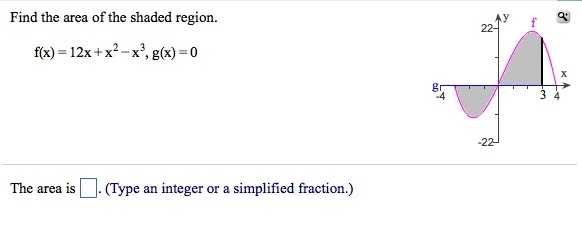
Does anyone know how to solve this area of the shaded region calculus problem? Please help if you know how to solve this what would the answer be?
 hunter3506:
You have to figure out what x is first
 velmalovesshaggy145:
Dang, we went over this on the midterm.
KyledaGreat:
I feel the curves intersect at x = 0, x = 3, and x = -4 but I wasn’t sure if it was right
 Lui0210:
Are you sure it's -4? Look again
 Lui0210:
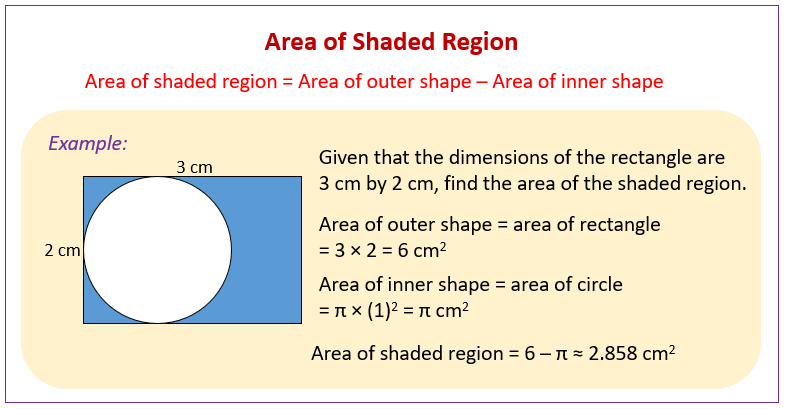
Set up an integral from 0 to 3, and subtract that from the area from - 3 to 0
hunter3506:
velmalovesshaggy145:
Yeah I realized that after I posted it lol
velmalovesshaggy145:
Review this page on Cuemath and if you still don't get it they'll help you. You will probably understand it better after you review the resource https://www.cuemath.com/calculus/area-under-the-curve/
KyledaGreat:
Ahh okay, I think I see what you're saying now. Okay, so if the whole rectangle area is from 0 to 3, then that integral would be: Integral from 0 to 3 of 1 dx Which would just be 3 right? Then for the unshaded part below the x-axis, that would be: Integral from -3 to 0 of 1 dx And that would give us 3 as well. So if we take the whole rectangle area and subtract the bottom unshaded part, that would give us: 3 - 3 = 0 So the area of the shaded region is 0? Is that right?
Lui0210:
Your equation is f(x)
Lui0210:
I'll show ya in a few mins
KyledaGreat:
Oh sorry I missed it
velmalovesshaggy145:
@kyledagreat y2 = 4ax The shape on the graph is a parabola. To find the area under the parabola's curve you would find the value "ax" and y square root both and you will get the area.
velmalovesshaggy145:
|dw:1701308782297:dw|
velmalovesshaggy145:
The y intercept and zeroes are easy enough to figure out.
velmalovesshaggy145:
|dw:1701308989135:dw|
KyledaGreat:
Okay I worked it out this on my notes, let me know if this is right: - The value of "a" would be 1/4, since we can factor that out of the right side - To find the area under the curve, I evaluate y^2 = 4(1/4)x - So y^2 = x - Taking the square root of both sides, I get y = √x - Then the formula for the area under a parabola is: Area = ∫ from 0 to a of 1/2 * sqrt(x) * fx - Plugging in the given values: Area = ∫ from 0 to 3 of 1/2 * sqrt(x) * Fx - Evaluating the integral gives: 1/2 * (x^(3/2)) from 0 to 3 - Which equals 9/2 So with this parabolic curve where y^2 = 4ax, and the bounds given from 0 to 3, the area under the curve is 9/2.
velmalovesshaggy145:
Your substitution is correct, you evaluated the integrals,and knew how to separate the shaded regions from the rest of the graph, everything looks in order. This is correct.
Lui0210:
Okay, do you know how to integrate?
 KyledaGreat:
Sure I could
KyledaGreat:
Integrating is definitely another tricky calculus concept. If I remember right from class, integrating is basically the reverse of taking the derivative, right? So it's finding the antiderivative or indefinite integral of a function. Some of the basic integrating rules I remember are: - The integral of a constant is just that constant times x - The integral of x is x^2/2 - The integral of x^2 is x^3/3 - For a power function like x^n, the integral is x^(n+1)/(n+1) To be honest, actually doing the integration is still something I'm a bit shaky on. But breaking down the process and using the rules is usually a good starting point. And I know with more practice I'll get better at it. Does this help explain what I know about integrating so far?
Lui0210:
Yes, you just needed to integrate the main function, and apply the limits shown in your graph. Notice how it stops at x = -3 to 0 and then it goes from x=0 to 3, not 4. It's only shaded to the x=3
KyledaGreat:
Yeah Yeah you're completely right, my explanation of integrating was missing the key step of actually applying it to the specific function and bounds given in the original problem. So let me try again and forever if I’m won’t there - The function was f(x) = 12x + x^2 - x^3 - To integrate this: ∫(12x + x^2 - x^3) Ff - Using the power rule: 12x + x^3/3 - x^4/4 - Now applying the bounds: From x=0 to x=3: (12(3) + 3 - 9) - (12(0) + 0 - 0) = 27 + 9 - 9 - 0 = 27 - From x=-3 to x=0: (12(-3) + (-3)3/3 - (-3)4/4) - (12(0) + 0 - 0) = -27 - 9 + 9 - 0 = -27 - Taking the whole area minus the unshaded: 27 - (-27) = 27 + 27 = 54 That’s what I came up with
KyledaGreat:
You were totally right that I missed applying the actual integration to the function and bounds. Thank you for catching that for me
KyledaGreat:
I meant correct if I’m wrong here
Lui0210:
You forgot to integrate the 12x, pull out a 2.
KyledaGreat:
Really, Ah man, you're absolutely right - I'm still making mistakes here. Let me go back, give me a few
KyledaGreat:
The function is f(x) = 12x + x^2 - x^3 - Integrating each term: ∫12x dx = 12x^2/2 ∫x^2 dx = x^3/3 ∫-x^3 dx = -x^4/4 - Putting it all together: f(x) = 6x^2 + x^3 - x^4 - Now applying the bounds: From x=0 to x=3: (6(3)^2 + 3 - 9) - (6(0)^2 + 0 - 0) = 54 + 9 - 9 - 0 = 54 From x=-3 to x=0: (6(-3)^2 + (-3) - (-3)^4) - (6(0)^2 + 0 - 0) = -54 - 9 + 9 - 0 = -54 Taking the whole area minus the unshaded: 54 - (-54) = 54 + 54 = 108
Lui0210:
You're right in your approach, but your calculations are off. For example, it's suppose to be (\large \frac{x^3}{3} \) not just x^3
Lui0210:
*x^3/3 since I can't latex on mobile
Lui0210:
You integrated right, you just didn't carry it over completely
KyledaGreat:
You're right, I think I'm still missing something here. Let me walk through it one more time carefully: - The function is f(x) = 12x + x^2 - x^3 - Integrating each term: ∫12x dx = 6x^2 ∫x^2 dx = x^3/3 ∫-x^3 dx = -x^4/4 - The integrated function is: f(x) = 6x^2 + x^3/3 - x^4/4 - Applying the bounds from 0 to 3: f(3) - f(0) = 6(3)^2 + (3)^3/3 - (3)^4/4 - 6(0)^2 + (0)^3/3 - (0)^4/4 = 54 + 9/3 - 81/4 - 0 = 54 + 3 - 20.25 = 36.75 - Applying the bounds from -3 to 0: f(0) - f(-3) = 6(0)^2 + (0)^3/3 - (0)^4/4 - 6(-3)^2 + (-3)^3/3 - (-3)^4/4 = 0 - -54 - 9/3 + 81/4 = 54 + 3 + 20.25 = 77.25 - Taking the whole area minus the unshaded: 36.75 - 77.25 = -40.5 Please check my work - I want to make sure I have fully carried out the integration correctly now. Thanks for your patience and for pushing me to get this right!
velmalovesshaggy145:
42.75 I believe
 Luigi0210:
Okay you're getting there, buutt your exponent was wrong \[\large 3^3 \neq 9\]
KyledaGreat:
Okay , what I came up with was 42.75 - 65.25 = -22.5
Luigi0210:
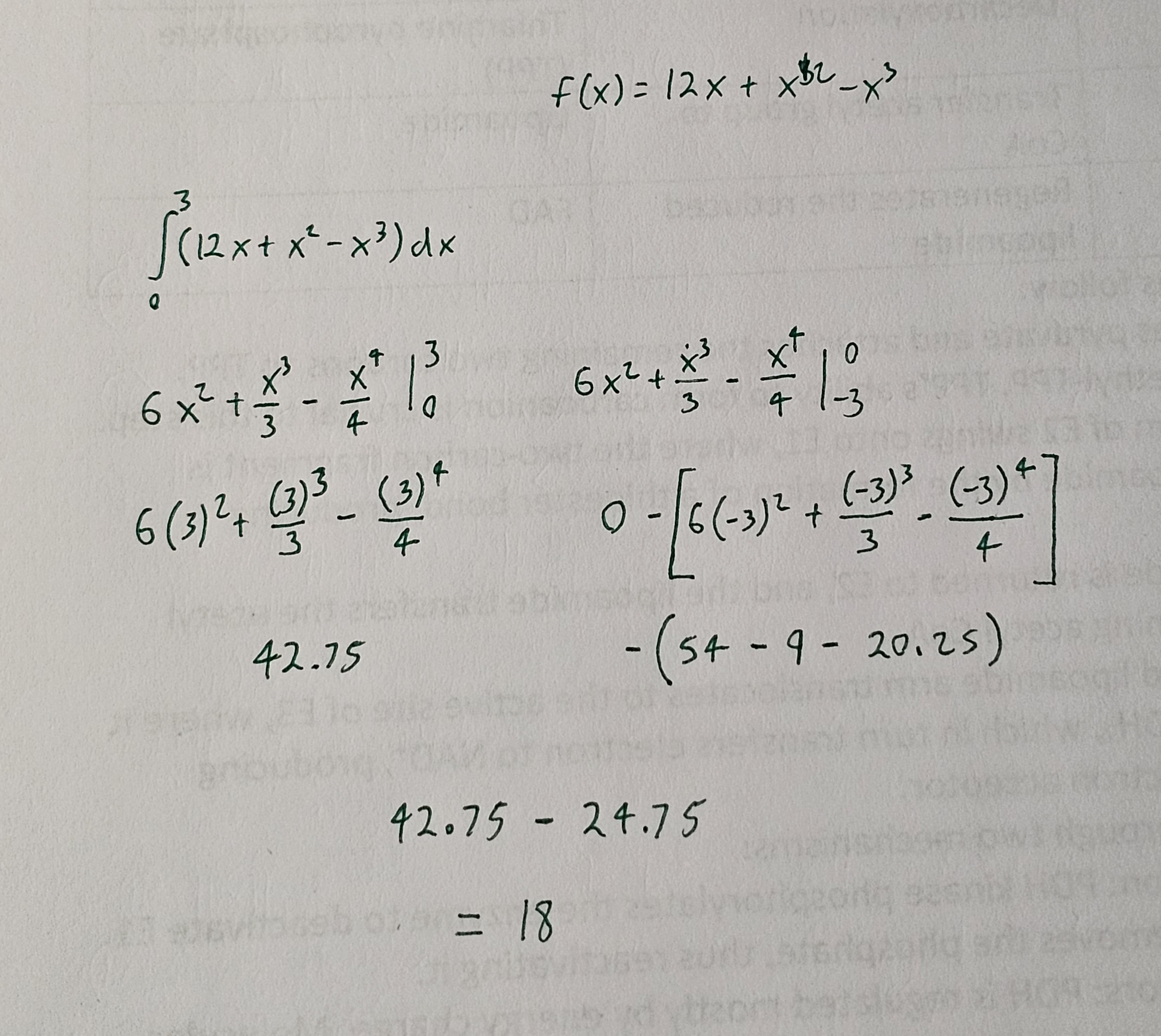
Okay so we have \[\Large \int_0^3 (12x+x^2-x^3)dx = 6x^2+\frac{x^3}{3}-\frac{x^4}{4}|_0^3\] This gives us this: \[\Large 6(3)^2+\frac{(3)^3}{3}-\frac{(3)^4}{4} \] Simplifying to just \(\large 42.75 \) as the positive area For the negative area it would be: \[\Large \int_{-3}^0 (12x+x^2-x^3)dx = 6x^2+\frac{x^3}{3}-\frac{x^4}{4}|_{-3}^0\] Giving you: \[\Large 0-[6(-3)^2+\frac{(-3)^3}{-3}-\frac{(3)^4}{4}] \] And you have an area of \(\Large -24.75 \) Now just add them: \[\Large 42.75+(-24.75) \]
KyledaGreat:
Oh okay I see, one moment
Luigi0210:
Edit, that last one should be: \[\Large 0-[6(-3)^2+\frac{(-3)^3}{3}-\frac{(-3)^4}{4}]\]
velmalovesshaggy145:
I knew it!
Luigi0210:
Hopefully that makes some sense to ya. I did it a bit differently by breaking up the areas by negative/positive. You could also do it by combining both areas into one integral
KyledaGreat:
You're completely right, I was way overcomplicating this. Here’s what I got: - The function is f(x) = 12x + x^2 - x^3 - Integrating: ∫(12x + x^2 - x^3) dx = 6x^2 + x^3/3 - x^4/4 - Positive area (0 to 3): 6x^2 + x^3/3 - x^4/4 |_0^3 = 6(3)^2 + (3)^3/3 - (3)^4/4 = 42.75 - Negative area (-3 to 0): 6x^2 + x^3/3 - x^4/4|_-3^0 = 0 - [6(-3)^2 + (-3)^3/3 - (-3)^4/4] = 0 - (-24.75) = -24.75 - Total area: 42.75 + (-24.75) = 18
Luigi0210:
Yes, there ya go. Regardless of which way you do it, the answers should be the same
KyledaGreat:
Dude, y’all are seriously the best at explaining this calc stuff! I feel like it's finally sinking in now thanks to all the different examples everyone worked through with me. Breaking it up into the positive and negative areas makes intuitive sense to me, but I can see how doing the whole integral at once is a neater way to do it mathematically. As long as the answers match up, either way works, right? And you're totally right - regardless of the method, as long as I'm integrating correctly the solutions should end up being the same number in the end. That's a really good point.
KyledaGreat:
For the answer of the solution is 18?
Luigi0210:
yes
KyledaGreat:
Okay thank y’all so much man, I really appreciate y’all time for this
Luigi0210:
No problem, good luck in calculus.. it's gonna be one hell of a ride lol
KyledaGreat:
Most definitely man, you can say that again lol I already went enough of a ride on this lol
velmalovesshaggy145:
np
 surjithayer:
\[f(x)=0,gives~12x+x^2-x^3=0\] \[x(12+x-x^2)=0\] \[-x(-12+4x+3x-x^2)=0\] \[-x(4(-3+x)+x(3-x))=0\] \[x(x-3)(x+4)=0\] x=0,3,-4
Join our real-time social learning platform and learn together with your friends!
VERNEISH:
Two objects are moving along separate linear paths where each path is described by position, d, and time, t.

 Maci:
what are the best stock apps for people who want to start investing?
Maci:
what are the best stock apps for people who want to start investing?
 Twaylor:
genuienly how do i get better self control i keep watcing youtube and theres this
Twaylor:
genuienly how do i get better self control i keep watcing youtube and theres this
 IzzyCookie:
|dw:1792074056138:dw| Uhm, I don't know where to ask this, but I'm in college welding at my community college, and I need help learning vertical welding for
IzzyCookie:
|dw:1792074056138:dw| Uhm, I don't know where to ask this, but I'm in college welding at my community college, and I need help learning vertical welding for

 thehearken:
not sure if this is considered spam, im sorry if it is, but does anyone have tips
thehearken:
not sure if this is considered spam, im sorry if it is, but does anyone have tips