
 whyjustwhy:
ummmmmmm hep me please
 whyjustwhy:
idk what to do
 Shadow:
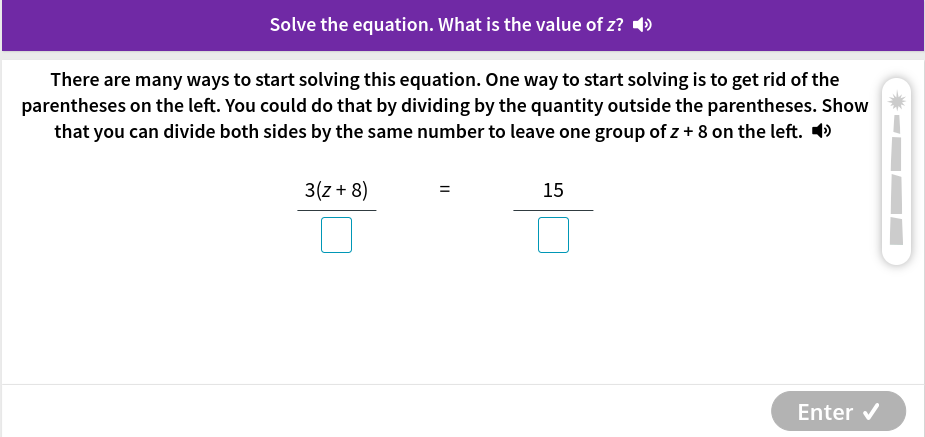
\[3 (z + 8) = 3 \times (z + 8)\] If we want z + 8 alone, we have to remove the 3. The number 3 is doing the equivalent of multiplying z + 8 by 3. What is the opposite of multiplication that we could do to 'remove' the 3?
 Kagura:
division correct?
Shadow:
The next step is identifying that this would be division. And in order to 'remove' the number, you must know that any number divided by itself is 1 So \[3 \div 3 = 1\] So we do \[\frac{ 3 (z + 8) }{ 3 } = \frac{ 15 }{ 3 }\] In order to keep the equation true, what we do to ONE side, we must do to the other.
Shadow:
\[z + 8 = 5\] This is what you should get. From there you need to further isolate z to see what that value of it is. Since 8 is being added to z, we can do the opposite operation to it to remove it. So subtract 8 from both sides \[z + 8 - 8 = 5 - 8\] \[z = 5 - 8 = -3\]
Shadow:
You can check your work by inputting the number -3 back into the equation\[3(-3 + 8) = 15\] \[3(5) = 15 \rightarrow 15 = 15\]
whyjustwhy:
thnk u
Shadow:
You're welcome
Join our real-time social learning platform and learn together with your friends!
 DoltonCarlee:
what are y'all's options on S A T essays because honestly their not that bad
DoltonCarlee:
what are y'all's options on S A T essays because honestly their not that bad

 thereneelg:
Can someone give me a summary of article 231, The war guilt clause?? I need to explain what it is, but I can't find any shortened version of what it is and
thereneelg:
Can someone give me a summary of article 231, The war guilt clause?? I need to explain what it is, but I can't find any shortened version of what it is and
 luisaam2:
What should you do when the person you want to talk to the most is the one making
luisaam2:
What should you do when the person you want to talk to the most is the one making
 Breathless:
https://medal.tv/games/roblox/clips/nAYivIl6oXB6q9QAI?invite=cr-MSxCSk4sMTY4OTA4N
Breathless:
https://medal.tv/games/roblox/clips/nAYivIl6oXB6q9QAI?invite=cr-MSxCSk4sMTY4OTA4N
 Twaylor:
I'm not that good at law can someone fact check this without bias? June 29, 2026, the Supreme Court decided Chatrie v.
Twaylor:
I'm not that good at law can someone fact check this without bias? June 29, 2026, the Supreme Court decided Chatrie v.
 Demon25:
For a hoco proposal with a cheerleader and football player, what else should be a
Demon25:
For a hoco proposal with a cheerleader and football player, what else should be a
