
 SALTCROC16:
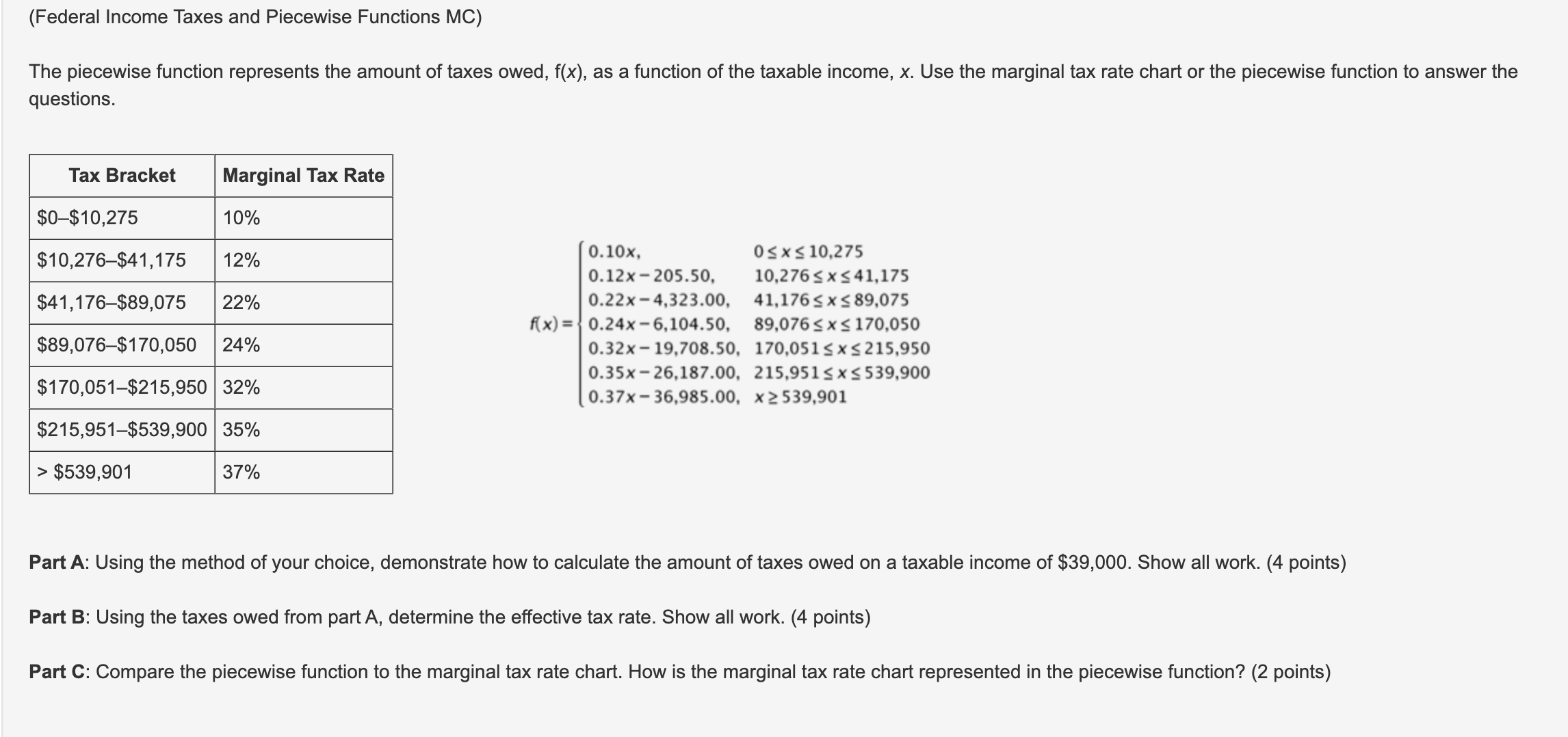
(Federal Income Taxes and Piecewise Functions MC)
 Illuminous:
Do you still need help with this?
 Vocaloid:
for part A) both the table and the piecewise function will let you calculate the tax for a given income. using the table: the first $0-$10,275 of a person's income will be taxed at 12%. since this person makes $39,000 which exceeds the highest limit of this bracket, the entire first $10,275 of their income gets taxed at 10%. so you would simply calculate 10% of 10,275 to get the tax on the first bracket. for the second bracket, the upper limit is $41,175. this person only makes $39,000 which is below the upper limit. so their remaining income, that has not yet been accounted for in the first bracket, will be taxed here. in other words, we subtract the total income $39,000 minus the $10,275 that has already been taxed to get the remaining $28,725 that falls in this bracket. since this bracket gets calculated at 12%, we calculate 12% of 28,725 to get the amount taxed for this bracket. finally, add up the total tax collected. thankfully, part B) is easier. simply calculate (total tax collected) / (total income) to get the effective rax rate. part C) notice each row in the table is represented as a line in the function. for example, in the table it shows income between $0 to $10,275 as a tax rate of 10%. this is represented in the function as 0.10 x (where x is the income) with the range 0 <= x <= 10,275 to demonstrate that this tax rate only applies for the first $10,275 of the income.
Join our real-time social learning platform and learn together with your friends!
VERNEISH:
Two objects are moving along separate linear paths where each path is described by position, d, and time, t.

 Maci:
what are the best stock apps for people who want to start investing?
Maci:
what are the best stock apps for people who want to start investing?
 Twaylor:
genuienly how do i get better self control i keep watcing youtube and theres this
Twaylor:
genuienly how do i get better self control i keep watcing youtube and theres this
 IzzyCookie:
|dw:1792074056138:dw| Uhm, I don't know where to ask this, but I'm in college welding at my community college, and I need help learning vertical welding for
IzzyCookie:
|dw:1792074056138:dw| Uhm, I don't know where to ask this, but I'm in college welding at my community college, and I need help learning vertical welding for

 thehearken:
not sure if this is considered spam, im sorry if it is, but does anyone have tips
thehearken:
not sure if this is considered spam, im sorry if it is, but does anyone have tips