
 ilovemypomchi17:
Another one~
 somnium:
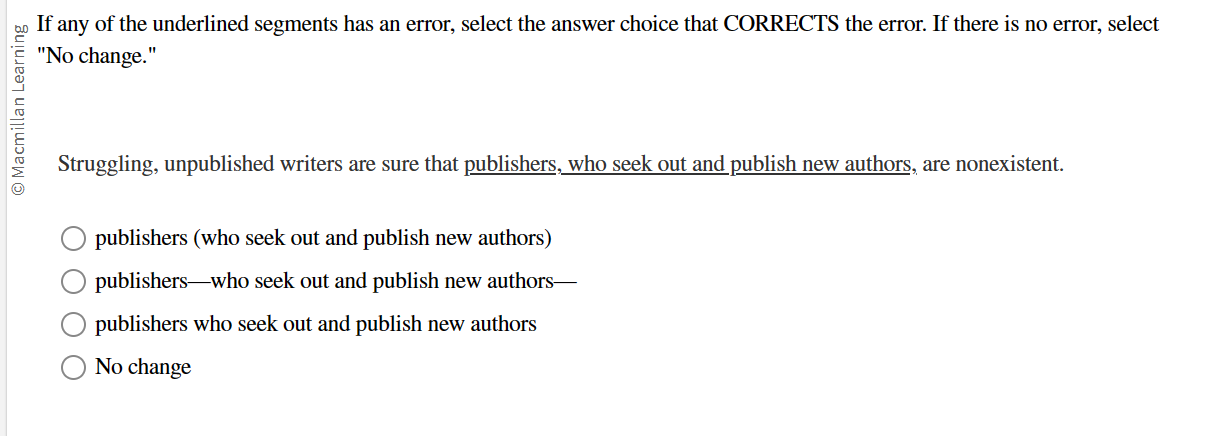
personally i think its c but i may be wrong on this one
 ShadowKid3:
it might be C
ilovemypomchi17:
@umm
 umm:
umm:
Instead of giving out direct answers... Can we explain why our answer choices would be C?
ShadowKid3:
ilovemypomchi17:
Ye sit seems like the commas dont belong to be honest
somnium:
cause c the phrase is modifying it, not explaining it that makes c sound right
ilovemypomchi17:
*yes it
ilovemypomchi17:
Im going to go with C. Thank you guys
umm:
In this case, C is correct. The original sentence is grammatically correct, but if you prefer to use restrictive clauses (defining information essential to the sentence's meaning), the correct form would be without commas. Therefore, the revised sentence would read: "Struggling, unpublished writers are sure that publishers who seek out and publish new authors are nonexistent." Option C is the correct answer because it provides the most grammatically accurate and stylistically appropriate punctuation for the sentence. The sentence is using a restrictive relative clause to provide additional information about the type of publishers being referred to. Restrictive relative clauses are not set off by commas and are essential to the meaning of the sentence. Therefore, the correct form is "publishers who seek out and publish new authors." A restrictive relative clause (also known as a defining or essential relative clause) is a type of clause that provides essential information about the noun it modifies. Unlike non-restrictive relative clauses, which are set off by commas and provide additional, non-essential information, restrictive relative clauses are crucial to understanding the meaning of the sentence and are not separated by commas. Here's some examples: 1. Restrictive relative clause: "The book that is on the table is mine." In this sentence, the restrictive relative clause is "that is on the table." It restricts or defines which book is being referred to—the one on the table. Without this information, the sentence would be ambiguous. 2. Non-restrictive relative clause: "The book, which is on the table, is mine." In this sentence, the non-restrictive relative clause is "which is on the table." It adds extra information about the book but is not necessary for identifying which book is being discussed. The sentence would still make sense without this clause.
somnium:
well there go all the medals
ilovemypomchi17:
Lol thank you
ilovemypomchi17:
I appreciate your help @somnium and @umm
umm:
You're welcome.
ShadowKid3:
uh im here to D':
ilovemypomchi17:
and yours too @shadowkid3
Join our real-time social learning platform and learn together with your friends!
 VERNEISH:
Two objects are moving along separate linear paths where each path is described by position, d, and time, t.
VERNEISH:
Two objects are moving along separate linear paths where each path is described by position, d, and time, t.

 Maci:
what are the best stock apps for people who want to start investing?
Maci:
what are the best stock apps for people who want to start investing?
 Twaylor:
genuienly how do i get better self control i keep watcing youtube and theres this
Twaylor:
genuienly how do i get better self control i keep watcing youtube and theres this
 IzzyCookie:
|dw:1792074056138:dw| Uhm, I don't know where to ask this, but I'm in college welding at my community college, and I need help learning vertical welding for
IzzyCookie:
|dw:1792074056138:dw| Uhm, I don't know where to ask this, but I'm in college welding at my community college, and I need help learning vertical welding for

 thehearken:
not sure if this is considered spam, im sorry if it is, but does anyone have tips
thehearken:
not sure if this is considered spam, im sorry if it is, but does anyone have tips