
 jayfafr:
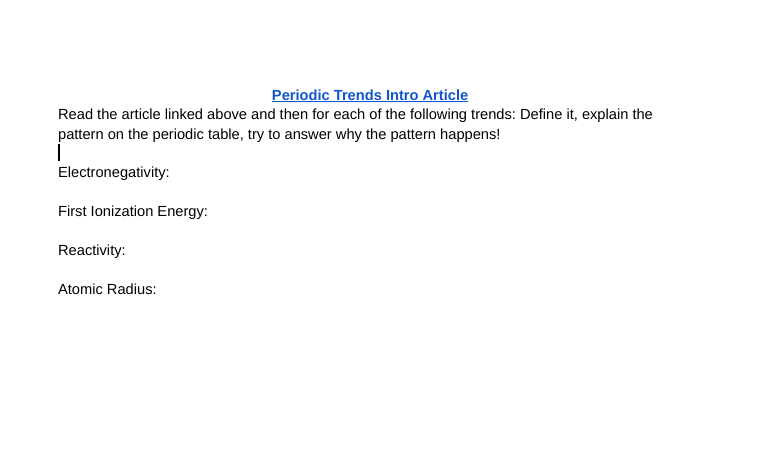
chesmitr help
 hannahj:
I need the link for the article
hannahj:
oh wait nvm
jayfafr:
its the first one
hannahj:
got it give me a minute
hannahj:
Electronegativity is a measure of an atom's ability to attract shared electrons to itself. On the periodic table, electronegativity generally increases as you move from left to right across a period and decreases as you move down a group. This is observed through Periodic Trends, as the further right of a period, and higher up a group are observed to have increased values in electronegativity. Note that the noble gases do not have an electronegativity. Ionization energy, is the amount of energy required to remove an electron from an isolated atom or molecule. An example of high ionization energy is in helium, as it has a very small atomic radius with +2 charge present in the nucleus. This allows for electrons to be retained as a result of these attractive forces. Reactivity is the quality or condition of being reactive. The reactivity of metals increases further left along a period, and further down a group. On the other hand, reactivity in non-metals increase further right down a period, and further up a group. The most highly reactive element to be observed is cesium, as it spontaneously reacts with air and water! Atomic radius is is the total distance from the nucleus of an atom to the outermost orbital of its electron. Through Periodic trends, the atomic radius increases in size further left of a period, and lower down a group. Following this pattern, cesium is shown to have the largest atomic radius.
jayfafr:
hannahj:
Join our real-time social learning platform and learn together with your friends!
 VERNEISH:
Two objects are moving along separate linear paths where each path is described by position, d, and time, t.
VERNEISH:
Two objects are moving along separate linear paths where each path is described by position, d, and time, t.

 Maci:
what are the best stock apps for people who want to start investing?
Maci:
what are the best stock apps for people who want to start investing?
 Twaylor:
genuienly how do i get better self control i keep watcing youtube and theres this
Twaylor:
genuienly how do i get better self control i keep watcing youtube and theres this
 IzzyCookie:
|dw:1792074056138:dw| Uhm, I don't know where to ask this, but I'm in college welding at my community college, and I need help learning vertical welding for
IzzyCookie:
|dw:1792074056138:dw| Uhm, I don't know where to ask this, but I'm in college welding at my community college, and I need help learning vertical welding for

 thehearken:
not sure if this is considered spam, im sorry if it is, but does anyone have tips
thehearken:
not sure if this is considered spam, im sorry if it is, but does anyone have tips