Join the QuestionCove community and study together with friends!
Sign Up
Gucchi:
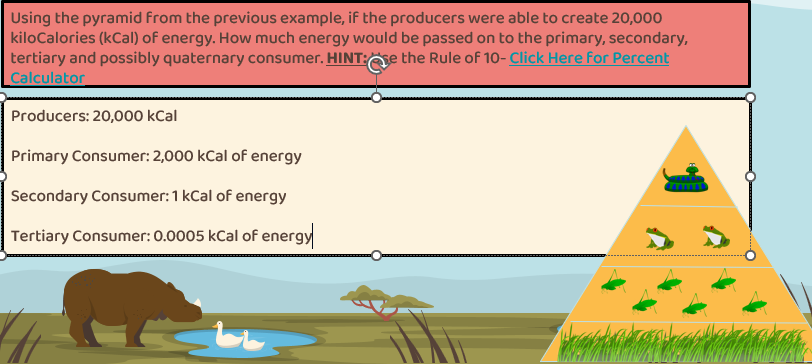
primary is 2000 right
Gucchi:
@xcoledd1
Gucchi:
@umm could u confirm this nobody's helping
umm:
The top 2 are correct. However, the bottom 2 are incorrect, if you’re using rule of 10. It’s basically 10 off of 100 leaving you with 90 and so forth and on.
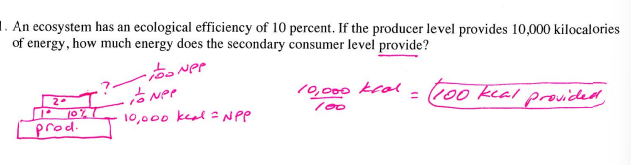
Think about having a whole pizza, and the pizza represents all the energy in an ecosystem. When a rabbit eats plants, it gets only about 10% of the energy from those plants, so to speak, like having just one slice of the pizza. Then, when a fox eats the rabbit, it gets about 10% of the energy the rabbit had, which is like getting a small bite of that one slice. This happens at each step, so as you go up the food chain, there's less and less energy to go around.
umm:
I’m not sure if that’s something you’d be able to visualize, but I’m currently on mobile.. so I can come up with a drawing for it unfortunately. Let me know if you need any more assistance.
Still Need Help?
Join the QuestionCove community and study together with friends!
Sign Up
Gucchi:
@umm wrote:
The top 2 are correct. However, the bottom 2 are incorrect, if you’re using rule of 10. It’s basically 10 off of 100 leaving you with 90 and so forth and on.
Think about having a whole pizza, and the pizza represents all the energy in an ecosystem. When a rabbit eats plants, it gets only about 10% of the energy from those plants, so to speak, like having just one slice of the pizza. Then, when a fox eats the rabbit, it gets about 10% of the energy the rabbit had, which is like getting a small bite of that one slice. This happens at each step, so as you go up the food chain, there's less and less energy to go around.
i see but isn't the energy getting lower on the bottom two?
Gucchi:
@umm wrote:
I’m not sure if that’s something you’d be able to visualize, but I’m currently on mobile.. so I can come up with a drawing for it unfortunately. Let me know if you need any more assistance.
i understand it
umm:
@gucchi wrote:
@umm wrote:
The top 2 are correct. However, the bottom 2 are incorrect, if you’re using rule of 10. It’s basically 10 off of 100 leaving you with 90 and so forth and on.
Think about having a whole pizza, and the pizza represents all the energy in an ecosystem. When a rabbit eats plants, it gets only about 10% of the energy from those plants, so to speak, like having just one slice of the pizza. Then, when a fox eats the rabbit, it gets about 10% of the energy the rabbit had, which is like getting a small bite of that one slice. This happens at each step, so as you go up the food chain, there's less and less energy to go around.
i see but isn't the energy getting lower on the bottom two?
Precisely, yes. But it’d stay in the 2’s section.
umm:
Here, let's break it down.
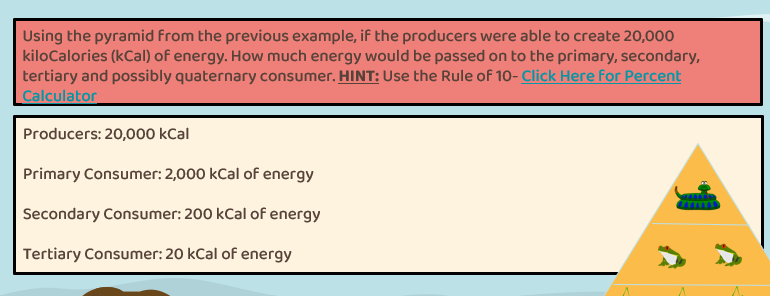
Cinsider the producers, like plants, make a total of 20,000 units of energy (kcal). The primary consumers, which are the herbivores eating those plants, get about 10% of that energy, which is 2,000 kcal. Then, if secondary consumers, like carnivores eating the herbivores, get 10%, they get around 200 kcal. This pattern continues with tertiary consumers getting about 10% of what secondary consumers had (around 20 kcal), and quaternary consumers getting around 10% of what tertiary consumers had (around 2 kcal). It's like everyone gets a smaller share as you move up the food chain.
Gucchi:
@umm wrote:
Here, let's break it down.
Cinsider the producers, like plants, make a total of 20,000 units of energy (kcal). The primary consumers, which are the herbivores eating those plants, get about 10% of that energy, which is 2,000 kcal. Then, if secondary consumers, like carnivores eating the herbivores, get 10%, they get around 200 kcal. This pattern continues with tertiary consumers getting about 10% of what secondary consumers had (around 20 kcal), and quaternary consumers getting around 10% of what tertiary consumers had (around 2 kcal). It's like everyone gets a smaller share as you move up the food chain.
mm yeah i get it so my table is correct then right
Still Need Help?
Join the QuestionCove community and study together with friends!

 Gucchi:
 curriful:
 xcoledd1:
 axie:
axie:

 umm:
umm:
 DoltonCarlee:
what are y'all's options on S A T essays because honestly their not that bad
DoltonCarlee:
what are y'all's options on S A T essays because honestly their not that bad

 thereneelg:
Can someone give me a summary of article 231, The war guilt clause?? I need to explain what it is, but I can't find any shortened version of what it is and
thereneelg:
Can someone give me a summary of article 231, The war guilt clause?? I need to explain what it is, but I can't find any shortened version of what it is and
 luisaam2:
What should you do when the person you want to talk to the most is the one making
luisaam2:
What should you do when the person you want to talk to the most is the one making
 Breathless:
https://medal.tv/games/roblox/clips/nAYivIl6oXB6q9QAI?invite=cr-MSxCSk4sMTY4OTA4N
Breathless:
https://medal.tv/games/roblox/clips/nAYivIl6oXB6q9QAI?invite=cr-MSxCSk4sMTY4OTA4N
 Twaylor:
I'm not that good at law can someone fact check this without bias? June 29, 2026, the Supreme Court decided Chatrie v.
Twaylor:
I'm not that good at law can someone fact check this without bias? June 29, 2026, the Supreme Court decided Chatrie v.
 Demon25:
For a hoco proposal with a cheerleader and football player, what else should be a
Demon25:
For a hoco proposal with a cheerleader and football player, what else should be a
